Departure
94%
vs 95% ▼ 1
 MY FS FLIGHTS
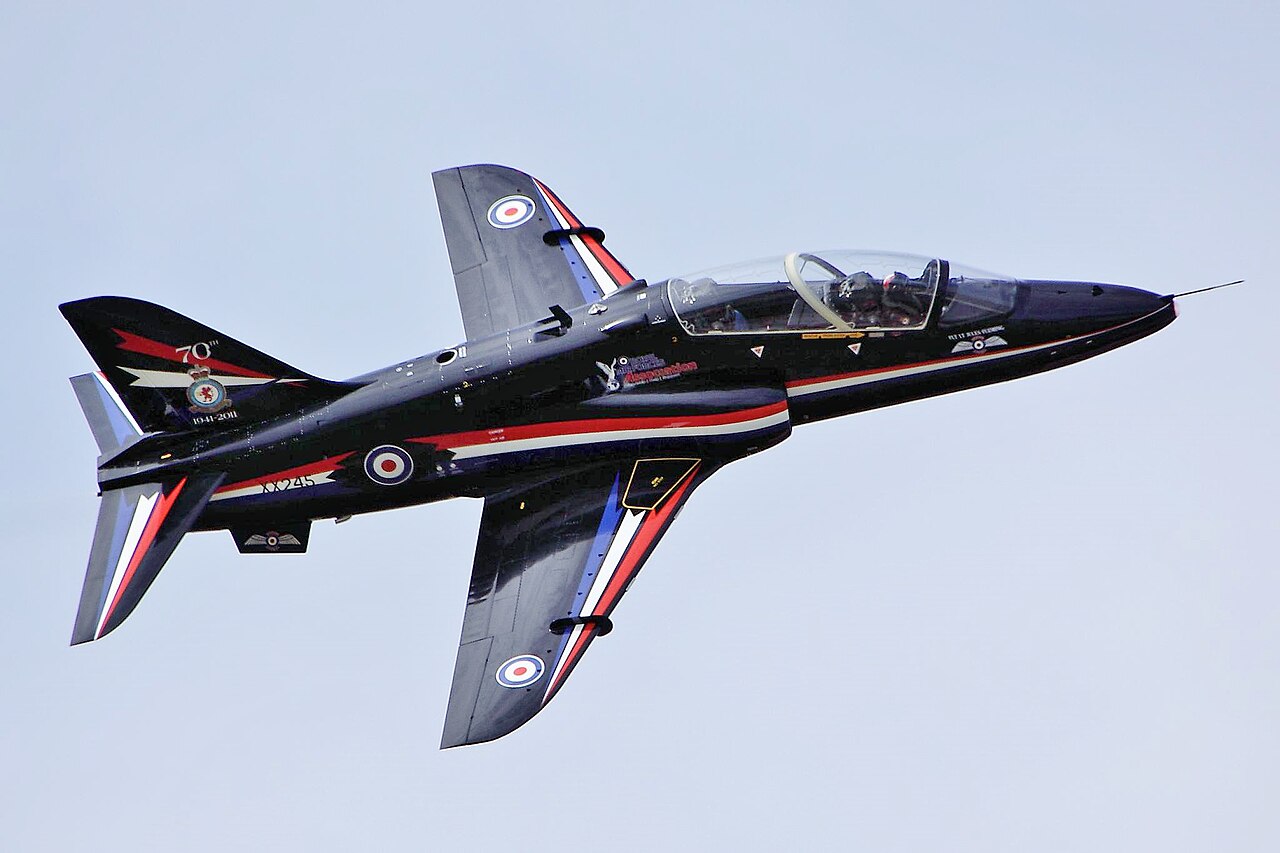
The Hawk T1 is a British single-engine, subsonic advanced jet trainer built by Hawker Siddeley and later British Aerospace, designed to prepare pilots for fast-jet flying and best known as the mount of the Royal Air Force's Red Arrows display team. Fully aerobatic and dual-control, it has served the RAF in training, weapons instruction and light attack roles since the late 1970s. For simulator pilots it represents a classic, well-mannered British military jet with a long and storied service history.
The Hawk T1 is a British single-engine, subsonic, jet-powered advanced trainer aircraft, originally designed and built by Hawker Siddeley Aviation and subsequently produced by British Aerospace. It is a fully aerobatic, low-wing, transonic, two-seat training aircraft with tandem dual controls, developed to prepare Royal Air Force pilots for the transition to fast-jet fighter types. Beyond its training role it has also been used as a low-cost combat aircraft, and it is most widely recognised as the aircraft flown by the RAF Aerobatic Team, the Red Arrows.
The origins of the Hawk lie in a 1964 Royal Air Force requirement, Air Staff Target 362, for a new fast jet trainer to replace the Folland Gnat. The SEPECAT Jaguar was initially considered for the role but proved too complex, and only a small number of two-seat versions were ordered. In 1968 Hawker Siddeley Aviation began studies for a simpler aircraft under the designation Special Project 117, led by design team head Ralph Hooper, funded initially as a private venture in anticipation of RAF interest. The design was conceived with tandem seating and combat capability from the outset to improve export prospects. By the end of 1968 Hawker Siddeley had submitted a proposal to the Ministry of Defence, and in early 1970 the RAF issued Air Staff Target 397 formalising the requirement. The RAF selected the HS.1182 design on 1 October 1971, and a contract for 175 aircraft was signed in March 1972. The prototype, XX154, first flew on 21 August 1974 from Dunsfold, piloted by Duncan Simpson, Chief Test Pilot of Hawker Siddeley Aviation (Kingston), reaching 20,000 ft in a flight lasting 53 minutes. All development aircraft were built on production jigs and the programme remained on time and to budget throughout. The Hawk T1 entered RAF service in April 1976, replacing the Folland Gnat and Hawker Hunter for advanced training and weapons training, with deliveries commencing in November 1976. The first export variant, the Hawk 50, flew on 17 May 1976, offering greater weapons capacity than the T1 for the dual role of lightweight fighter and advanced trainer. By early 1998 a total of 734 Hawks of all variants had been sold, more than 550 of them to export customers, and the Hawk family has since exceeded 1,000 aircraft built, with production continuing under licence in India by Hindustan Aeronautics Limited.
The Hawk T1 has an aluminium alloy fuselage of conventional stressed-skin construction. It is a low-wing monoplane with tandem seating for an instructor and student under a single canopy, and is fully aerobatic. From 1983 to 1986 some Hawks were fitted out as short-range interceptor aircraft, and 88 T1s were subsequently modified to carry two AIM-9L Sidewinder air-to-air missiles in addition to a 30 mm ADEN cannon gun pod, being redesignated Hawk T1A. In the close air support training role the aircraft could carry up to eight 3 kg practice bombs. During the 1990s and 2000s, 80 Hawk T1/T1A aircraft were upgraded under the Fuselage Replacement Programme, in which sections of the centre and rear fuselage were entirely replaced to extend the airframes' operational lives.
The Hawk T1 is described as a fully aerobatic, transonic trainer, with the prototype reaching 20,000 ft during its first flight of 53 minutes' duration. The Red Arrows have characterised the Hawk T1 as stable and predictable, qualities regarded as essential for an aircraft used in precision aerobatic display flying.
The Hawk T1 was the original version used by the Royal Air Force. Some T1s were modified from 1983 to carry AIM-9L Sidewinder missiles and a 30 mm ADEN cannon pod, becoming the Hawk T1A. The Royal Navy acquired a dozen Hawk T1/T1A aircraft from the RAF for support duties, including simulated combat training for ships. The export Hawk 50, first flown on 17 May 1976, was designed for a dual lightweight fighter and advanced trainer role with greater weapons capacity than the T1. Later export variants introduced increased range, more powerful engines, a redesigned wing and undercarriage, radar and forward-looking infrared, GPS navigation and night-vision compatibility, with avionics tailored to individual customer air forces. The type was further developed into the higher-specification Hawk T2, which features a computerised glass cockpit in place of the T1's conventional instruments, and which has progressively replaced the T1 in RAF service since 2009. A carrier-capable derivative was also developed for the United States Navy as the McDonnell Douglas T-45 Goshawk, entering service in 1994.
The Hawk T1 entered RAF service in April 1976, replacing the Folland Gnat and Hawker Hunter in the advanced and weapons training roles, with deliveries beginning in November 1976. It went on to replace the English Electric Canberra for target-towing duties. The type became the aircraft of the Royal Air Force Aerobatic Team, the Red Arrows, and is closely associated with that role in public perception. The Royal Navy operated a dozen T1/T1A airframes transferred from the RAF in a support capacity, including simulated combat training aboard ships. The Hawk T Mk1 was withdrawn from service with 100 Squadron on 31 March 2022, and the RAF's Hawk T1 fleet has been progressively succeeded by the Hawk T2. In November 2011 the Red Arrows suffered a fatal accident when a Martin-Baker Mk.10 ejection seat fitted to a Hawk T1 activated while the aircraft was stationary on the ground; the pilot died on ground impact after the ejection seat parachute also failed to deploy.
The Hawk T1 is available to simulator pilots through dedicated third-party add-ons for Microsoft Flight Simulator and X-Plane, including the Hawk T1/A Advanced Trainer developed by Just Flight in partnership with Thranda Design. Its appeal in the simulator stems largely from the real aircraft's reputation for stable, predictable handling, the qualities the Red Arrows themselves cite as essential to safe formation aerobatics, alongside its status as one of the most recognisable British military jets.