Departure
95%
vs 95%
 MY FS FLIGHTS
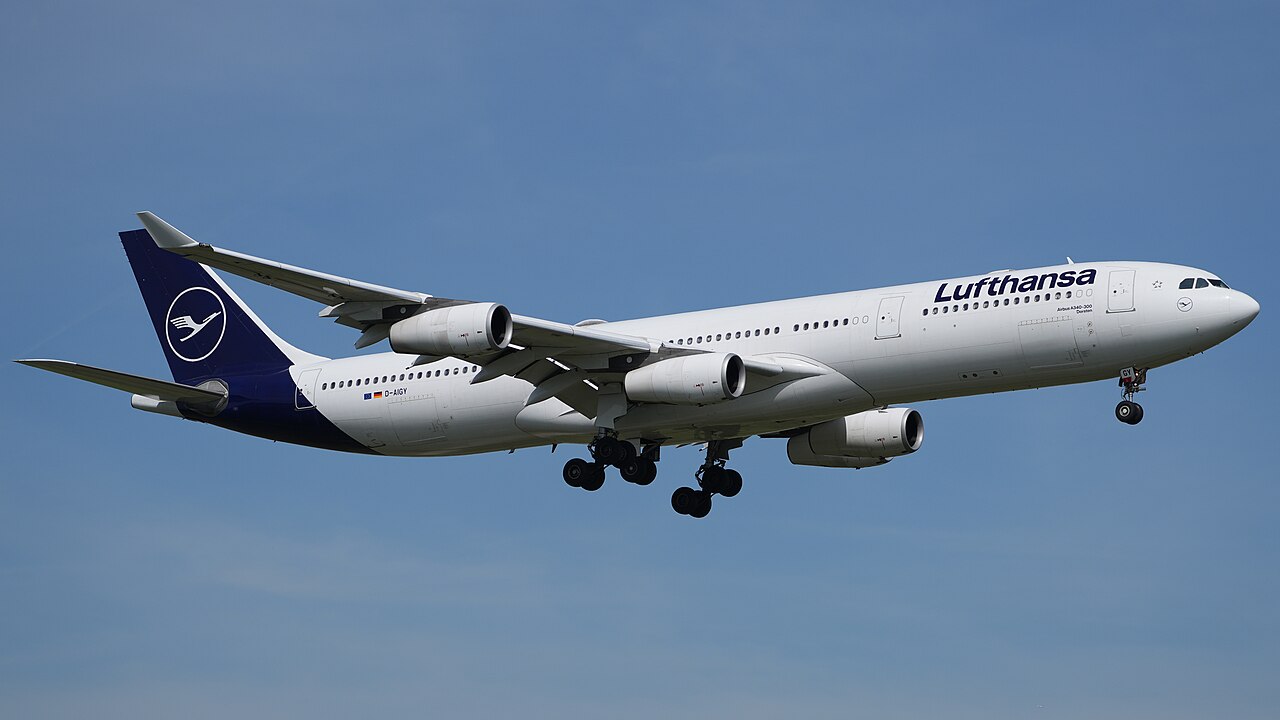
The Airbus A340-600 is a four-engine, long-range widebody airliner built by Airbus as the largest and longest member of the A340 family, developed to give the manufacturer a direct high-capacity, long-haul competitor to the Boeing 747-400. For the sim pilot it represents one of the last of the great four-engine wide-bodies, notable for its extreme fuselage length, distinctive extra centre main-gear bogey, and fly-by-wire systems with a fully electric rudder control architecture.
The A340-600 (ICAO type designator A346) is a four-engine, long-range widebody airliner built by Airbus France as the largest member of the A340 family. It was conceived as a high-capacity, long-range counterpart to the ultra-long-range A340-500, giving Airbus a direct answer to Boeing's dominant 747-400 in the high-capacity intercontinental market. With a fuselage stretched well beyond the earlier A340-200/300, it became for a time the world's longest airliner and remains one of the longest passenger aircraft ever built.
Airbus launched the A340-600 in December 1997 alongside the ultra-long-range A340-500, responding to airline demand for greater capacity and range at a time when Boeing had no direct rival in that segment with its 747-400. The A340-600 made its first flight in April 2001 and entered commercial service in August 2002 with launch customer Virgin Atlantic. A total of 97 A340-600 aircraft were ordered and delivered. Production effectively ended in 2011 when Airbus stopped accepting new A340 orders, with the final airframe delivered from storage in April 2012.
The A340-600 has an overall length of 75.36 m, making it the world's second longest passenger aircraft, with a wingspan of 63.45 m and a tail height in the region of 17.9 m. The fuselage diameter is 5.64 m, giving a cabin width of around 5.28-5.3 m, a cabin height of 2.54 m and a cabin length of roughly 61 m. A distinctive design feature is the extra central two-wheel main landing gear bogey fitted beneath the fuselage, used to spread the aircraft's considerable weight, along with canted wingtip winglets. Power comes from four Rolls-Royce Trent 500-series engines (Trent 556), with individual thrust ratings cited between about 56,000 lbf (249 kN) and 61,900 lbf (275 kN) depending on the specific engine build, each with a fan diameter of 2.47 m. Compared with the earlier A340-200/300, the -600 introduced a fully electric rudder control architecture, eliminating the mechanical linkages between rudder pedals and actuators, and its electrical system was upgraded from 75 kVA to 90 kVA integrated drive generators, supported by a new Electrical Load Management System (ELMS) to handle the increased power demand. Published weight figures vary by source and build standard, with maximum takeoff weight cited at around 368,000 kg (and up to roughly 380,000 kg for some builds), a maximum landing weight of around 259,000 kg, and an operational empty weight of around 177,800 kg. Maximum payload has been quoted at around 62,500 kg, with fuel capacity of about 204,500 litres (163,600 kg of Jet A), and baggage volume of some 207.6 cubic metres.
Maximum cruising speed is quoted at around Mach 0.86, roughly 885-889 km/h, with an operating ceiling of about 41,000-41,450 feet (12,600 m). Rate of climb has been given as 5,700 feet per minute (29 m/s). Range figures vary with source and build, from around 12,900 km up to as much as 14,450 km (7,802 nm) for later, higher-weight aircraft. Typical approach speed is around 135 knots (250 km/h), with a takeoff distance of about 3,140 m (10,300 ft) and a landing distance of about 2,000 m (6,550 ft). The four-engine layout gave the type strong takeoff performance from high, hot or otherwise demanding airports, and allowed operation on long overwater routes without the ETOPS restrictions applied to twin-engine aircraft of the era.
The A340-600 was launched in December 1997 together with the ultra-long-range A340-500, the two forming Airbus's second-generation A340 variants developed from the original A340-200/300 airframe. The A340-600 was the high-capacity member of this pairing, distinguished by its further-stretched fuselage, the extra central main-gear bogey, and the fully electric rudder control system and upgraded 90 kVA electrical generation and ELMS that set it apart from the earlier -200/-300 models.
Virgin Atlantic was the launch operator of the A340-600 from August 2002. Other airlines that operated the type included Lufthansa, Iberia, South African Airways and Etihad Airways, deploying it on high-density, long-haul intercontinental routes that demanded substantial passenger capacity. Lufthansa's A340-600 fleet, for example, was configured with 8 First Class suites, 56 Business, 28 Premium Economy and 189 Economy seats. The aircraft filled a role providing significant seating capacity over long distances before the economics of twin-engine widebodies made large four-engine aircraft less competitive, and several operators, including Lufthansa, have since retired their A340-600 fleets.
For a simulator pilot, the A340-600 stands out as one of the last large four-engine widebodies, combining Airbus fly-by-wire flight controls with the fully electric rudder architecture and upgraded electrical system introduced on this variant. Its unusually long fuselage and the extra central main-gear bogey make ground handling and rotation characteristics of particular interest, while its four Rolls-Royce Trent 500-series engines give it a distinctive powerplant sound and management workload compared with twin-engine long-haul types. With most operators having retired the type, it retains appeal among simmers as a study of a now largely vanished class of quad-engine long-haul airliner.