Departure
88%
vs 95% ▼ 7
 MY FS FLIGHTS
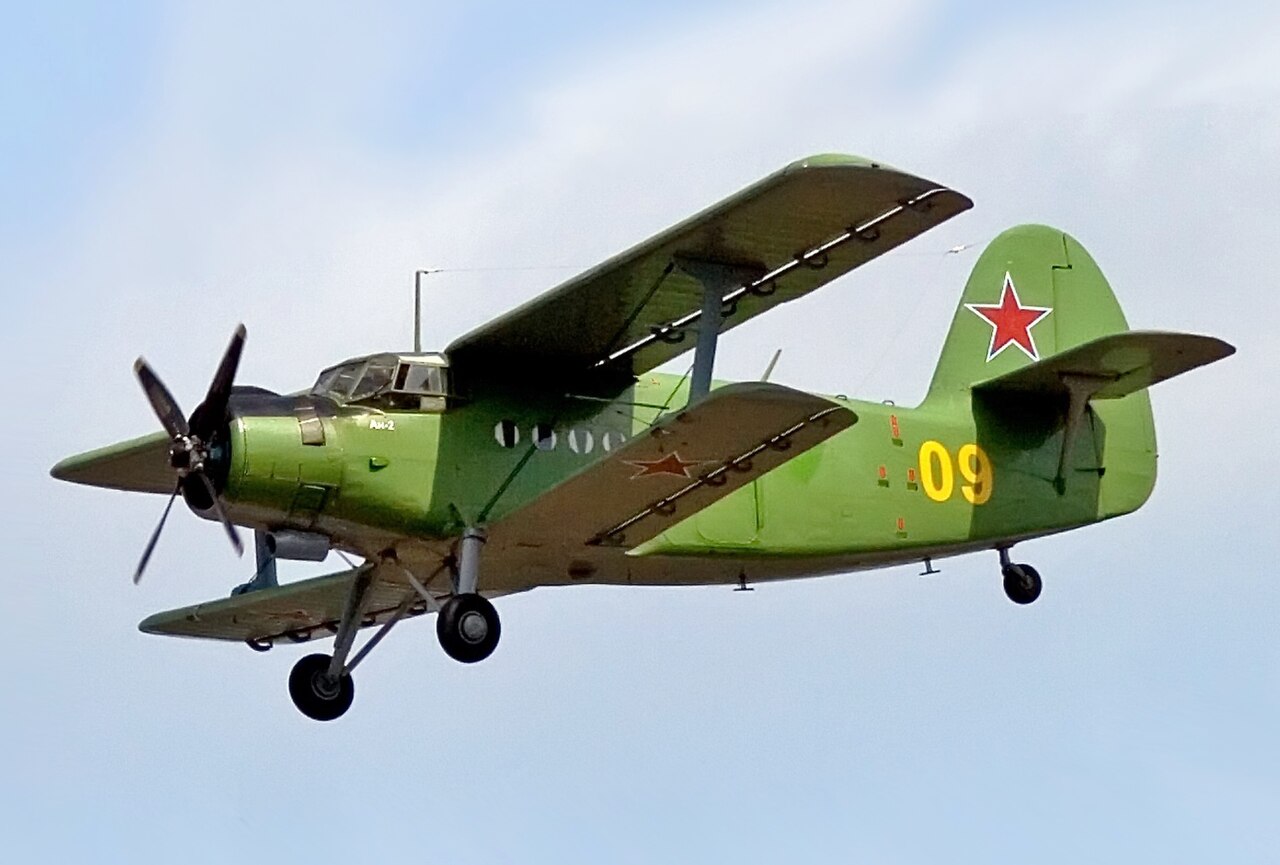
The Antonov An-2 is a Soviet-designed single-engine biplane utility and agricultural aircraft built by the Antonov Design Bureau from 1947, and remains one of the most numerous and longest-produced aircraft types ever built. Rugged, simple and famed for having no published stall speed, it earned the NATO reporting name Colt and the affectionate nickname Annushka, and it is of interest to sim pilots for its extraordinary short-field and slow-flight capability rather than for outright performance.
The An-2 is a Soviet mass-produced single-engine biplane, designed and manufactured by the Antonov Design Bureau, that served as an agricultural aircraft, utility transport and military transport. It carries the USAF/DoD reporting name Type 22 and the NATO reporting name Colt, and is known throughout the former Soviet Union as Annushka. It is one of the largest single-engine biplanes ever produced, and its combination of durability, lifting power and ability to operate from poor runways gave it a service life stretching from 1947 into the twenty-first century.
The An-2 was designed to meet a 1940s Soviet Ministry of Forestry requirement to replace the smaller Polikarpov Po-2, which was used in large numbers in agricultural and utility roles. Antonov produced a large single-bay biplane of all-metal construction with an enclosed cockpit and a cabin seating twelve passengers. The first prototype, designated SKh-1 and powered by a Shvetsov ASh-21 radial engine, first flew on 31 August 1947 from Yeltsovka Airport in Novosibirsk Oblast. A second prototype was fitted with the more powerful Shvetsov ASh-62 engine, which raised payload from 1,300 to 2,140 kg (2,870 to 4,720 lb), and it was this version that entered production. Initial production was at State Factory 473 in Kyiv, where up to 5,000 units had been built by 1960; later Soviet production, particularly of the An-2M, moved to State Factory 464 at Dolgoprudniy after 1965. From 1960 most An-2s were built at the WSK factory in Mielec, Poland, which is believed to have produced over 13,000 aircraft before manufacturing ended there in 1991. Limited production continued using remaining stocks of spares until 2001, including a small batch of four aircraft built for Vietnam. China also built the type under licence as the Shijiazhuang Y-5. The Guinness Book of World Records noted that the An-2's 45-year production run was for a time the longest of any aircraft, a record since exceeded. In the early 1980s Antonov experimented with a turboprop-powered derivative fitted with a 1,080 kW (1,450 hp) Glushenkov engine and a longer, streamlined nose, which became the An-3. In 2013 Antonov flew the An-2-100, fitted with a three-blade reversible propeller and a 1,100 kW (1,500 shp) Motor Sich MS-14 turboprop running on kerosene rather than increasingly scarce avgas, and received orders to upgrade aircraft in Azerbaijan, Cuba and Russia to this standard. The Siberian Research Institute of Aviation (SibNIA) also flight-tested a modified An-2 with winglets, a carbon-fibre wing structure and a five-bladed-propeller turboprop as a demonstrator for a possible replacement, with wing panels, spars and ribs produced by the Novosibirsk Aviation Plant.
The An-2 is an all-metal single-bay biplane deliberately built with a minimum of complex systems, featuring an enclosed cockpit and a cabin originally seating twelve passengers. Its wing leading-edge slats, which give the aircraft its slow-flight qualities, are fully automatic, held shut by airflow and extended by elastic rubber springs when airspeed drops below 64 km/h (40 mph). It uses a pneumatic brake system similar to those on heavy trucks, together with an air line attached to the compressor for reinflating tyres in the field. All versions apart from the An-3 and An-2-100 are powered by a 750 kW (1,010 hp) nine-cylinder Shvetsov ASh-62 radial engine. A preserved example at the Museum of Flight gives a wingspan of 59.71 ft, a length of 46 ft, a height of 14 ft and a wing area of 765.30 sq ft, with a gross weight of 12,125 lb.
Under typical conditions the An-2 can take off within 170 m (560 ft) and requires a landing run of 215 m (705 ft), figures that vary with weight, air temperature, runway surface and wind direction. The type has no published stall speed, and pilots have flown it under full control at speeds as low as 30 mph. A preserved example is quoted with a maximum speed of 157 mph, a cruise speed of 124 mph and a range of 562 miles.
The most common version is the An-2T, a 12-seat passenger aircraft, alongside the An-2TP. The adaptable airframe has been produced in numerous other forms, including hopper-equipped agricultural crop-dusters, scientific versions for atmospheric sampling, water-bombers for firefighting, air ambulances, seaplanes, and versions configured for paratroop drops. The An-2M was a later production variant. The turboprop-powered An-3 featured a longer, streamlined nose and a Glushenkov engine, while the An-2-100 introduced a Motor Sich MS-14 turboprop with a three-blade reversible propeller. China built the type under licence as the Shijiazhuang Y-5, with derivatives including an agricultural Y-5B, a Y-5B(T) para-drop model used by the PLAAF, an amphibious Y-5C, a Y-5D bomber crew trainer, and a five-seat VIP transport, the Y-5K. SibNIA also produced a carbon-fibre-winged demonstrator with winglets and a five-bladed-propeller turboprop as a possible eventual replacement.
Originally intended for forestry and agricultural work, the An-2's adaptable design saw it used for transportation, search-and-rescue, geographical survey, firebombing and research, as well as paratroop operations, in addition to its agricultural role. Military versions served with Soviet and later Russian armed forces and their allies, and the type has also served with the Korean People's Army Air Force and the Ukrainian Air Force. It has seen combat use, including during the Korean War and the Vietnam War, where it was flown by North Vietnamese forces, and improvised bomber conversions were used during the Croatian War of Independence in 1991. Following the collapse of the Soviet Union and the Eastern European communist states, most airlines in the region withdrew their aging An-2s from service, a process hastened by declining avgas production, but private operators have continued to use the type, valuing its stability, capacity and slow-flying ability, notably for skydiving operations.
The An-2's defining characteristics for a pilot are its extraordinarily forgiving low-speed handling and short-field performance: automatic leading-edge slats deploy without pilot input below 64 km/h to maintain control at very low airspeeds, and the type has no published stall speed, with documented controlled flight at speeds as low as 30 mph. Take-off and landing runs of well under a thousand feet make it a natural fit for unimproved strips, and its deliberately simple systems, including truck-style pneumatic brakes, give the airframe a rugged, workmanlike feel rather than one built for speed or refinement, which is a large part of its enduring appeal to pilots interested in bush-flying and STOL-style operations.