Departure
93%
vs 95% ▼ 2
 MY FS FLIGHTS
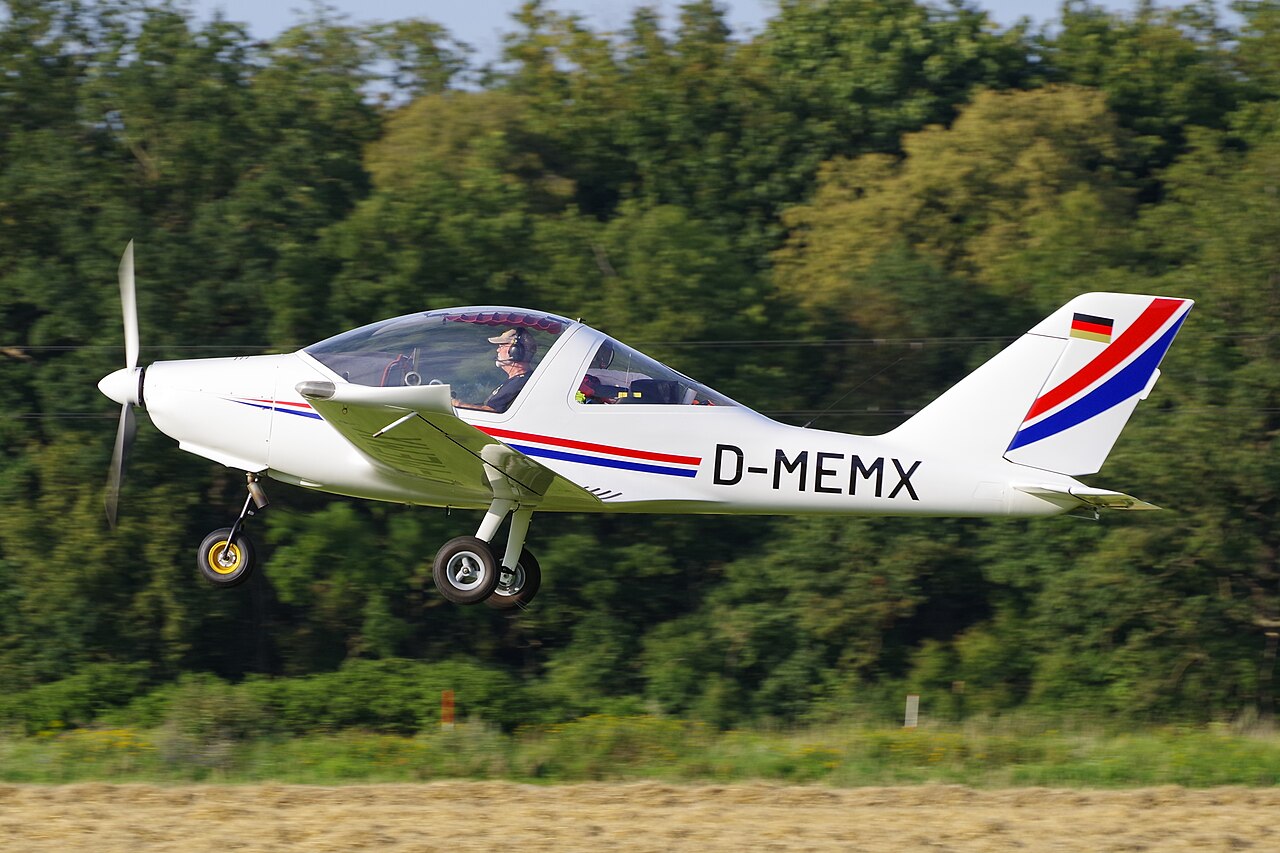
The TL-96 Star is a two-seat, side-by-side ultralight monoplane designed and built by TL-Ultralight in the Czech Republic during the 1990s, first flying in November 1997. It became the direct forerunner of the well-known TL-2000 Sting family, and more than 150 examples have been registered, making it a familiar sight on European ultralight and microlight fields.
The TL-96 Star is a single-engine, low-wing, side-by-side two-seat ultralight of Czech design and manufacture, built by TL-Ultralight. It occupies the European ultralight category and sits at the design root of the later TL-2000 Sting series, sharing the same basic layout of a low composite wing, tricycle undercarriage and a large single-piece forward-hinging canopy.
The TL-96 Star was designed in the Czech Republic during the 1990s and made its first flight in November 1997. It achieved German certification before 2000, giving it access to the European ultralight and microlight market. By mid-2010 there were 202 TL-96 Stars on European civil registers, excluding Russia, alongside 153 examples of its successor, the TL-2000 Sting. The type formed the basis for a continuing line of development at TL-Ultralight, evolving through the all-carbon TL-2000 Sting Carbon and subsequent Sting variants.
The Star is an all-composite aircraft built from a mixture of glass and carbon fibre reinforced plastics. It is a low-wing monoplane seating two occupants side by side beneath a prominent single-piece, forward-hinging canopy, with a second fixed transparency forming the rear of the cabin. The wings are unswept with constant chord, apart from a slight rounding of the leading edge at the tips, and carry plain inboard flaps. The tailplane is one-piece and all-moving, sharing the wing's plan shape and fitted with a central anti-balance tab, while the fin and rudder are swept, the rudder being horn balanced. The undercarriage is a fixed tricycle arrangement with faired wheels and cable brakes. The Star has been offered with several flat-four engines: the 60 kW (80 hp) Rotax 912, the 86 kW (115 hp) Rotax 914, or the 67 kW (90 hp) Aero Prag AP-45; the Rotax engines drive a three-blade propeller while the AP-45 turns a two-blade wooden propeller. In its Rotax 912-powered form the aircraft has a length of 6.50 m (21 ft 4 in), a wingspan of 9.20 m (30 ft 2 in), a height of 2.15 m (7 ft 1 in) and a wing area of 12.20 sq m (131.3 sq ft). Empty weight is 265 kg (584 lb) against a gross weight of 450 kg (992 lb), the latter set by the European ultralight category limit. Fuel capacity is 50 litres (11.0 Imp gal, 13.2 US gal), and the powerplant fitted for these figures is a Rotax 912 UL-DCDI air/water-cooled flat four driving a three-bladed Albastar composite propeller.
With the Rotax 912 engine, the TL-96 Star has a maximum speed of 255 km/h (158 mph, 138 kn) and cruises at 220 km/h (140 mph, 120 kn) at 75 percent power. Stall speed is 63 km/h (39 mph, 34 kn), and never-exceed speed is 275 km/h (171 mph, 148 kn). Range is quoted at 1,000 km (620 mi, 540 nmi), maximum glide ratio is 16:1 power off, and maximum rate of climb at sea level is 6.0 m/s (1,180 ft/min).
The TL-96 Star spawned a series of related models under the TL-2000 Sting name. The TL-2000 Sting Carbon (2002-2004) was an all-CFRP version that gained Czech certification, with span reduced by 760 mm (30 in) and length by 570 mm (22.4 in) compared with the Star, though empty weight rose by 10 kg (22 lb). The TL 2000 RG (2003) introduced retractable gear and a quoted cruise speed of 285 km/h (177 mph), announced ahead of its first flight at Aero '03 in Friedrichshafen. The TL StingSport (2004-2006) was the US SLSA-certified model introduced in 2005. The TL-2000 Sting S3 (2007-2009), announced at Sun 'n Fun 2007 in Lakeland, Florida, succeeded the StingSport with a new tapered wing of greater span (9.11 m or 29 ft 11 in), area and aspect ratio, larger flaps, a 540 lb useful load, a 21 gallon main tank plus two 6 gallon wing tanks for 32 gallons total, higher instrumentation standards and a Rotax 912ULS engine; quoted speeds with that engine include a 75 percent cruise of 115 kn, Va of 118 kn, Vr of 45 kn, Vx of 50 kn, Vy of 55 kn, Vne of 164 kn and Vso of 39 kn at max gross weight, with climb rates of over 1,200 fpm single-pilot at max gross and over 800 fpm otherwise. The TL-2000 Sting S4 (2010-present) improved on the S3 with a revised canopy, redesigned instrument panel and cockpit, main landing gear, engine cowling and tail surfaces, offered with the 80 hp (60 kW) Rotax 912UL, 100 hp (75 kW) Rotax 912ULS and 912iS, or the turbocharged 115 hp (86 kW) Rotax 914. The TL-2000 Sting S4 RG is a retractable-gear version of the S4 with a maximum level speed of 285 km/h (154 kn), offered with the 912ULS, 912iS or 914 engines.
The TL-96 Star has been used primarily for private sport and recreational flying under the European ultralight category, and is certificated under technical guideline UL 2 for sporting and recreational purposes, including basic and continuation training, but not for commercial operations other than instruction and hire. By mid-2010, 202 TL-96 Stars were registered across European civil registers, excluding Russia, reflecting a substantial and active fleet concentrated in Germany, Poland, Spain and other European countries. On 25 July 2020, a TL-96 suffered a structural failure shortly after takeoff and crashed into a residential building near Wesel in western Germany, killing both occupants and one person on the ground.