Departure
93%
vs 95% ▼ 2
 MY FS FLIGHTS
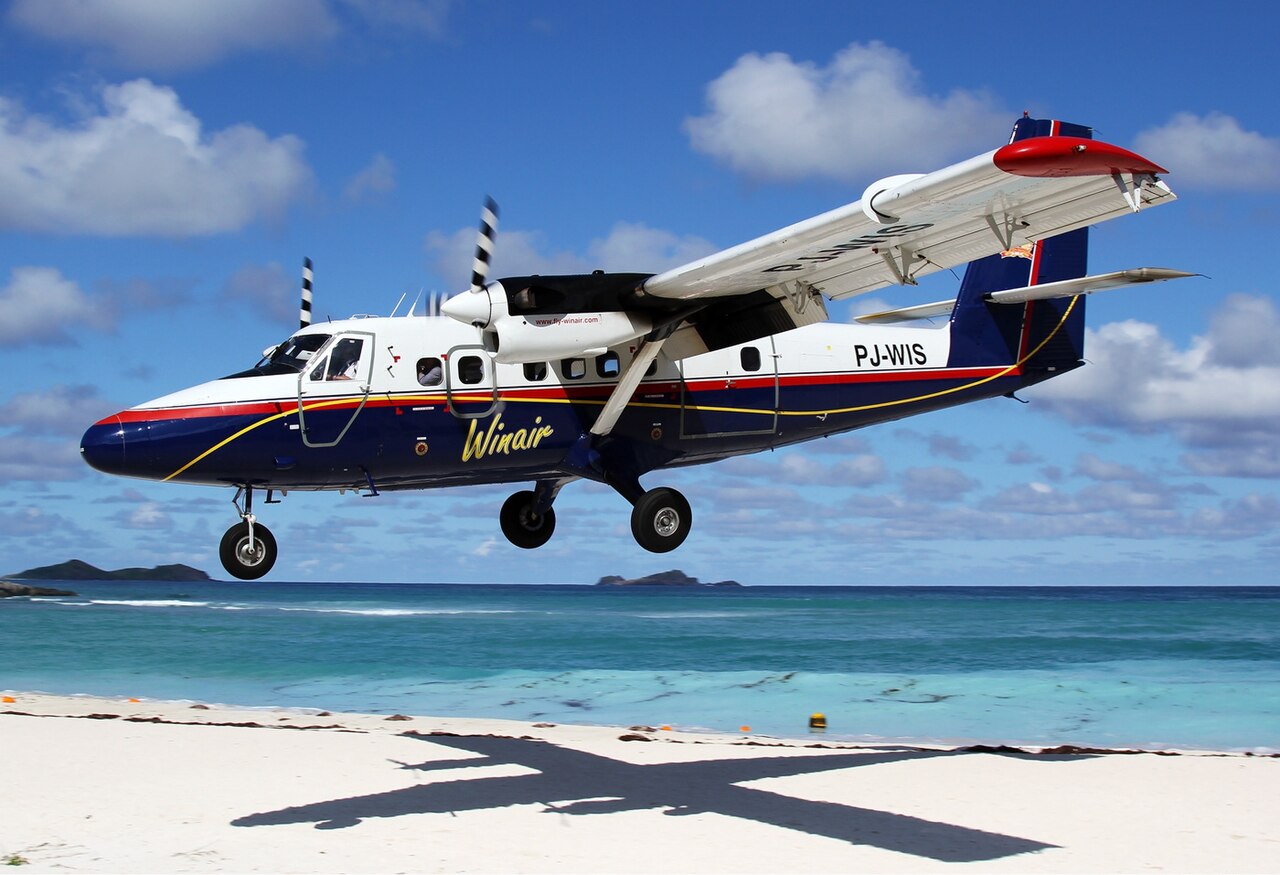
The de Havilland Canada DHC-6 Twin Otter is a Canadian twin-turboprop STOL utility aircraft developed in the mid-1960s as a twin-engine successor to the single-engine DHC-3 Otter. Renowned for its rugged simplicity, high rate of climb and ability to operate from short unprepared strips, water or snow, it has become one of the most enduring commuter, bush, cargo, medevac and skydiving aircraft in the world, and remains in production today under De Havilland Canada. For a sim pilot it offers a genuinely different flying experience: unpressurised, mechanically simple, and built around STOL performance rather than speed.
The DHC-6 Twin Otter is a high-wing, twin-turboprop utility aircraft built by de Havilland Canada, later revived by Viking Air and now produced again under the De Havilland Canada name. Fitted with fixed tricycle undercarriage (or optional floats and skis), it was designed from the outset for short takeoff and landing performance and rugged operation away from prepared airfields. Typically configured to seat 18 to 20 passengers, it has served as a regional airliner, bush aircraft, cargo hauler, air ambulance and military utility type, and is considered one of the most successful aircraft programmes in Canadian aviation history.
Development of the Twin Otter began in 1964 as a twin-engine replacement for the single-engine DHC-3 Otter, retaining the Otter's STOL qualities while adding the reliability and performance of two engines. The availability of the 550 shaft horsepower Pratt & Whitney Canada PT6A-20 turboprop in the early 1960s made the twin concept feasible; a DHC-3 Otter had already been experimentally re-engined with two PT6A-4 turboprops and flown in 1963 for STOL research. The Twin Otter itself first flew on 20 May 1965. The first six aircraft were Series 1 prototypes, followed by initial production Series 100 aircraft (serial numbers 7 to 115). Series 200 production began in 1968 from serial number 116, introducing improved STOL performance, a longer nose with a larger baggage compartment on wheeled aircraft, and a larger rear baggage door. The Series 300, introduced in 1969 from serial number 231, adopted the more powerful PT6A-27 engine, flat-rated to 620 hp, and became by far the most successful variant, with 614 Series 300 aircraft and subvariants sold before Toronto production ended in 1988; 844 aircraft had been built by that point. After production ceased, Viking Air of Victoria, British Columbia, which had been supplying replacement parts for out-of-production de Havilland Canada types, purchased the type certificates for the DHC-1 through DHC-7 from Bombardier Aviation on 24 February 2006. Viking announced its intention to build a new Series 400 Twin Otter at the 2006 Farnborough Airshow, and confirmed the restart of production on 2 April 2007 with more powerful PT6A-34 engines, establishing a new final assembly plant in Calgary, Alberta. The first new-production aircraft, serial number 845, was delivered to Zimex Aviation of Switzerland in July 2010. By mid-2014, 55 new Series 400 aircraft had been built at a rate of about 24 per year, though this was reduced to 18 per year in April 2015. In June 2015 Viking announced a partnership with China's Reignwood Aviation Group covering 50 aircraft. In June 2023, De Havilland Canada launched the fifth-generation DHC-6 Twin Otter Classic 300-G at the Paris Air Show, a lighter-weight development of the Series 400 with a new cabin interior and a Garmin G1000 NXi flight deck, backed by combined purchase agreements and letters of intent for 45 aircraft. Production of the type had reached 1,000 aircraft by March 2026, comprising 844 built by the original de Havilland Canada and 156 by Viking Air and its successor, with the 1,000th aircraft delivered to Colombian regional operator SATENA on 20 March 2026.
The Twin Otter is a high-wing, twin-turboprop aircraft with fixed tricycle undercarriage as standard, though it can also be fitted with floats for water operations or skis for snow and ice. Its STOL-oriented design features double-slotted trailing-edge flaps combined with ailerons that droop in unison with the flaps to boost low-speed lift and short-field performance. Early Series 1, 100 and 200 aircraft, along with their 110 and 210 sub-variants, were powered by 550 shp Pratt & Whitney Canada PT6A-20 turboprops. From 1969 the Series 300 introduced the more powerful PT6A-27 engine, rated at 680 hp but flat-rated to 620 hp for use in the aircraft. The modern Series 400 is fitted with PT6A-34 engines and introduced Honeywell Primus Apex fully integrated avionics, the deletion of the aircraft's AC electrical system in favour of a modernised electrical and lighting arrangement, and greater use of composite materials for non load-bearing structures such as doors. The newest Classic 300-G variant retains the same rugged Pratt & Whitney-powered airframe in a lighter-weight form, paired with an all-new cabin interior and a Garmin G1000 NXi integrated flight deck offering wireless cockpit connectivity and a GFC 700 autopilot with envelope protection. The cabin is unpressurised throughout the family, in keeping with the type's role as a low-level utility and short-sector transport rather than a high-altitude airliner.
The Twin Otter's defining performance characteristics are its short-field capability and high rate of climb, both products of its twin-turboprop power and STOL-optimised flap and aileron design. Successive series improved on this baseline: the Series 200 brought further gains in STOL performance over the original Series 100, and the Series 300's more powerful PT6A-27 engines improved both payload and overall performance. The aircraft is flown with two constant-speed propellers and, being unpressurised, is operated at relatively low altitudes suited to its utility and regional roles rather than high-speed cruise. Its ability to operate from unprepared strips, gravel, snow, ice and water, when fitted with the appropriate undercarriage, remains central to its operational character.
The Twin Otter progressed through several distinct generations. The Series 1 comprised the first six prototype aircraft. The Series 100 was the initial production version, followed in 1968 by the Series 200 with improved STOL performance, a longer nose and larger baggage compartment, and a bigger rear baggage door. The Series 300, introduced in 1969, was the most numerous variant with 614 built, fitted with more powerful PT6A-27 engines, and included country-specific sub-variants such as the Series 310 for United Kingdom operators and Series 320 for Australian operators. After an 18-year production gap, Viking Air introduced the Series 400 in 2008, featuring PT6A-34 engines and Honeywell Primus Apex avionics. In 2023, De Havilland Canada launched the Classic 300-G, a fifth-generation, lighter-weight version of the Series 400 with a Garmin G1000 NXi flight deck, offered alongside the continuing Series 400.
The Twin Otter's combination of STOL performance, twin-engine reliability and undercarriage flexibility made it immediately popular with bush operators as a successor to the piston-engined DHC-3 Otter, and it went on to become a widely used commuter airliner as well as a cargo and medical evacuation aircraft. It has also been favoured by commercial skydiving operations and is used by the United States Army Parachute Team and the 98th Flying Training Squadron of the United States Air Force. In Canada's north and other remote regions, its payload, versatility and reliability made it popular with both civil and military operators, and it has been closely associated with Arctic search-and-rescue work; one preserved example is reputed to have more flights over the North Pole than any other aircraft in history. Early Twin Otters replaced veteran types such as the Douglas DC-3 and Beech 18 on intercity shuttle and air taxi routes. As of the aircraft's most recent production milestone, around 38 percent of Series 400 aircraft were operated as regional airliners, and the type continues to serve passenger, VIP transport, cargo, medevac and special-mission operators, including amphibious float operations that allow it to move between paved runways and water.
Known affectionately as the 'Twotter,' the Twin Otter is modelled as a high-wing, twin-engine turboprop with non-retractable tricycle undercarriage, a non-pressurised cabin and two constant-speed propellers, and it is regarded as one of the most successful aircraft programmes in Canadian aviation history. For simmers this translates into an aircraft whose appeal lies less in outright speed than in its STOL handling: the double-slotted flaps and flap-linked ailerons reward careful speed and configuration management on short or unprepared strips, and the type's twin-turboprop, fixed-gear layout makes it a comparatively straightforward but characterful platform for practising bush, float and ski operations as well as regional airline flying.