Departure
85%
vs 95% ▼ 10
 MY FS FLIGHTS
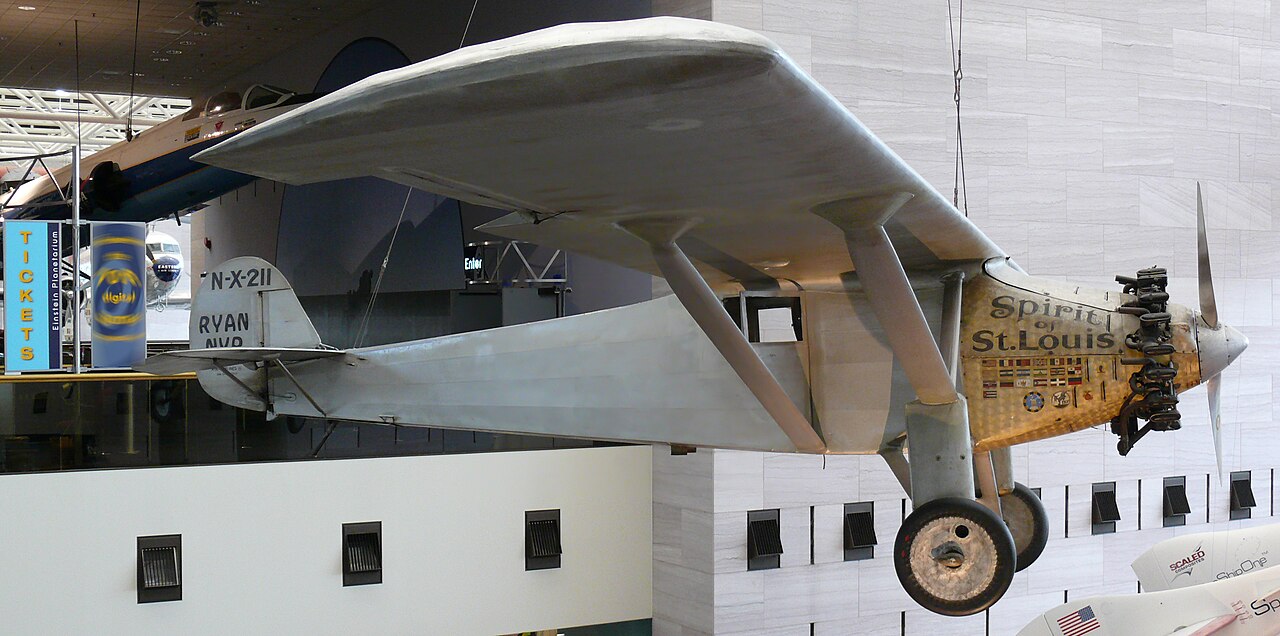
The Spirit of St. Louis is the custom-built, single-engine, single-seat, high-wing monoplane in which Charles Lindbergh made the first solo nonstop transatlantic flight, from Long Island to Paris, on 20-21 May 1927. Built in just 60 days by Ryan Airlines of San Diego to a design by Donald A. Hall, it remains one of the most famous individual aircraft in aviation history and is preserved at the Smithsonian's National Air and Space Museum. For a sim pilot it represents an early, purpose-built long-range design whose entire configuration was dictated by the need to carry enough fuel to cross an ocean.
Officially designated the Ryan NYP (New York to Paris) and registered N-X-211, the Spirit of St. Louis was a single-engine, single-seat, high-wing monoplane built by Ryan Airlines in San Diego, California. It was a one-off, non-standard design, hence its experimental registration, created specifically to win the Orteig Prize for the first nonstop flight between New York and Paris. It was owned and flown by Charles Lindbergh and is one of the best-known aircraft in the world.
The aircraft was conceived after Lindbergh, then a U.S. Air Mail pilot, approached several manufacturers about building a Wright Whirlwind-engined aircraft capable of flying nonstop between New York and Paris. Ryan Airlines, owned by B. Franklin Mahoney after he bought out founder T. Claude Ryan's interest in 1926, responded that it could build a plane similar to its M-1 but with larger wings, initially quoting three months before Mahoney committed to two. Lindbergh travelled to San Diego on 23 February 1927 and, after meeting Mahoney, chief engineer Donald A. Hall, factory manager Hawley Bowlus and sales manager A. J. Edwards, agreed a price of 10,580 dollars, contributing 2,000 dollars of his own savings from his mail-flying earnings with the balance provided by the Spirit of St. Louis Organization of his St. Louis backers. Working exclusively on the project, Hall and the Ryan staff completed the aircraft 60 days after Lindbergh's arrival, with the design loosely based on the company's 1926 Ryan M-2 mailplane but with a wingspan extended by about 3 metres (10 feet) to 14 metres (46 feet) to carry the fuel needed for a 4,000-mile range. The aircraft first flew on 28 April 1927 and was named in honour of Lindbergh's backers from the St. Louis Raquette Club.
The Spirit of St. Louis was powered by a Wright Whirlwind J-5C, an air-cooled 9-cylinder radial engine rated at about 220 to 223 horsepower and reputed to be capable of running for over 9,000 hours without failure. It had a 46-foot (14 m) wingspan, was 27 feet 8 inches long and stood 9 feet 8 inches high. Empty weight on completion was 2,150 lb, and the aircraft's design was built around carrying a huge fuel load of 425 US gallons (1,610 litres), with Lindbergh insisting the main tank be placed forward of the cockpit, ahead of the pilot, so that in a crash he would be positioned safely behind the engine and fuel rather than in front of it. With a full load of fuel the gross weight reached around 5,100 lb. Lindbergh favoured a single-engine design over multi-engine alternatives, reasoning that fewer engines meant fewer chances of mechanical failure, while the extreme streamlining of the fuselage, running in an unbroken curved line from spinner to tail, was intended to maximise fuel efficiency for the long ocean crossing.
Fully loaded with roughly 450 US gallons of fuel weighing about 1,230 kg, the Spirit gained speed slowly on its muddy, rain-soaked takeoff run from Roosevelt Field on the morning of 20 May 1927, but the J-5C engine had enough power to clear telephone lines at the field's edge by about twenty feet with a fair margin of flying speed. The transatlantic flight to Le Bourget covered approximately 3,600 miles (3,610 miles by some measurements) in 33 hours 30 minutes. On the delivery flight from San Diego to New York, with a single stop at St. Louis, Lindbergh set a new transcontinental record of 21 hours 40 minutes. The aircraft's long wings and comparatively small tail made it unstable in the roll axis, demanding constant hands-on flying, a characteristic that inadvertently helped keep the exhausted Lindbergh awake during his long solo crossing, which was further complicated by icing, compass difficulties and uncertainty over wind strength and direction.
Only one Spirit of St. Louis was built as the Ryan NYP; no production series followed. A flying replica, the NYP-3, has since been built and is held by the San Diego Air and Space Museum, and other static replicas and reproductions exist, but the original remains unique.
Beyond the transatlantic crossing, Lindbergh used the Spirit extensively for goodwill and demonstration flights. After landing at Le Bourget he flew it to Belgium and England before it was shipped back to the United States aboard the USS Memphis, arriving on 11 June 1927. From 20 July to 23 October 1927 he flew the aircraft on an extensive tour of the United States, and on 13 December 1927 he flew it nonstop from Washington to Mexico City and on through Central America, Colombia, Venezuela and Puerto Rico, with a nonstop leg from Havana to St. Louis; flags of the countries visited were painted on the cowling beginning in Mexico City. The aircraft's final flight took place on 30 April 1928, from St. Louis to Washington, D.C., where Lindbergh presented it to the Smithsonian Institution. It has been on permanent display at the National Air and Space Museum ever since, most recently as part of the Barron Hilton Pioneers of Flight exhibit, which reopened in 2025 after renovation.
Flying the Spirit demands respect for the trade-offs built into its design: the long wings and small tail left it unstable in roll, so it could not be trimmed hands-off and required continuous small corrections throughout a flight, a trait that in the real aircraft doubled as a way of keeping a sleep-deprived pilot alert. Loaded with its full fuel burden the aircraft was heavy and slow to accelerate, as demonstrated by its sluggish, muddy-field takeoff at the start of the transatlantic flight, so pilots should expect a long ground run and limited climb margin at high weights. Anyone attempting a recreation of the New York-Paris flight or the earlier transcontinental dash to St. Louis should be prepared for a genuinely hands-on, physically demanding sortie rather than a docile cruise.