Departure
91%
vs 95% ▼ 4
 MY FS FLIGHTS
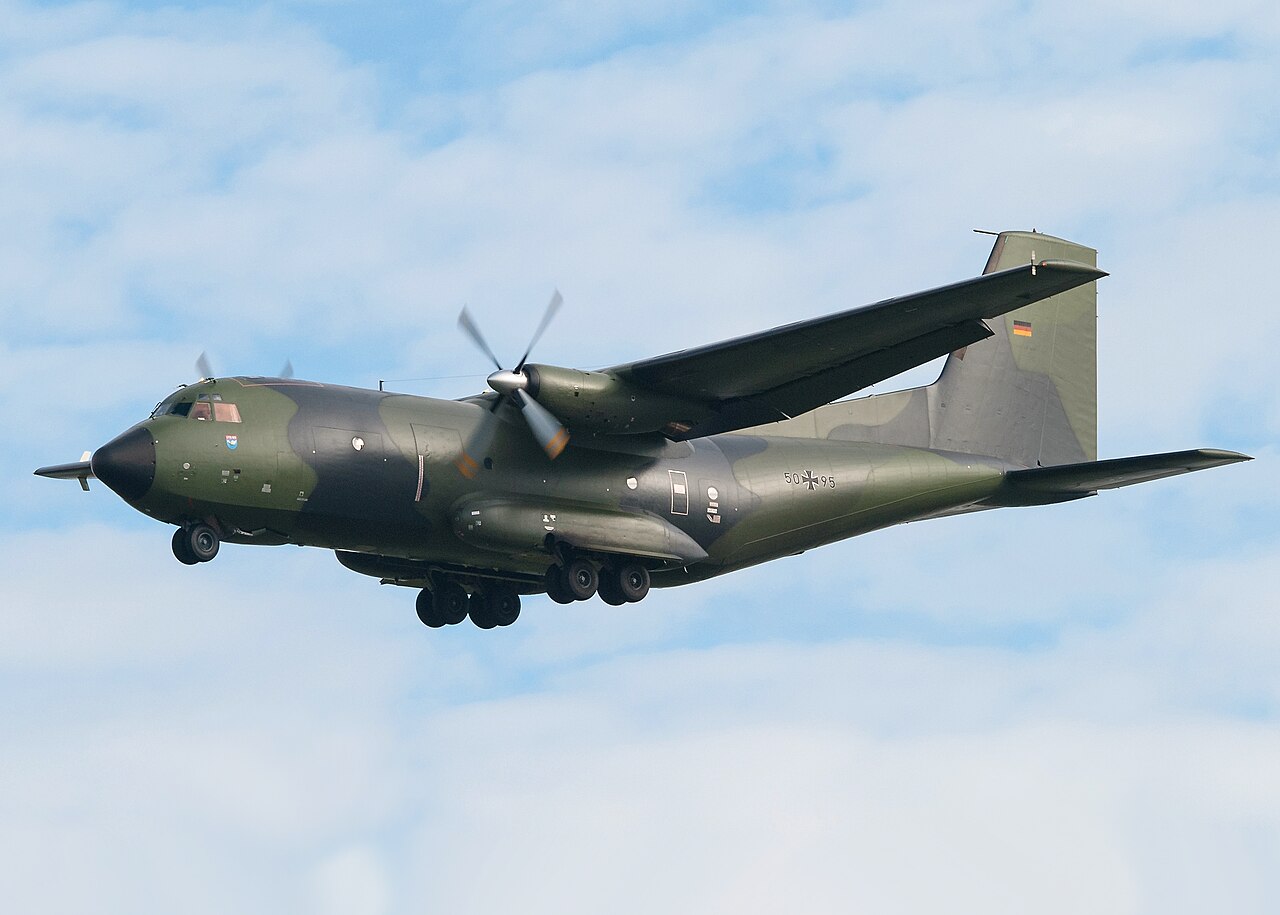
The Transall C-160 is a twin-turboprop tactical military transport aircraft developed jointly by France and Germany as a replacement for the piston-engined Nord Noratlas, built by the Transall consortium of Nord Aviation, Weser Flugzeugbau and Hamburger Flugzeugbau (later Aerospatiale, VFW and MBB). Entering service in 1967, it became the backbone of French and German tactical airlift for decades, was exported to South Africa and Turkey, and adapted into aerial-refuelling, electronic-intelligence and communications-relay roles. Still flying in Turkish Air Force service more than sixty years after its first flight, it is of interest to sim pilots for its rear-loading ramp, kneeling undercarriage, twin Rolls-Royce Tyne turboprops and long, varied multinational career.
The Transall C-160 is a high-wing, twin-turboprop tactical transport aircraft produced as a joint venture between France and Germany, its name being a German abbreviation of the manufacturing consortium Transporter Allianz, made up of the companies Nord Aviation (later Aerospatiale), Weser Flugzeugbau (later Vereinigte Flugtechnische Werke, VFW) and Hamburger Flugzeugbau (later absorbed into Messerschmitt-Bolkow-Blohm, MBB). Configured with a rear-access loading ramp beneath an upswept tail, a long tapered fuselage and turboprop engines mounted under and ahead of the high-set wings, it was designed from the outset for medium-lift tactical airlift, paratroop dropping and operation from semi-prepared airstrips. It holds a place as one of the first successful joint European aerospace ventures, predating later multinational programmes, and its primary users were the German Air Force, French Air and Space Force and Turkish Air Force, with South Africa also an early operator.
The requirement for a C-160 arose in the late 1950s from the need to replace the piston-engined Nord Noratlas transports operated by both the French Armee de l'Air and the German Luftwaffe, and on 28 November 1957 France and Germany signed an agreement for the joint development of a Noratlas successor. Italy was briefly involved in the programme but withdrew in favour of the smaller, locally built Fiat G.222. The Transporter-Allianz consortium was formally established in January 1959 between Nord Aviation of France and the German companies Weser Flugzeugbau and Hamburger Flugzeugbau, tasked with designing and building the new transport to a requirement for carrying a 16,000 kg cargo over 1,720 km or an 8,000 kg load over 4,540 km from semi-prepared strips. Each of the three partner companies built one prototype: the Nord-built aircraft first flew on 25 February 1963, followed by the VFW-built prototype on 25 May 1963 and the HFB-built prototype on 19 February 1964. Six pre-production examples, stretched by 51 centimetres compared with the prototypes, flew between 1965 and 1966. Production orders were delayed by an unsuccessful attempt by Lockheed to sell its C-130 Hercules to Germany, before a contract for 160 aircraft (110 for Germany, 50 for France) was signed on 24 September 1964. Manufacturing work was split along national lines, with Nord building the wings and engine nacelles, VFW the centre fuselage and horizontal tail, HFB the forward and rear fuselage, and Dornier the tail fin, assembled on three separate production lines. First deliveries to France and Germany began in 1967, comprising 110 C-160Ds for the Luftwaffe, 50 C-160Fs for the French Air Force and nine C-160Zs for the South African Air Force; four C-160Fs were later converted into C-160P air mail aircraft operated by Air France. Production continued until October 1972, by which time 169 aircraft had been built. Britain held talks with Transall, the British Aircraft Corporation and its own government about procuring and even manufacturing the C-160, but ultimately chose the C-130 instead. In July 1977 France ordered 25 improved second-generation aircraft, with production work split 50-50 between Aerospatiale and MBB and consolidated onto a single assembly line in Toulouse; these New Generation aircraft replaced the port-side cargo loading door with provision for additional fuel tanks in the wing centre section, raising fuel capacity from 19,000 to 28,000 litres, and introduced updated avionics. The first second-generation C-160 flew in 1981, with this batch comprising 29 aircraft for France, plus four further non-standard aircraft for special missions, and six for Indonesia; four more were added in 1982 before production ended in 1985. Total production across both generations reached 214 aircraft.
The C-160 is a cantilever high-wing monoplane powered by two Rolls-Royce Tyne RTy.20 Mark 22 turboprops rated at 6,100 shp each, driving the aircraft's characteristic twin engine nacelles mounted under and extending beyond the wing leading edges. The fuselage is long and tapered to the rear, terminating in an upswept tail section housing a rear loading ramp; the main undercarriage can be lowered to kneel the fuselage, easing loading and unloading of vehicles and freight. The aircraft has a wingspan of 131 feet 3 inches (40 m), a length of 106 feet 3.5 inches (32.40 m) and a height at the tail of 38 feet 5 inches (11.65 m). Its cargo hold measures up to 10 feet 4 inches (3.15 m) wide and 9 feet 6 inches (2.98 m) high, with a usable length including the ramp of 56 feet 6 inches (17.21 m). Second-generation C-160NG aircraft trade the port-side cargo door for additional wing centre-section fuel tanks, increasing total fuel capacity from 19,000 to 28,000 litres, and are fitted with a refuelling probe above the cockpit along with updated avionics. Later upgrade programmes further modernised the type: French Air Force aircraft received a head-up display, an electronic warfare suite with radar warning receiver, missile approach warner and chaff and decoy dispensers, an EFIS 854 TF electronic flight instrument system with electronic attitude and horizontal situation indicators, a flight management system built around two Gemini 10 computers, and new inertial reference, attitude and heading reference, and GPS sensors, while German C-160Ds were fitted with a BAE Systems High Integration Air Data Computer, Litton ALR-68 radar warning systems and a Rockwell FMS-800 flight management and GPS system.
The C-160 cruises at 308 mph (495 km/h) and has a maximum speed of 323 mph (520 km/h), with a service ceiling of 26,900 feet (8,200 m) and a range of 972 nm (1,800 km) with maximum payload. Maximum payload is 35,275 lb (16,000 kg), and the cabin can accommodate 93 troops or 62 litters. Loads of up to 17,637 lb (8,000 kg) can be air-dropped, and the aircraft is capable of low-altitude drops at between 10 and 30 feet (3 to 9 m) as well as touch-and-go drops, in which it briefly touches the runway without landing. It was designed for steep approach descents of up to 20 degrees and for operation from runways as short as 400 metres, reflecting its intended role of supporting tactical and unimproved-strip airlift.
The original production batch comprised the C-160D for the German Air Force and the C-160F for the French Air Force, alongside nine C-160Z aircraft built for the South African Air Force. Four C-160Fs were converted into C-160P air mail transports operated by Air France on behalf of the French Postal Service. Turkey received 20 C-160T aircraft, former Luftwaffe C-160Ds transferred in the early 1970s. The second-generation C-160NG (Nouvelle Generation), ordered by France from 1977, introduced additional wing centre-section fuel tanks in place of the port cargo door, a refuelling probe and updated avionics; six further aircraft of this standard were built for Indonesia. Specialist derivatives included ten aircraft fitted with a hose-drum unit in the port undercarriage sponson for tanker duties, with five more wired for rapid conversion to the tanker role; the C-160G Gabriel, an electronic and communications intelligence platform fitted with an ELINT subsystem and a COMINT subsystem, identifiable by wingtip pods with UHF/DF blade antennas, a group of large blade antennas atop the forward fuselage, blister fairings on the rear fuselage and a retractable ventral dome; and the C-160H Astarte, four communications relay aircraft delivered to the French Air Force from 1987 for maintaining unjammable very low frequency communications with France's submerged ballistic missile submarines, equipped with a Rockwell VLF transmitter, a Thomson-CSF communications centre and dual trailing wire antennae.
The C-160 entered squadron service with the German and French air forces from 1967, becoming the standard tactical transport for both nations for several decades. It provided logistical support during a range of overseas operations, including the invasion of Cyprus, the South African Border War, the Gulf War, and French operations over Libya, where at least one aircraft operated from a base in Crete. The German Transall fleet had accumulated a combined one million flight hours by late 2011. South Africa retired its C-160Zs in 1997. An upgrade programme for French Air Force aircraft, covering avionics, electronic warfare equipment and flight management systems, was completed in 1999, while German C-160Ds received a parallel avionics and radar warning upgrade. Germany withdrew its last Transalls from service in 2021, with the type's operating wing subsequently disbanded, and France retired its fleet in 2022; both air forces replaced the C-160 with the larger Airbus A400M Atlas and, in small numbers, the Lockheed-Martin C-130J Super Hercules. The Turkish Air Force has continued to operate around 20 ex-Luftwaffe C-160T aircraft, with retirement anticipated in 2026, meaning the type has remained in active service more than sixty years after its first flight.
The Transall C-160 is available for Microsoft Flight Simulator as a dedicated add-on from AzurPoly, recreating the Franco-German military transport with a detailed cockpit, systems and cargo modelling. The project was developed with input from real Transall pilots and enthusiasts, with access to a retired French C-160R held by the Musee Europeen de l'Aviation de Chasse in Montelimar used as a reference for accuracy. It is modelled on the C-160NG/R standard, the most modern version to have served with the French Air Force, and because of the complexity of the type's military-specific systems the developer built a large amount of bespoke systems modelling rather than reusing the simulator's generic avionics. Features include an interactive walk-around mode with a lift platform for accessing the top of the aircraft, SimBrief flight-plan integration, and integrated GNS 430 and GTN 650 navigation units, with versions available for both MSFS 2020 and native MSFS 2024 through the Microsoft Marketplace and third-party retailers.