Departure
89%
vs 95% ▼ 7
 MY FS FLIGHTS
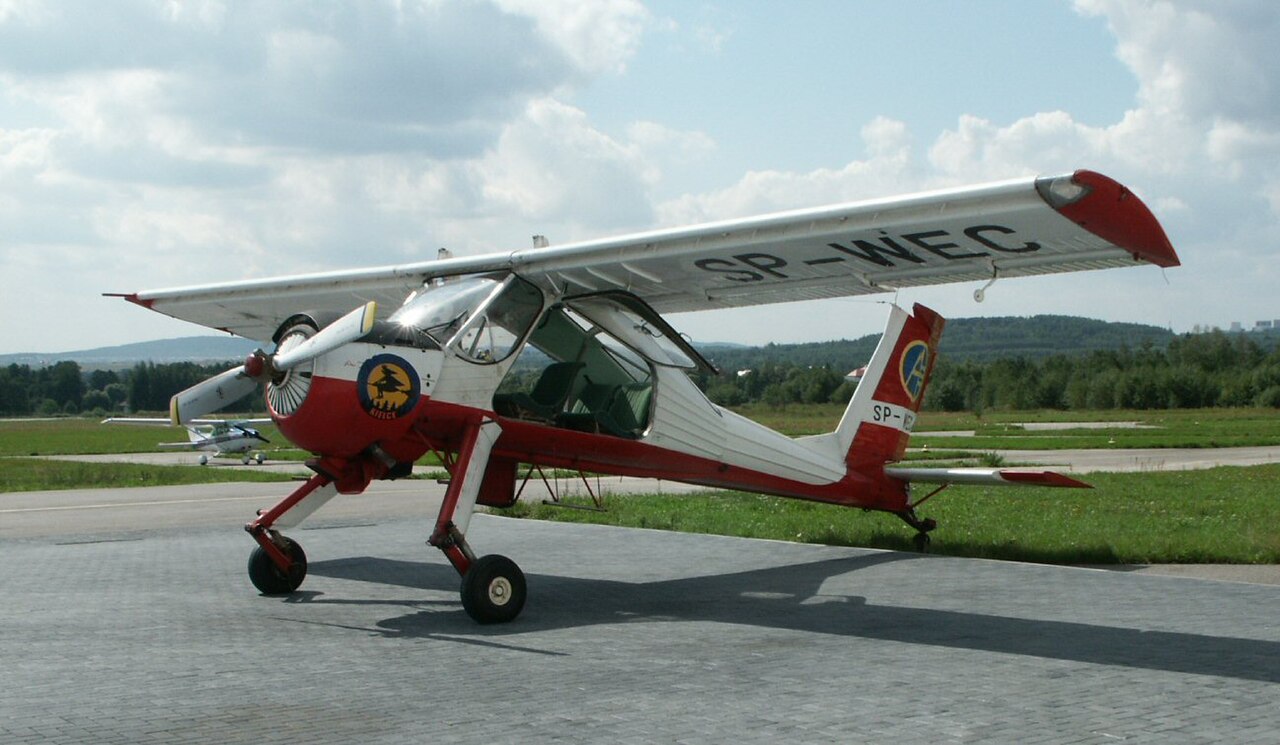
The PZL-104 Wilga 80 is a Polish-built, radial-engined STOL utility aircraft, part of the long-running Wilga family designed and manufactured by PZL Warszawa-Okecie and later by EADS. Introduced in 1979 as a version specifically certified for the American market, it combines short-field capability with a rugged, glider-towing and parachute-jump heritage that makes it an unusual and characterful type for a simulator pilot to fly.
The Wilga 80 is a four-seat, fixed-gear, single-engine STOL utility aircraft belonging to the PZL-104 Wilga family, a Polish design manufactured by PZL Warszawa-Okecie and, after 2001, by the European Aeronautic Defence and Space Company. It sits within a lineage of aircraft conceived for robust civil and sporting use, particularly glider-towing and parachute training, and the Wilga 80 represents the version of the type specifically developed and certified for operation in the United States.
The Wilga family traces back to 24 April 1962, when the prototype Wilga 1 first flew powered by a 220 hp PZL WN-6RB flat engine. Flight testing exposed excessive airframe weight and poor rear visibility for glider-towing, prompting a thorough redesign under engineers Bronislaw Zurakowski and Andrzej Frydrychewicz. The resulting Wilga 2, first flown on 1 August 1963, retained the successful wing structure but introduced a slimmer, strengthened fuselage with improved rear view and upward-opening doors suited to aerial observation and parachute work. Because the WN-6RB engine was never fully developed, production shifted to the Wilga C, an export model for Indonesia using the American Continental O-470 engine, first flown on 30 December 1963, and to the Wilga 3, which adopted the 260 hp Ivchenko AI-14R radial engine and first flew on 31 December 1965. The switch to a radial powerplant compromised the aircraft's originally clean aerodynamic lines but proved successful in practice. Following an initial batch of thirteen Wilga 3s, the landing gear base was widened from 2.12 to 2.83 metres to improve takeoff stability, and the improved Wilga 35 first flew on 29 June 1967, becoming the most numerous variant alongside its Wilga 35A utility derivative. The Wilga 80 entered production in 1979 as a further-improved model specifically certified for the US market. During the late 1990s a California-based dealer, Terra-San, developed its own special-mission conversion of the Wilga 80 for law-enforcement use. In January 1996 PZL announced plans for an armed version intended for border patrol and counter-insurgency duties, fitted with under-wing hardpoints for gun pods and rockets. Production of the Wilga line continued until 2006, when EADS announced its end, a decision reported to have surprised many of the type's international dealers given continuing demand. More than 1,000 Wilgas of all versions were built in total, with around 935 of these constructed to Wilga 35 and Wilga 80 standards.
The Wilga 80 carries forward the structural approach established with the Wilga 2 and Wilga 3: a wing structure retained from the original design paired with a slim, strengthened fuselage that gives good rear visibility, a feature specifically engineered to aid glider-towing operations. The cabin doors open upward, allowing the aircraft to be flown with them open for aerial observation or parachute-jump sorties, and the airframe supports an air ambulance cabin conversion. The type is powered by the 260 hp Ivchenko AI-14R radial engine, the same nine-cylinder unit introduced on the Wilga 3, which rotates counter-clockwise when viewed from behind, a detail of note to pilots more familiar with American-built engines. The aircraft sits on fixed, widely-spaced main landing gear, the track having been increased from 2.12 to 2.83 metres during earlier development to improve takeoff stability. It is configured as a four-seat utility aircraft.
The combination of the 260 hp Ivchenko AI-14R radial engine and the airframe's STOL design gives the type an exceptionally high rate of climb, quoted as up to 11 m/s (2,165 fpm) under minimal load, a figure recorded for the AI-14R-powered Wilga 3 and characteristic of the engine shared by the Wilga 80. This performance comes at the cost of relative fuel inefficiency, the radial engine being noted as uneconomical to operate compared with the flat engines used in some export variants.
The Wilga family progressed through the Wilga 1 (prototype, WN-6RB flat engine), Wilga 2 (redesigned fuselage, same engine), Wilga C (Indonesian export model with Continental O-470 engine), Wilga 3 (Ivchenko AI-14R radial engine), Wilga 32 (small-series export variant with a Continental flat engine, also produced in Indonesia as the Gelatik), and the mass-produced Wilga 35 and Wilga 35A. The Wilga 80, introduced in 1979, was an improved model specifically certified for the US market. A California-based dealer, Terra-San, later produced a customised special-mission derivative of the Wilga 80 fitted with a Wescam gimbal-mounted camera and infrared imaging system for law-enforcement use, and in 1996 PZL announced an armed variant intended for border patrol and counter-insurgency roles with under-wing hardpoints for gun pods and rockets.
The Wilga family was used predominantly by civil operators, with military air arms that adopted the type typically employing it as a trainer and liaison aircraft. The Wilga 80's US certification opened it to the American general aviation and utility market, where its STOL characteristics and rugged construction suited glider-towing, parachute operations and general utility flying. The Terra-San special-mission conversion of the Wilga 80 was marketed specifically as a lower-cost alternative to helicopters for law-enforcement surveillance, exploiting the aircraft's slow-flight and observation capabilities.
In simulation the Wilga 80 is modelled as a civilian fixed-wing light aircraft powered by its 260 hp Russian-built radial engine, notable for rotating counter-clockwise when viewed from behind, a handling quirk that distinguishes it from the more familiar clockwise-rotating engines on many Western light aircraft. This, combined with the type's STOL wing and glider-towing heritage, makes it an aircraft of particular interest to simulator pilots seeking an unusual, characterful piston taildragger with strong short-field manners.