Departure
93%
vs 95% ▼ 2
 MY FS FLIGHTS
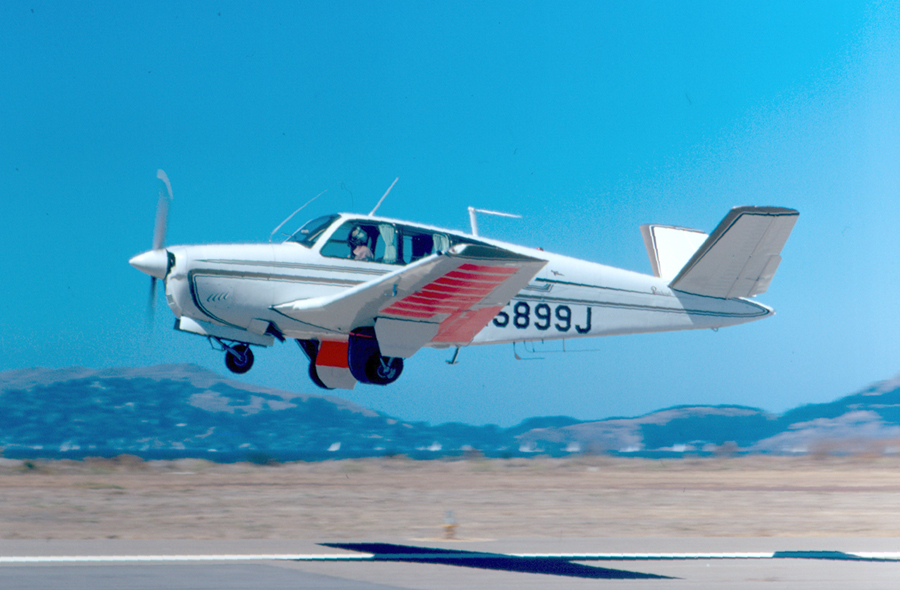
The Beechcraft Bonanza is an American single-engined light aircraft introduced in 1947 by Beech Aircraft Corporation of Wichita, Kansas, instantly recognisable in its original form by its distinctive V-tail. It has remained in production, in one guise or another, for longer than any other aircraft in history, and has long been a favoured business and personal transport for the executive and professional pilot.
The Bonanza is a four-to-six seat, single-engined, low-wing civil utility aircraft built by Beechcraft. It was produced in two distinct tail configurations over its life: the original butterfly, or V-tail, arrangement using combined elevator-rudders called ruddervators, and a later conventional-tail layout. Early conventional-tail examples were marketed under the separate name Debonair before that branding was dropped. The type is widely regarded as one of the first two fully modern light aircraft of the postwar era, alongside the North American Navion, and has been in continuous production since 1947.
The prototype Model 35 Bonanza made its first flight on December 22, 1945, and received its airworthiness certificate on March 25, 1947, with production beginning that year. It was designed by a team led by Ralph Harmon as an all-aluminium, low-wing aircraft with retractable tricycle undercarriage at a time when most light aircraft were still built of wood and fabric. The nosewheel on early aircraft was castering rather than steerable. The first 30 to 40 Bonanzas produced had fabric-covered flaps and ailerons, after which those surfaces were changed to magnesium alloy sheet. Initially the Model 35 was powered by a 185 hp horizontally opposed six-cylinder engine, retractable tricycle gear and its signature V-tail. At the end of the Second World War it competed at the premium end of the civil market against the high-wing, radial-engined Cessna 195, both types cruising up to around 170 mph. The related but substantially larger and heavier Twin Bonanza, which shared only the front fuselage sides, windows and main cabin door with the single-engined Bonanza, struggled against the lighter Cessna 310 and Piper PA-23, prompting Beechcraft to instead use the Bonanza's basic fuselage to create the twin-engined Travel Air, which was later developed into the Baron. An experimental twin-engined derivative, the Model 40, was also built in 1948 with a single prototype featuring two 180 hp Franklin engines mounted one above the other and driving a single propeller. In November 2025 Textron Aviation, the later corporate owner of Beechcraft, announced that Bonanza and Baron production would cease once the final backlog of orders was filled, with parts, maintenance and support to continue for existing owners.
The Bonanza is an all-metal, low-wing design with retractable tricycle undercarriage. The original Model 35 was fitted with a 185 hp, horizontally opposed, six-cylinder engine and is defined by its V-tail, in which combination elevator-rudders known as ruddervators replace a conventional tail assembly. The Model 33, introduced as the Debonair, used a conventional tail and a more austere specification of standard instrumentation, exterior equipment, paint and interior trim than the V-tail Bonanza, though most Bonanza features were available to Debonair buyers as factory options; by the mid-1960s most Debonair customers were ordering most or all of these options, leading Beechcraft to drop the Debonair name with the introduction of the E33 in 1968. The Model 36, introduced in 1968, is a stretched, straight-tail derivative of the Model 33 and remains the current production variant as the G36.
In its original form the Bonanza was capable of cruising up to around 170 mph, comparable to the contemporary Cessna 195 despite the very different design approaches of the two aircraft. The V-tail configuration, using ruddervators in place of separate elevator and rudder surfaces, gave the aircraft distinctive handling characteristics that became the subject of considerable comment over the years. The type earned a reputation, rightly or wrongly, as the forked-tail doctor killer following a series of fatal accidents and in-flight breakups, often attributed to overconfident amateur pilots rather than any inherent flaw in the design; the American Owners and Pilots Association undertook a detailed analysis of accident records for retractable-gear single-engine aircraft in response to this reputation, and the doctor killer label has at times also been applied to the conventional-tailed version.
The Bonanza family comprises three major variants. The Model 35 Bonanza, produced from 1947 to 1982, is the original V-tail aircraft. The Model 33, sold first as the Debonair and later simply as the Bonanza, ran from 1960 to 1995 with a conventional tail; it was originally a lower-priced, more austerely equipped model before the Debonair name was dropped with the E33 in 1968. The Model 36 Bonanza, in production since 1968 and continuing today as the G36, is a longer-bodied, straight-tail stretch of the Model 33. Beyond the single-engined family, the substantially larger and mostly dissimilar Twin Bonanza shared only the front fuselage sides, windows and main cabin door with the Bonanza proper, and the single Model 40 prototype of 1948 was an experimental twin with two Franklin engines mounted one above the other driving a single propeller. Military derivatives, including trainer variants, served with the United States Air Force and United States Navy and with other countries.
The Bonanza has been widely sought as a business and personal transport for the executive and professional class, and has been described as one of general aviation's great success stories. Several military variants served as trainers for the U.S. Air Force and U.S. Navy and for other countries. The type was also briefly used as a short-haul feeder airliner at the outset of Central Airlines of Texas. Its performance made it a favoured mount for record flights: on March 7-8, 1949, William P. Odom set a light-plane nonstop distance record flying the Waikiki Beech, the fourth Bonanza built, from Honolulu to Teterboro, New Jersey, having earlier, on January 12, 1949, established a record for light-plane flights from Hawaii to the continental United States over a great circle distance of 2,406.9 miles, though he actually flew around 2,900 miles. In 1951 Congressman Peter F. Mack flew the same aircraft, renamed the Friendship Flame, on an around-the-world goodwill flight between October 7, 1951 and January 27, 1952. Production has continued from 1947 through to the end of 2026, a run of 79 years making the Bonanza the longest continually produced aircraft in the world, with more than 18,000 examples built along with over 6,000 twin-engined derivatives. The conventional-tail Model 33 remained in production until 1995, while the Model 36 continues today; no Bonanzas were delivered in 2021, but production of the G36 restarted on April 10, 2022.
For the simulator pilot the Bonanza's chief interest lies in its unusual V-tail control arrangement, where ruddervators combine the functions of elevator and rudder, giving the aircraft a handling character quite distinct from conventional-tailed light singles of the same era. The type's long production history means that both early V-tail Model 35 aircraft and later straight-tail Model 33 and Model 36 variants offer differing panels, equipment fits and performance, reflecting the aircraft's steady evolution from a 185 hp postwar four-seater into the more heavily equipped six-seat G36 still in production today.