
Departure
94%
vs 95% ▼ 1
Track every flight, analyse your performance,
and master your flying skills with My FS Flights
Get 10 flights free every month!
Tracked and analysed flights over miles
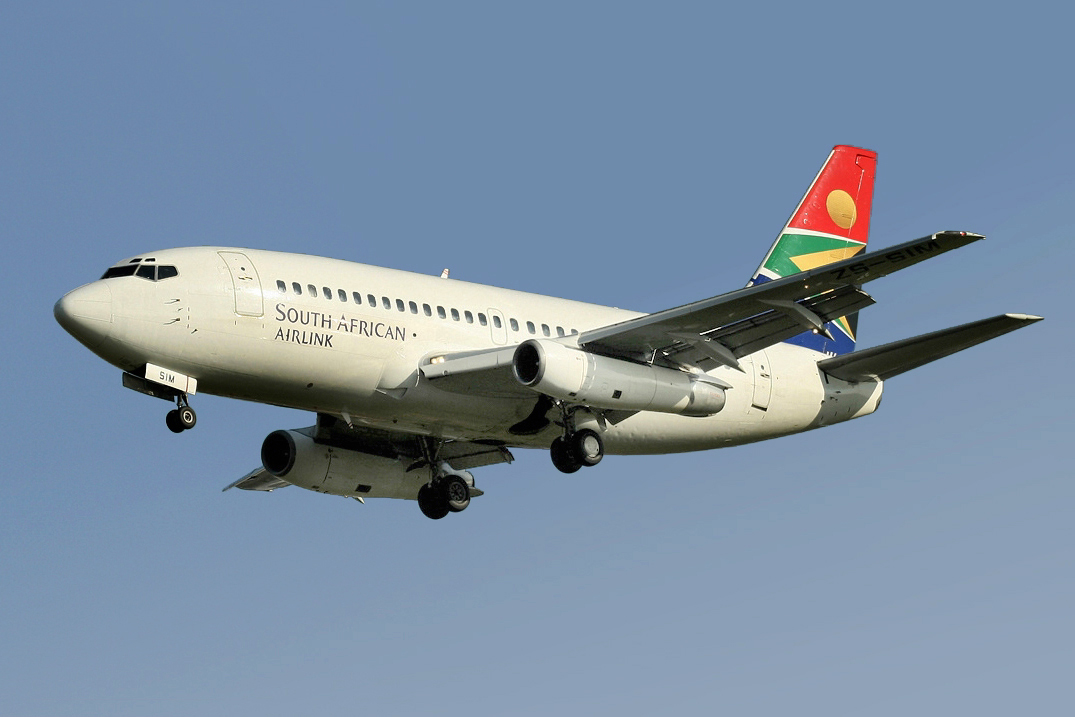
The Boeing 737 is an American narrow-body twinjet airliner built by Boeing at its Renton, Washington factory, developed to supplement the 727 on short and thin routes. It has grown through four generations from the original -100/-200 into the Classic, Next Generation and MAX families, becoming the best-selling commercial jet airliner and a mainstay of short and medium-haul flying, and thus one of the most widely represented types in flight simulation.
The Boeing 737 is a twin-engined, narrow-body jet airliner produced by Boeing at its Renton factory in Washington. It was developed to supplement the Boeing 727 on short and thin routes, retaining the 707 fuselage width and six-abreast seating but with two underwing engines rather than three rear-mounted units. Since its 1967 first flight the family has evolved through four generations - Original, Classic, Next Generation and MAX - offering variants seating from 85 to 215 passengers, plus Boeing Business Jet and military derivatives such as the P-8 Poseidon, C-40 Clipper and E-7 Wedgetail. It has been the best-selling commercial aircraft in history, only surpassed in orders by the Airbus A320 family in October 2019 and in total deliveries in September 2025.
Boeing began studying short-haul jet designs in the early 1960s, seeing a need for an aircraft to supplement the 727 on short, thin routes. Preliminary design work began on May 11, 1964, based on research indicating a market for a fifty to sixty passenger airliner flying routes of 50 to 1,000 miles. The initial concept featured podded engines on the aft fuselage, a T-tail as on the 727, and five-abreast seating; engineer Joe Sutter then relocated the engines to the wings, which lightened the structure, simplified six-abreast seating, and allowed the landing gear to be shortened and the fuselage lowered for easier baggage and passenger access. Relocating the engines also meant the horizontal stabilizer could be attached to the aft fuselage rather than mounted as a T-tail. At the time Boeing was behind its rivals: the Sud Aviation Caravelle had been in service since 1955, and the BAC One-Eleven, Douglas DC-9 and Fokker F28 were already in flight certification. To speed development, Boeing reused about 60% of the structure and systems of the existing 727, particularly its fuselage, which was itself derived from the 707 and gave the 737 a 148-inch-wide cross-section allowing six-abreast seating compared with rivals' five-abreast. The chosen engine was the Pratt & Whitney JT8D-1 low-bypass turbofan, delivering 14,500 pounds-force of thrust. The concept was presented in October 1964 by chief project engineer Jack Steiner, whose elaborate high-lift devices raised early concerns about maintenance costs and dispatch reliability. The 737-100 made its first flight on April 9, 1967, and entered service with Lufthansa on February 10, 1968; the lengthened 737-200 entered service in April 1968. The Classic series (-300/-400/-500) was launched in 1979-1980 and introduced in 1984 with CFM56-3 high-bypass turbofans. The Next Generation (-600/-700/-800/-900) was launched on November 17, 1993 following Boeing's need to answer United Airlines' purchase of the fly-by-wire Airbus A320, and entered service on December 17, 1997 with Southwest Airlines after the first 737NG, a -700, rolled out on December 8, 1996 and first flew on February 9, 1997. The 737 MAX, powered by CFM LEAP-1B engines, entered service in 2017 and was grounded worldwide between March 2019 and November 2020 following two fatal crashes. As of June 2026, 17,497 Boeing 737s had been ordered and 12,615 delivered.
The 737 shares its fuselage cross-section, 148 inches wide, with the 727 and, in turn, the 707, giving it six-abreast seating compared with the five-abreast layout of contemporary rivals such as the DC-9 and BAC One-Eleven. The original design moved the engines from the aft fuselage to underwing pods mounted directly beneath the wing without pylons, which lightened the airframe, allowed a shorter landing gear and a lower fuselage for easier ground servicing, and permitted the horizontal stabilizer to be mounted conventionally on the aft fuselage rather than as a T-tail. The wing airfoil sections were based on those of the 707 and 727 but made somewhat thicker, with modified sections near the nacelles to reduce drag at high Mach numbers. Early Original and Classic variants used Pratt & Whitney JT8D low-bypass turbofans, the initial JT8D-1 delivering 14,500 pounds-force of thrust; the Classic series introduced CFM International CFM56-3 high-bypass turbofans. The Next Generation family uses CFM International CFM56-7 series engines together with a redesigned, larger-area wing with a wider wingspan, increased fuel capacity, a glass cockpit and upgraded, redesigned interior configurations, giving greater range and higher maximum takeoff weight than the Classic. The MAX generation is powered by CFM LEAP-1B high-bypass turbofans.
The 737 family is grouped into four generations. The first generation, the Original series, comprises the 737-100 and 737-200 together with the military T-43 and CT-43, launched in February 1965 and powered by Pratt & Whitney JT8D turbofans, seating 85 to 130 passengers. The second generation, the Classic series, comprises the 737-300, -400 and -500, launched in 1979-1980, introduced in 1984, and fitted with CFM56-3 high-bypass turbofans, seating 110 to 168 passengers. The third generation, the Next Generation (NG), comprises the 737-600, -700, -800 and -900, plus military derivatives including the C-40 Clipper, E-7 Wedgetail and P-8 Poseidon, and the Coulson 737 Fireliner firefighting conversion; it introduced CFM56-7 engines, a larger wing and a glass cockpit, seating 108 to 215 passengers, and is the best-selling generation, with the -800 alone accounting for 5,991 commercial, 224 military and 23 corporate orders. The fourth generation, the 737 MAX, comprises the -7, -8, -9 and -10, powered by CFM LEAP-1B engines and accommodating 138 to 204 passengers; it entered service in 2017. Boeing Business Jet corporate versions have been produced since the Next Generation series.
The 737 has served primarily as a short- to medium-haul commercial airliner, with the -200 becoming the first mass-produced model and remaining in service with operators such as South African Airlink. Its principal current operators include Southwest Airlines, Ryanair, United Airlines and American Airlines. By 2013 the global 737 fleet had completed more than 184 million flights and 264 million block hours since entering service. Beyond airline service, the airframe has been adapted for military and specialised roles, including the T-43 and CT-43 navigation trainers, the C-40 Clipper transport, the E-7 Wedgetail airborne early warning aircraft, the P-8 Poseidon maritime patrol aircraft, and the Coulson 737 Fireliner aerial firefighting conversion, alongside Boeing Business Jet corporate variants. The 737NG's assembly for commercial customers ended in 2019, with final deliveries made in January 2020, as production shifted to the MAX.