Departure
94%
vs 95% ▼ 1
 MY FS FLIGHTS
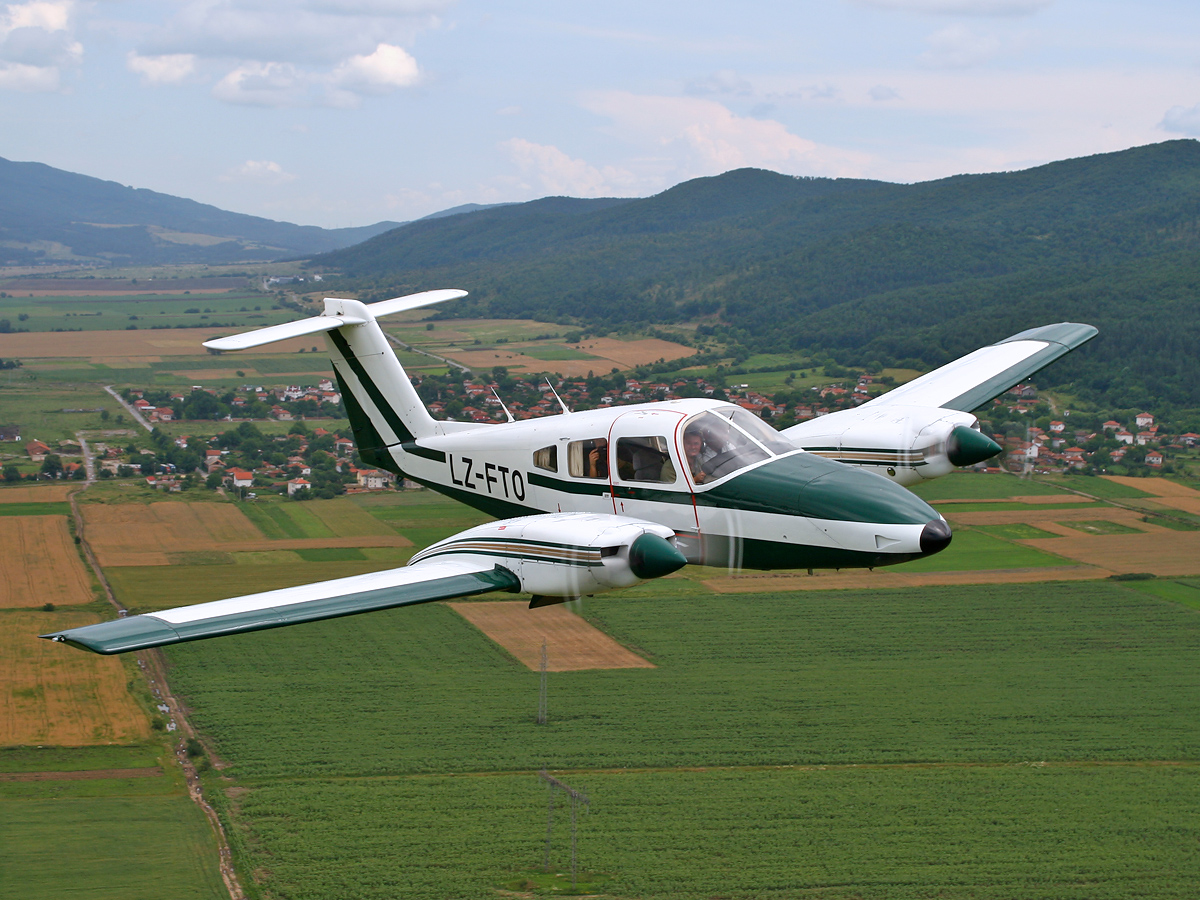
The Piper PA-44 Seminole is a twin-engined, four-seat light aircraft developed by Piper Aircraft from the single-engined Piper Cherokee, built specifically for multi-engine flight training. With counter-rotating propellers that eliminate the critical engine, a T-tail, and a long production run stretching from 1979 to the present day, it has become the standard multi-engine trainer for flight schools around the world, making it a useful and instructive type for any simulator pilot working through a multi-engine rating.
The PA-44 Seminole is an American twin-engined, low-wing, retractable-gear light aircraft manufactured by Piper Aircraft. It was developed from the single-engined Piper Cherokee family specifically to serve as a multi-engine trainer, and it remains one of the most widely used aircraft of its type in flight schools globally. The type features a distinctive high T-tail, similar to the T-tailed Piper Arrow IV, and is visually comparable to its contemporary rival, the Beechcraft Duchess. It carries a crew of one plus three passengers in its standard four-seat cabin.
The first prototype Seminole made its maiden flight in May 1976, and the type was publicly announced on February 21, 1978. It received FAA type certification on March 10, 1978, with the first delivery taking place in July 1978, and it entered production as a 1979 model year aircraft in late 1978. A turbocharged version, the PA-44-180T Turbo Seminole, was certified on November 29, 1979. Production of both the standard and Turbo Seminole ran until 1982, by which point 361 Seminoles and 87 Turbo Seminoles had been built. The normally aspirated PA-44-180 returned to production in 1988 with modifications limited to the electrical systems and instrumentation, but this second run ended in 1990 after only 29 more aircraft had been delivered, a casualty of Piper's financial difficulties at the time. Production resumed again in 1995 and has continued since. By 2019 a total of 926 Seminoles had been built, and Piper announced certification of the 1,000th Seminole, a PA-44-181, in April 2020. A diesel-powered variant, the Seminole DX, fitted with two DeltaHawk DHK4A180 engines, has since been developed, with the first US order reported in 2025.
The Seminole is of conventional low-wing, twin-engine configuration with retractable landing gear and a high T-tail. Early production aircraft used two 180 hp (135 kW) Lycoming O-360-E1A6D engines, with the right-hand engine a Lycoming LO-360-E1A6D variant that turns in the opposite direction to the left-hand engine; this counter-rotation eliminates the critical engine and improves controllability in the event of an engine failure. Later production aircraft used Lycoming O-360-A1H6 engines, while the current production Seminole is fitted with two fuel-injected Lycoming IO-360-B1G6 engines flat-rated to 180 hp each, driving Hartzell Scimitar two-blade constant-speed, fully-feathering propellers. Earlier aircraft used 2-bladed Hartzell fully-feathering metal constant-speed propellers of 6 ft 2 in (1.88 m) diameter. The Turbo Seminole (PA-44-180T) uses two turbocharged Lycoming TO-360-E1A6D engines of the same 180 hp rating, offering improved performance at high density altitude, and had its takeoff gross weight raised to 3,925 lb (1,780 kg) while retaining the standard landing weight of 3,800 lb (1,723 kg). Dimensions for the PA-44-180 are a length of 27 ft 7 1/4 in (8.41 m), wingspan of 38 ft 7 1/4 in (11.77 m), height of 8 ft 6 in (2.59 m), and wing area of 183.8 sq ft (17.08 m2) using a NACA 652-415 airfoil. Empty weight is 2,354 lb (1,068 kg) against a maximum takeoff weight of 3,800 lb (1,724 kg). Usable fuel capacity is quoted as 108 US gal (409 L) by Piper for the current model, with earlier figures of 110 US gal (420 L) total, of which 2 US gal (7.6 L) is unusable. The current production aircraft is equipped with a Garmin G1000 NXi avionics suite as standard, including dual 10.4 inch PFD and MFD displays, Garmin FliteCharts, Garmin SafeTaxi, a GMA 1360 digital audio panel, a GTX 345R transponder and a Garmin G5 standby instrument, with options including the GFC 700 autopilot, TAWS-B, Jeppesen ChartView, an Appareo Vision 1000 flight monitoring system, and a Safe Flight angle of attack system.
The PA-44-180 Seminole has a maximum speed of 193 mph (311 km/h, 168 kn) and a cruise speed of 187 mph (301 km/h, 162 kn) at 75 percent power, with a stall speed of 68 mph (109 km/h, 59 kn) flaps down. Range is quoted at 1,053 mi (1,695 km, 915 nmi) at 55 percent power, with a service ceiling of 17,100 ft (5,200 m) and a single-engine service ceiling of 4,100 ft (1,200 m). Rate of climb is 1,340 ft/min (6.8 m/s), takeoff distance to 50 ft is 1,400 ft (430 m), and landing distance from 50 ft is 1,190 ft (360 m). Current Piper factory figures for the modern production Seminole quote a maximum cruise speed of 162 KTAS (300 km/h) and a maximum range of 940 nm (1,741 km). The Turbo Seminole offers improved high-altitude performance, with a quoted maximum speed of 196 kt (363 km/h) and a maximum cruising speed of 185 kt (343 km/h), an initial rate of climb of 1,290 ft/min, and a range with reserves of about 820 nm (1,520 km).
The PA-44-180 Seminole is the normally aspirated version, originally powered by two Lycoming O-360-E1A6D engines and later by two O-360-A1H6 engines, with the current production PA-44-181 using fuel-injected Lycoming IO-360-B1G6 engines. The PA-44-180T Turbo Seminole is a turbocharged version powered by two Lycoming TO-360-E1A6D engines, offering better performance at high density altitude at the cost of a slightly higher takeoff gross weight. A diesel-powered variant, the Seminole DX, has been introduced with two DeltaHawk DHK4A180 engines.
The Seminole is used primarily as a multi-engine trainer and is a familiar sight at flight schools worldwide, valued for its low life-cycle costs and high dispatch rates. It is also operated by air charter companies, private individuals and companies for personal and light commercial use. In the military sphere, the type has been used by the Royal Jordanian Air Force and the Peruvian Air Force.
For a simulator pilot working toward or maintaining a multi-engine rating, the Seminole offers the classic light-twin training experience: stable handling, forgiving low-speed characteristics, and the counter-rotating propeller arrangement that removes the concept of a single critical engine, simplifying engine-out procedures compared with many other twins. Its modern production version is equipped with the Garmin G1000 NXi glass cockpit and, optionally, the GFC 700 autopilot with Electronic Stability Protection, Underspeed Protection, Level Mode and Coupled Go-Around, all of which give a realistic picture of contemporary integrated trainer avionics. Its widespread use as the standard multi-engine trainer across flight schools globally makes it a natural choice for anyone using the simulator to prepare for or practise multi-engine and instrument procedures.