Departure
94%
vs 95% ▼ 1
 MY FS FLIGHTS
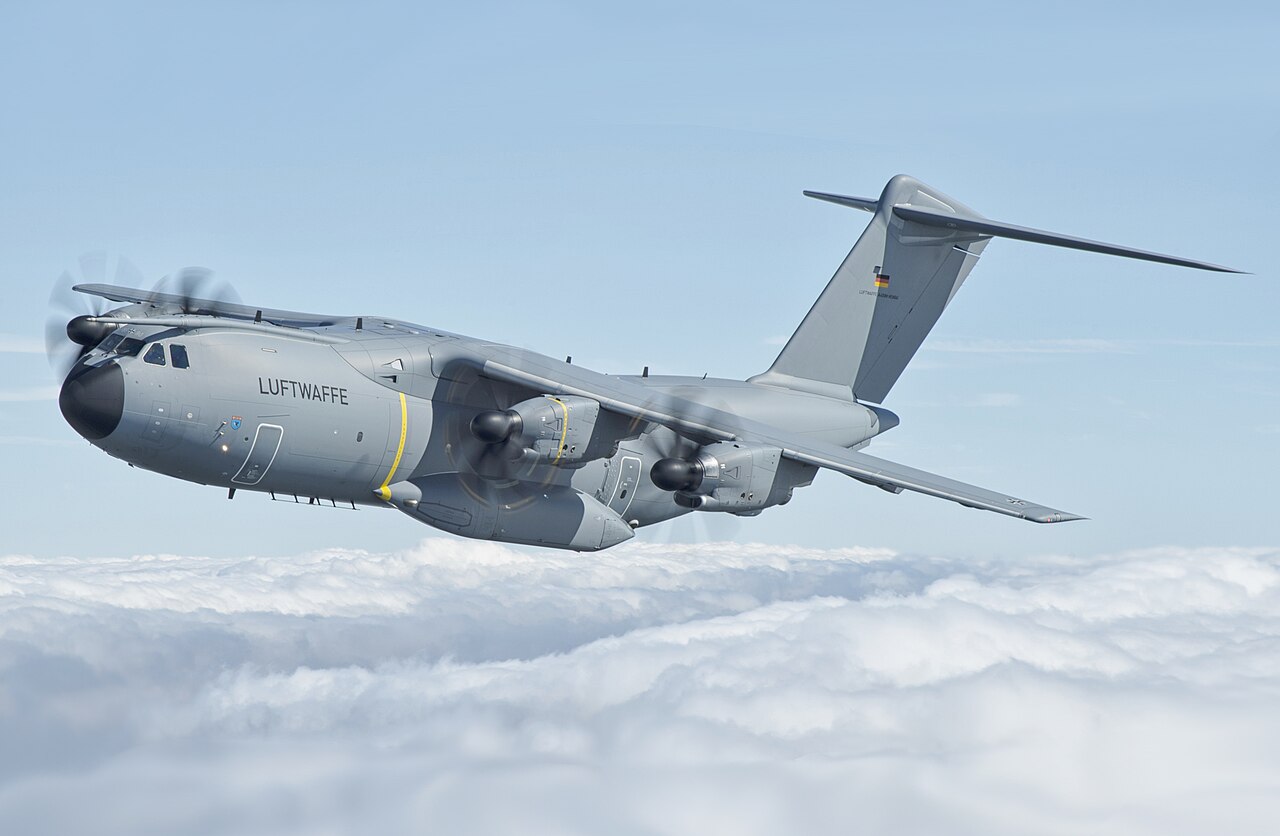
The Airbus A400M Atlas is a four-engine turboprop military transport built by Airbus Defence and Space to bridge the gap between tactical airlifters like the Lockheed C-130 Hercules and strategic jets like the Boeing C-17 Globemaster III. Conceived by a consortium of European nations to replace the Transall C-160 and the C-130, it combines the ability to carry heavy or outsize loads over long, jet-like cruise distances with the capacity to operate from short, rough or unpaved airstrips. For a sim pilot it is of interest as a modern fly-by-wire turboprop that behaves in many respects like a strategic jet while retaining genuine tactical short-field and low-level capability.
The A400M Atlas is a European four-engine turboprop military transport aircraft, developed by Airbus Military, later renamed Airbus Defence and Space. It was conceived as a tactical airlifter with strategic reach, intended to replace older types such as the Transall C-160 and the Lockheed C-130 Hercules. In size and role it sits between the C-130 and the Boeing C-17 Globemaster III, able to lift loads too heavy or bulky for the Hercules while still using rough, short landing strips beyond the reach of larger jet-powered airlifters. Beyond its core transport role the aircraft is also configured for aerial refuelling, both as tanker and receiver, and for aeromedical evacuation.
The programme traces its roots to the Future International Military Airlifter (FIMA) group formed in 1982 by Aerospatiale, British Aerospace, Lockheed and Messerschmitt-Bolkow-Blohm to find a joint replacement for the C-130 and Transall C-160. Lockheed withdrew in 1989 to pursue its own C-130J Super Hercules, and with the addition of Alenia and CASA the effort became Euroflag. Engine configuration studies considered twin and quad turbofans, a quad propfan and a quad turboprop, eventually settling on the turboprop layout, which in turn demanded a new powerplant capable of a Mach 0.72 cruise since no existing Western turboprop was powerful enough. An initial SNECMA M138 design proved unable to meet requirements, and following a 2002 request for proposals contested by Pratt & Whitney Canada's PW180 and the Europrop International consortium, Airbus Military selected the Europrop TP400-D6 in May 2003. The original partner nations were France, Germany, Italy, Spain, the United Kingdom, Turkey, Belgium and Luxembourg, with the Organisation for Joint Armament Cooperation (OCCAR) managing procurement; a contract for 212 aircraft was signed in May 2003, later reduced to 180 after Italy's withdrawal. South Africa joined the programme in 2005, with Denel Saab Aerostructures supplying fuselage components, and Malaysia's CTRM later took on composite component manufacture. The first flight took place on 11 December 2009 from Seville Airport, following delays that saw first delivery pushed from 2009 to at least 2012, alongside reports in January 2009 that the aircraft was some 12 tonnes overweight and initially unable to meet its 32-tonne payload requirement. The programme faced possible cancellation between 2009 and 2010 over cost overruns, but in November 2010 Belgium, Britain, France, Germany, Luxembourg, Spain and Turkey finalised the contract and agreed to lend Airbus Military 1.5 billion euros to continue, while reducing orders overall from 180 to 170 aircraft, with the UK cutting its order from 25 to 22 and Germany from 60 to 53. The aircraft received EASA certification in March 2013 and the first example was delivered to the French Air Force in August 2013, with the German Air Force receiving its first aircraft on 18 December 2014. By July 2011 a total of 174 aircraft had been ordered by eight nations. In 2016 a cracking issue was identified in aluminium-zinc alloy fuselage frames on a French aircraft, deemed repairable during routine maintenance and subsequently excluded from later production, and in July of that year Airbus took a one billion US dollar charge linked to delivery issues. The programme's 100th aircraft was delivered in May 2021, and as of 31 January 2025, 130 aircraft had been built against 178 orders from ten nations.
The A400M is a high shoulder-wing monoplane powered by four EuroProp International TP400-D6 turboprop engines, each rated at around 11,000 shaft horsepower, making them among the most powerful turboprops developed in the West. The engines drive propellers arranged in a Between the Engines Propeller configuration, in which the two propellers on each wing rotate in opposite directions with the inboard units turning inward and upward, improving aerodynamic efficiency, allowing a lighter wing structure and easing low-speed handling. The aircraft is fitted with fly-by-wire flight controls, an armoured cockpit, bullet-resistant windscreens and inert gas within the fuel tanks, together with chaff and flare countermeasures and a defensive aids system for survivability in contested environments. A twelve-wheel main landing gear arrangement spreads weight for operation from soft or unpaved strips. The airframe measures around 45.1 metres in length with a tail height of 14.7 metres and a wingspan exceeding 42 metres. The cargo hold offers a four by four metre cross-section and roughly 340 cubic metres of volume, with a hold width of about 4.00 metres, height of 3.85 metres and length of around 17.71 metres. Maximum take-off weight is 141,000 kilograms (311,000 lb) and maximum landing weight 123,000 kilograms (271,000 lb), with a maximum payload of 37,000 kilograms (around 81,500 to 81,600 lb). Basic fuel capacity is around 51 tonnes, equating to roughly 62,900 litres. The cabin can accommodate up to 116 troops or paratroops, or be configured for aeromedical evacuation carrying stretcher patients alongside medical personnel.
The A400M cruises at speeds around Mach 0.68 to 0.72, comparable to jet-powered aircraft and equating to a maximum cruise speed of roughly 780 km/h (421 kt), allowing it to use the same commercial air corridors as airliners and speed up long-range deployments. Its service ceiling is 40,000 feet. It can carry 20 tonnes of payload out to around 3,400 nautical miles, with a maximum ferry-type range of around 4,800 nautical miles when lighter loaded. Typical rate of climb is around 3,000 feet per minute, and it can deliver its 37-tonne payload onto an unpaved strip of less than 750 metres, with quoted take-off and landing distances of around 3,200 feet (980 m) and 2,550 feet (770 m) respectively; approach speed is around 130 knots. The aircraft is capable of manoeuvring with bank angles of up to 120 degrees, low-level flight down to 150 feet, and steep climb and descent profiles, characteristics built in for survivability and tactical delivery. Aerial delivery can be conducted from as low as 150 feet up to 38,000 feet, supporting drops of up to 25 tonnes of cargo or up to 116 paratroopers using a Computed Air Release Point system, with autopilot and flight director support.
The A400M is fielded as a single core airframe adapted to different mission fits rather than as a family of distinct fixed variants. It can be configured as a straight tactical and strategic transport, as an aerial tanker fitted with underwing refuelling pods able to refuel fighters and helicopters while also being able to receive fuel itself through a probe, and as a medical evacuation platform using dedicated patient transport units fitted into the cargo hold for the movement of patients, including those requiring intensive care.
The A400M's primary operators include the German Air Force, the French Air and Space Force, the Royal Air Force and the Spanish Air and Space Force, alongside further export customers. By early 2025, 130 aircraft had been built against 178 orders placed by ten nations, and the fleet had accumulated more than 200,000 flight hours. Roles undertaken have included strategic and tactical military transport of troops, vehicles and equipment, humanitarian aid delivery, aerial refuelling of fixed-wing and rotary aircraft, and aeromedical evacuation, including long-range medical missions to remote locations. European operators have also explored closer cooperation, including moves toward a multinational A400M fleet arrangement to make better use of national capacity.
The A400M presents a modern, highly automated cockpit environment, with fly-by-wire controls operated through a sidestick and head-up displays feeding flight data directly into the pilots' field of view, giving handling characteristics closer to those of a modern airliner than a traditional propeller transport. Its design tolerances for steep climb and descent profiles, low-level flight down to 150 feet and bank angles of up to 120 degrees reflect a genuinely tactical handling envelope layered on top of jet-like cruise performance, which would make short-field, low-level and aerial delivery scenarios distinctive parts of flying the type. The counter-rotating Between the Engines Propeller layout is intended to keep the aircraft manageable at low speed, a factor that would be noticeable during short and unpaved-strip operations, while its dual role as both tanker and receiver during air-to-air refuelling adds a further dimension of complex handling tasks for a pilot to master.