Departure
93%
vs 96% ▼ 3
 MY FS FLIGHTS
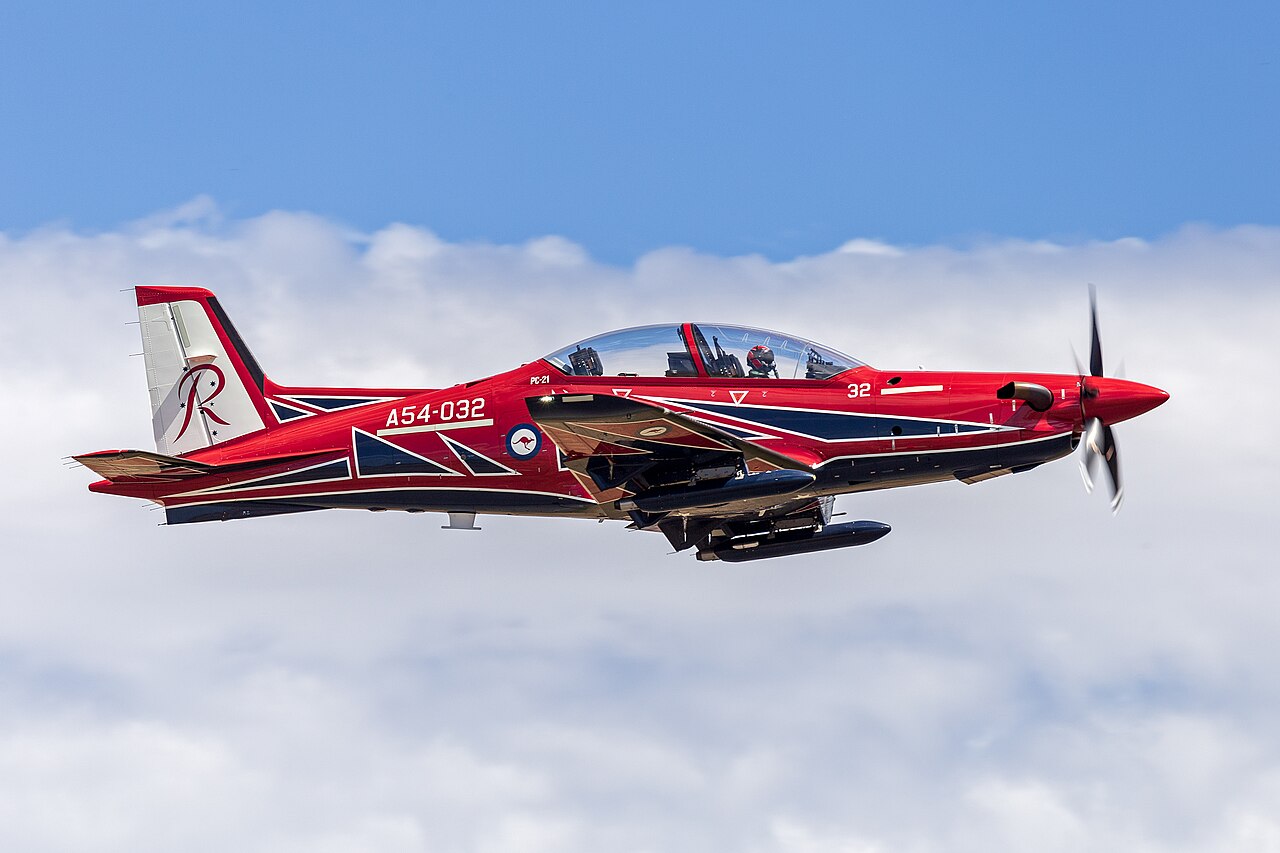
The Pilatus PC-21 is a Swiss-built, single-engine turboprop advanced trainer with a stepped tandem cockpit, designed to carry student pilots from basic instruction through to the threshold of front-line jet types. Developed by Pilatus Aircraft as a clean-sheet successor to the PC-7 family, it has become one of the most widely adopted military trainers of its generation, in service with air forces across Europe, the Middle East, Asia and Australia. For a simulator pilot it represents the modern bridge aircraft between piston/turboprop primary trainers and fast-jet handling, combining a high-performance airframe with a fully integrated ground and air training system.
The PC-21 is an advanced single-engine turboprop trainer manufactured by Pilatus Aircraft of Switzerland, built around a stepped tandem cockpit with the student seated forward and the instructor behind. Pilatus markets it as the 'Twenty-first Century Trainer', a type intended to cover basic flying training, advanced flight training, full mission-management training and embedded simulation or emulation within a single airframe. Its core purpose is to allow future jet pilots, and where required weapons officers or electronic warfare operators, to complete the great majority of their training on a turboprop before converting to jets, reducing the number of aircraft types an air force must operate and cutting overall training cost.
Pilatus tested a modified PC-7 Mk.II in November 1997 to explore improvements for a next-generation trainer, and on the strength of those trials committed funding for a new training system in November 1998, with formal development of the aircraft designated PC-21 beginning in January 1999. The programme was conceived from the outset as a completely new training system rather than a derivative design, intended to meet military training requirements for capability and life-cycle cost over the following three decades, and in May 2002 Pilatus stated its ambition for the PC-21 to capture half of the global trainer market between 2005 and 2030. The first prototype was rolled out at the Pilatus factory in Stans on 30 April 2002 and flew for the first time on 1 July 2002. Full development was formally approved by Pilatus management in May 2003, and a second prototype, whose construction was delayed to incorporate lessons from the first airframe, made its maiden flight on 7 June 2004. Switzerland's Federal Office for Civil Aviation granted civil type certification for VFR operation in December 2004, with full IFR certification following in December 2006; civil certification was pursued deliberately, despite the type's military role, to allow civil maintenance procedures and private-finance supply arrangements, with individual military certification such as for ejection seats applied separately. On 13 January 2005 the second development aircraft crashed at Buochs during an aerobatic training flight, killing the pilot and injuring a person on the ground; the surviving prototype was grounded for several weeks pending investigation, and in August 2006 the crash was attributed to pilot error. The first pre-series production PC-21 flew in late August 2005, and the type entered service in April 2008. By the time of the most recent published totals, 211 of a total of 312 ordered aircraft had been built.
The PC-21 is powered by a single Pratt & Whitney Canada PT6A-68B turboprop engine rated at 1,600 shaft horsepower, driving a five-bladed propeller. The tandem cockpit, with the student seated in front and the instructor behind on a stepped arrangement, sits beneath a bird strike-resistant glass canopy giving all-round vision. The cabin is pressurised and equipped with an On-Board Oxygen Generation System, air conditioning, and Martin-Baker CH16C zero-zero ejection seats. Flight controls are fully balanced and harmonised for ease of operation, and the aircraft carries an anti-g system to reduce the effects of high load factors during tactical and aerobatic manoeuvres, alongside a full autopilot and a civil flight management system. A digital power management system and automatic yaw compensation are fitted to make the aircraft straightforward to handle in the circuit while retaining the performance needed for advanced training. From the earliest design stages Pilatus incorporated modern materials and full-scale fatigue analysis to give the airframe a predictable cost profile across its service life, and the aircraft is supplied as part of a wider integrated training system encompassing synthetic training devices, computer-based training and classroom instruction alongside the aircraft itself.
Pilatus quotes a maximum operating speed of 370 KIAS, a maximum rate of climb of 4,010 feet per minute, and a load factor envelope of +8.0 g to -4.0 g for the PC-21. The digital power management system and automatic yaw compensation are designed to keep the aircraft easy to fly in the circuit for less experienced students while still delivering the performance envelope needed for advanced and tactical training, allowing the type's full capability to be exploited from the earliest stages of a training syllabus.
No separately designated PC-21 sub-variants are described; rather, individual air forces have taken delivery of aircraft configured with customer-specific avionics, mission equipment and training system fits, tailored to each customer's syllabus and front-line aircraft.
Primary operators of the PC-21 include the Swiss Air Force, the Royal Australian Air Force, the Spanish Air and Space Force and the Royal Saudi Air Force, with the type also delivered to Singapore, France, Qatar and the United Arab Emirates Air Force and Air Defence among other customers. Pilatus had sold nearly 235 PC-21 aircraft to nine air forces between 2006 and January 2020. The Royal Australian Air Force ordered 49 aircraft in 2015 as part of the AIR5428 project, valued at 1.15 billion dollars, with the fleet based at RAAF Base East Sale in Victoria and RAAF Base Pearce in Western Australia, feeding undergraduate pilots through to advanced military aircraft. The UAE Air Force and Air Defence ordered 25 PC-21s under a 494 million dollar contract signed in December 2009, with the first UAE aircraft flying in November 2010 and deliveries beginning in the first quarter of 2011. In July 2018 Pilatus handed over two PC-21s to the Empire Test Pilots School, part of the British Ministry of Defence and operated by QinetiQ.
The PC-21's digital power management system and automatic yaw compensation are engineered to make the aircraft forgiving and easy to handle in the circuit for a student pilot, while still exposing them to the higher speeds, g-loading up to +8.0/-4.0 g, and system management workload associated with front-line jets. This combination, allowing the type to be flown gently early in a course yet challenged hard later on, is central to its role as a single-type bridge between basic instruction and jet lead-in training, and is the character a simulator pilot exploring the type would expect to encounter across the different phases of a training syllabus.