Departure
95%
vs 95%
 MY FS FLIGHTS
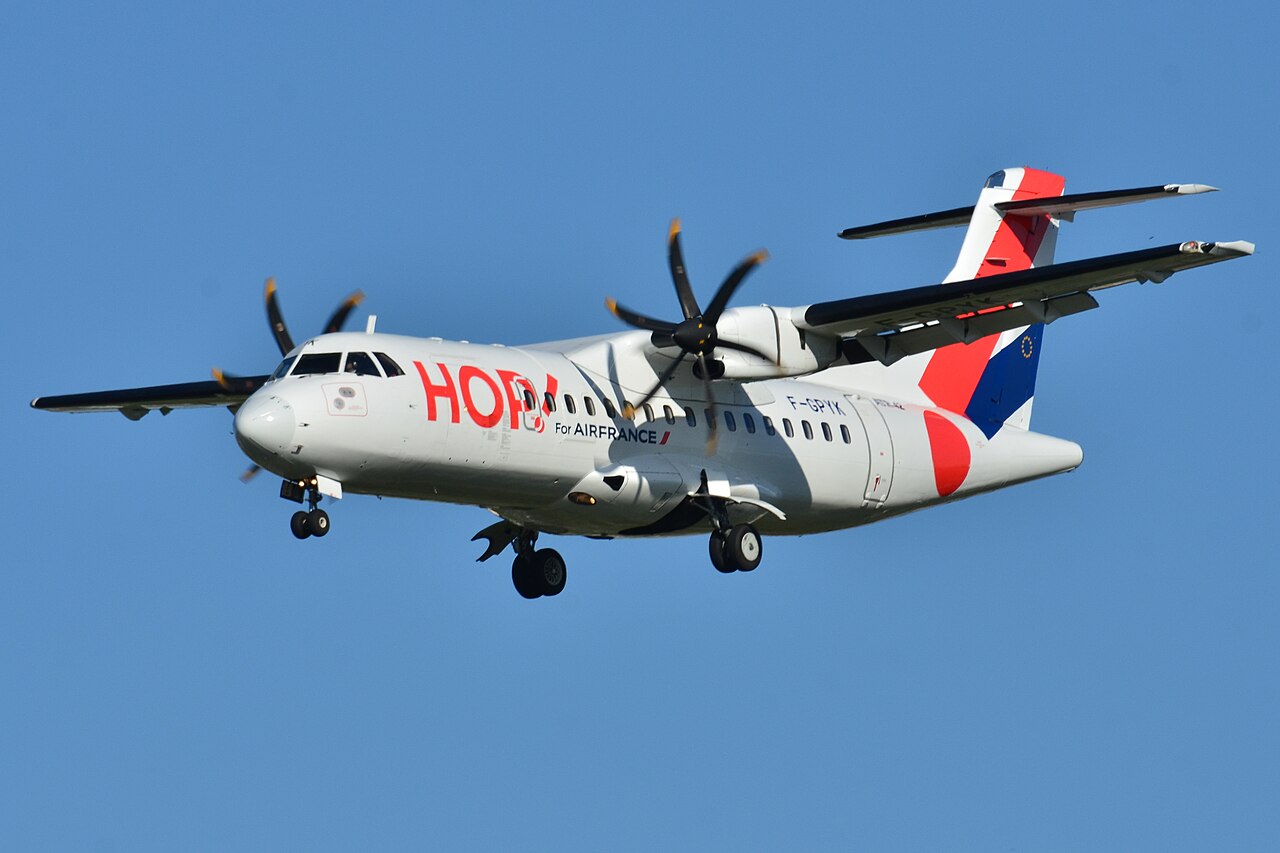
The ATR 42 is a twin-turboprop regional airliner produced by the Franco-Italian manufacturer ATR, formed as a joint venture between Aerospatiale and Aeritalia. Seating originally 42 passengers, from which it takes its name, it has remained in continuous production since 1984 and today survives as the last 30-50 seat regional turboprop still being built, making it a mainstay of short-haul and island-hopping operations worldwide.
The ATR 42 is a high-wing, twin-turboprop regional airliner built by ATR, with final assembly at Toulouse in France. It emerged from a formal co-operation agreement between French manufacturer Aerospatiale and Italian conglomerate Aeritalia, signed in Paris on 4 November 1981, which merged their separate regional airliner concepts into a single design and formed the ATR company itself. Powered by two Pratt & Whitney Canada PW120-series turboprops, the type was designed for short sectors and has since been developed through several variants up to the current PW127XT-powered ATR 42-600, which ATR markets as the only aircraft still in production in the 30-50 seat regional segment.
During the 1960s and 1970s European airframers moved increasingly towards collaborative multinational programmes, and against this backdrop Aerospatiale and Aeritalia had each been independently studying regional airliner concepts from as early as 1978, the AS 35 in France and the AIT 230 in Italy. These studies were combined into a single design under the formal agreement signed by Aeritalia chairman Renato Bonifacio and Aerospatiale chairman Jacques Mitterrand on 4 November 1981, which launched both the ATR consortium and its first aircraft. The partners targeted a fuel burn of 430 kg over a 200 nmi sector, nearly half the 790 kg required by rivals such as the British Aerospace HS.748 and Fokker F.27, and also planned a 58-seat stretched derivative known internally as the ATR XX. By 1983 ATR had established a worldwide customer services division ahead of deliveries. The first ATR 42 flew from Toulouse on 16 August 1984, and type certification was awarded by the French DGCA and the Italian civil aviation authority in September 1985. The first production ATR 42-300 was delivered to launch customer Air Littoral on 3 December 1985, entering revenue service on 23 December on the Béziers Cap d'Agde to Paris Orly route. Confidence in the design was such that ATR announced the stretched ATR 72 programme as early as January 1986. Orders grew quickly: by the end of 1986 a substantial backlog had built up, prompting increased production rates, and in August 1988 US carrier Texas Air Corporation ordered 50 ATR 42-300s, while Trans World Express took delivery of the 100th production aircraft that same year. A dedicated global training centre opened in Toulouse on 1 July 1989 and, in June 1999, became one of the first European organisations recognised as a Type Rating Training Organization under Joint Aviation Authorities rules. By September 1989 ATR had passed its original sales target of 400 aircraft, the same year deliveries of the enlarged ATR 72 began; thereafter the two types were frequently ordered together and continue to be assembled on the same production line, sharing the majority of subsystems, components and manufacturing techniques. This shared production has helped sustain the ATR 42 in the market, and by 2015 it stood as the only 50-seat regional aircraft still being manufactured.
The ATR 42 is a high-wing monoplane powered by two turboprop engines, originally Pratt & Whitney Canada PW120s on the ATR 42-300, with the ATR 42-320 fitted with the more powerful PW121 for improved hot-and-high performance. The ATR 42-500 introduced PW127E engines driving six-blade propellers, a revised interior, an EFIS glass cockpit, and elevators and rudders shared with the larger ATR 72, along with new brakes and landing gear and a strengthened wing and fuselage to support higher operating weights. The current ATR 42-600 is powered by the PW127XT engine and, per ATR's published figures, has an overall length of 22.67 m (74 ft 5 in) and a wingspan of 24.57 m (80 ft 7 in). Its maximum take-off weight is 18,600 kg (41,005 lb), maximum landing weight 18,300 kg (40,344 lb), maximum zero-fuel weight 17,000 kg (37,478 lb), maximum payload 5,250 kg (11,574 lb) and maximum fuel load 4,500 kg (9,920 lb). Typical layouts accommodate 30 seats at 34 inch pitch or 48 seats at 30 inch pitch, or a combi arrangement of 30 seats plus 700 kg of additional cargo. A dedicated maritime patrol derivative, the ATR 42MP, retains the airframe's reliability and low operating costs while adding an advanced mission system comprising a multi-mode radar, an Electro-Optical Sensor Turret with colour and monochrome cameras, an Automatic Identification System, a direction finder and video recording equipment, plus two bubble observation windows and external pylons capable of carrying a high-intensity searchlight.
The ATR 42-600 requires a take-off distance of 1,107 m (3,632 ft) at maximum take-off weight in ISA conditions at sea level, and a landing distance of 966 m (3,169 ft) at maximum landing weight, and can operate from runways as short as 1,000 m. Its maximum-passenger range is quoted at 726 nautical miles (1,345 km / 835 mi). The earlier ATR 42-500, with its more powerful PW127E engines, offered a cruising speed of 565 km/h (305 kt) and a maximum range of around 1,850 km (1,000 nm), figures that marked a substantial improvement over the original 42-300/320 models.
The initial production version was the ATR 42-300, fitted with PW120 engines and manufactured until 1996; the closely related ATR 42-320 used more powerful PW121 engines for better hot-and-high performance and was also withdrawn from production in 1996. An ATR 42 Cargo was offered as a quick-change freight and passenger version of the 42-300. The ATR 42-500 represented the first major upgrade, bringing a revised interior, PW127E engines with six-blade propellers, a maximum range of about 1,850 km (1,000 nm), an EFIS glass cockpit, elevators and rudders carried over from the stretched ATR 72, new brakes and landing gear, and a strengthened wing and fuselage for higher weights. The current-generation ATR 42-600 introduced the PW127XT engine and further cockpit and cabin updates, and remains the only aircraft in production in the 30-50 seat regional segment. A stretched derivative, the ATR 52, was studied but never built, while the ATR 72 became the successful larger stretch of the basic design, entering service in October 1989. A specialised maritime patrol variant, the ATR 42MP, has also been developed for long-endurance surveillance missions.
Air Littoral, the French launch customer, opened commercial service with the ATR 42-300 in December 1985. The type went on to be adopted by a wide range of regional and commuter carriers, with FedEx Feeder and Canadian North listed among its primary users; other operators recorded across the ATR 42 family include Air Tahiti, Air Corsica, Air Saint-Pierre, Loganair, Olympic Air, Japan Air Commuter, Amakusa Airlines, Bahamasair, Danish Air Transport, Calm Air, EasyFly, SATENA, Pakistan International Airlines, Silk Way West Airlines and Sky Express, among many others. In August 2017 Silver Airways placed an order for 20 ATR 42-600s, marking the type's entry into the US regional airline market, while from 2019 Loganair began replacing its Saab 340 and Saab 2000 fleets with around 20 ATR 42s. Beyond civil airline service, the type has found military and government roles: the Nigerian Air Force operates two ATR 42 maritime patrol aircraft, the Myanmar Air Force three special mission examples, and the Colombian Navy and Senegalese Air Force also field the type. Government agencies using the ATR 42 include the Italian Coast Guard, with three maritime patrol aircraft, and the Italian Guardia di Finanza, with five, alongside French environmental research and Indonesian fisheries surveillance applications.
The ATR 42's core appeal for a sim pilot lies in its role as a rugged short-field regional workhorse: ATR quotes a take-off distance of just 1,107 m and a minimum runway length requirement of 1,000 m for the current -600 model, reflecting its design for opening and sustaining routes into remote communities and island airports. The high-wing turboprop layout, twin PW127-series engines and, on later -500 and -600 variants, an EFIS glass cockpit give it a distinct character among regional types, combining straightforward short-sector operations with genuine performance in demanding environments.