Departure
96%
vs 95%
 MY FS FLIGHTS
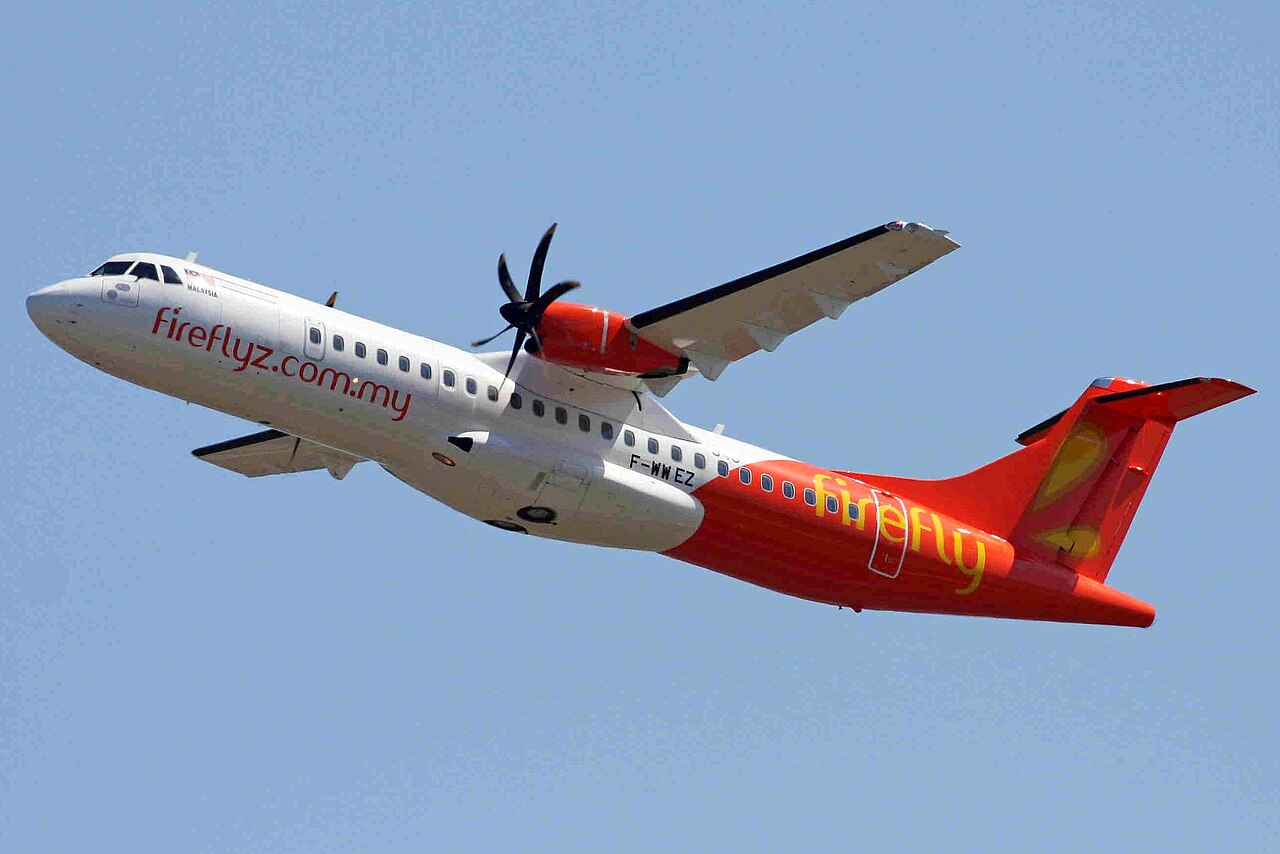
The ATR 72 is a twin-engine turboprop regional airliner developed jointly by the French and Italian aerospace industries under the ATR banner, stretched from the smaller ATR 42 to carry up to 78 passengers. In continuous production since 1988 and still the benchmark aircraft in its market segment, it combines short-field capability with low operating costs, making it a familiar sight on regional and island-hopping routes worldwide. For the simulator pilot it represents a classic high-wing, twin-turboprop regional type with a strong emphasis on efficiency and rugged short-runway operation.
The ATR 72 is a twin-engine turboprop, short-haul regional airliner developed and produced in France and Italy by the manufacturer ATR, a joint venture between French aerospace company Aérospatiale (now part of Airbus) and Italian aviation conglomerate Aeritalia (now Leonardo S.p.A.). Airbus SE continues to hold a 50 percent interest in ATR. The aircraft's typical standard seating capacity of 72 passengers gives the type its name, though configurations range from 44 to 78 seats. All ATR 72s are completed at the company's final assembly line in Toulouse, France, and the type shares a high degree of commonality with the smaller ATR 42, including the same fuselage cross-section and cockpit for cross-crew qualification. Beyond passenger service, the ATR 72 has also been used as a corporate transport, a cargo aircraft, and a maritime patrol aircraft.
ATR was established during the 1980s when Aérospatiale and Aeritalia merged their work on a new generation of regional aircraft, with their first airliner, the ATR 42-300, making its maiden flight on 16 August 1984. During the mid-1980s ATR sought a larger airliner with increased capacity, leading to the stretched ATR 72, which increased maximum seating from 48 to 78 passengers principally by lengthening the fuselage by 4.5 m (15 ft), enlarging the wingspan, fitting more powerful engines and increasing fuel capacity by around 10 percent. The stretched ATR 72 programme was launched on 15 January 1986, and the prototype made its first flight on 27 October 1988. The type received airworthiness certification from the French Directorate General for Civil Aviation on 25 September 1989, and Finnair became the launch operator on 27 October 1989. Because the ATR 72 is assembled on the same production line as the ATR 42 and shares most subsystems, components and manufacturing techniques, the two types have supported each other's continued production; by 2015 the ATR 42 was the only 50-seat regional aircraft still being manufactured. By 2000 the combined global ATR fleet had reached its ten-millionth flight, covering around 4 billion km and carrying about 450 million passengers. Organisational milestones included the launch of ATR's Asset Management Department in July 1998, a 2001 reinforcement of the partnership between EADS and Alenia Aeronautica regrouping regional airliner activities into the ATR consortium, ISO 9000-2000 and EN/AS/JISQ 9100 certification in October 2003, a 2004 co-operation agreement with Embraer on the AEROChain Portal, and the launch of a 'Door-2-Door' customer service option in April 2009. The current-generation ATR 72-600 was launched on 2 October 2007, and a 'green' technology demonstrator based on the -600 first flew on 8 July 2015 to test composite insulation materials and new air conditioning and electrical distribution systems as part of the European Clean Sky Joint Technology Initiative, in which ATR has participated since 2008. By the end of 2014 ATR had received 1,000 orders for the type and delivered 754, leaving a backlog of 246 aircraft; a record 113 new ATR aircraft were ordered in a single year in 2007. Total production of the ATR 72 series has reached around 1,233 aircraft.
The ATR 72 is a twin-turboprop regional airliner powered by Pratt & Whitney Canada PW100-series engines, with earlier models using the PW124B rated at 1,800 kW and later models the PW127 family rated up to a maximum of 2,050 kW for improved takeoff performance in high and hot conditions; the derivative ATR 72-210 used higher-power 2,750 SHP PW127 engines. The current ATR 72-600 is fitted with PW127M/N engines delivering 2,475 SHP take-off power, driving four- or six-bladed propellers supplied by Hamilton Standard. The standard aircraft does not carry an auxiliary power unit, though one can be installed in the C4 cargo section, and most operators fit a propeller brake to stop the propeller on the ground. The ATR 72-600 introduced a new glass cockpit alongside its updated engines and other minor improvements over the preceding -500 model. In its current form the ATR 72-600 has an overall length of 27.17 m (89 ft 1.5 in) and a wingspan of 27.05 m (88 ft 9 in). Maximum take-off weight is 23,000 kg (50,705 lb), maximum landing weight 22,350 kg (49,272 lb), maximum zero fuel weight 21,000 kg (46,296 lb), maximum payload 7,400 kg (16,313 lb) and maximum fuel load 5,000 kg (11,024 lb). Typical cabin layouts seat 72 passengers at 29 inch pitch or up to 78 at 28 inch pitch, and a combi configuration offers 44 seats plus 1,400 kg (3,086 lb) of additional cargo capacity.
With the aircraft at maximum take-off weight, ISA conditions and at sea level, the ATR 72-600 requires a take-off distance of 1,315 m (4,314 ft), while its landing distance at maximum landing weight and sea level is 915 m (3,002 ft). Maximum-passenger range is quoted at 740 NM (1,370 km / 851 mi). The type is noted for accessibility to challenging airfield profiles, including extreme temperatures, high altitudes, and short, narrow or unpaved runways, as well as steep approaches, reflecting its design for demanding regional operations. In-service dispatch reliability has been reported at largely exceeding 99 percent. ATR markets the -600 as the most fuel-efficient regional aircraft available, citing a fuel burn advantage that yields roughly $2 million in yearly operating cost savings per aircraft compared with competing regional jets, a 45 percent trip cost advantage and a 20 percent seat cost advantage, with operating costs on competing regional jets said to be at least 45 percent higher; CO2 emissions are quoted at 69 g per seat per km.
Early production comprised the ATR 72-200 series, with the ATR 72-210 derivative equipped with higher-power 2,750 SHP PW127 engines. This was followed by the ATR 72-500, itself succeeded by the current-generation ATR 72-600, launched on 2 October 2007 with improved PW127M engines, a new glass cockpit and reduced fuel burn and operating costs relative to the -500. A freighter derivative, the ATR 72-600F, has also been developed. A dedicated maritime patrol variant, the ATR 72MP, features Command, Control, Communications, Computers, Intelligence, Surveillance and Reconnaissance (C4ISR) capability built around the Airborne Tactical Observation and Surveillance (ATOS) mission system, together with an Identification Friend or Foe transponder, two INS/GPS inertial navigation systems and a tactical air navigation system, added to the advanced glass cockpit of the ATR 72-600; it is used for sea lane monitoring, fisheries protection, counter-smuggling and counter-drug operations, exclusive economic zone patrol and search and rescue. A further stretched development, provisionally designated ATR 52, was studied but not built.
Finnair was the launch operator of the ATR 72, introducing the type into revenue service on 27 October 1989. The aircraft has gone on to serve as the backbone of numerous regional carriers' fleets, with primary users including Wings Air, IndiGo, Azul Linhas Aéreas and Air New Zealand. Beyond scheduled passenger service, the ATR 72 has also been employed as a corporate transport, a cargo aircraft, and, in its ATR 72MP form, a maritime patrol platform performing surveillance, fisheries protection and search and rescue duties. In 2017 the unit cost of a new ATR 72-600 was around US$26 million.