Departure
94%
vs 95% ▼ 1
 MY FS FLIGHTS
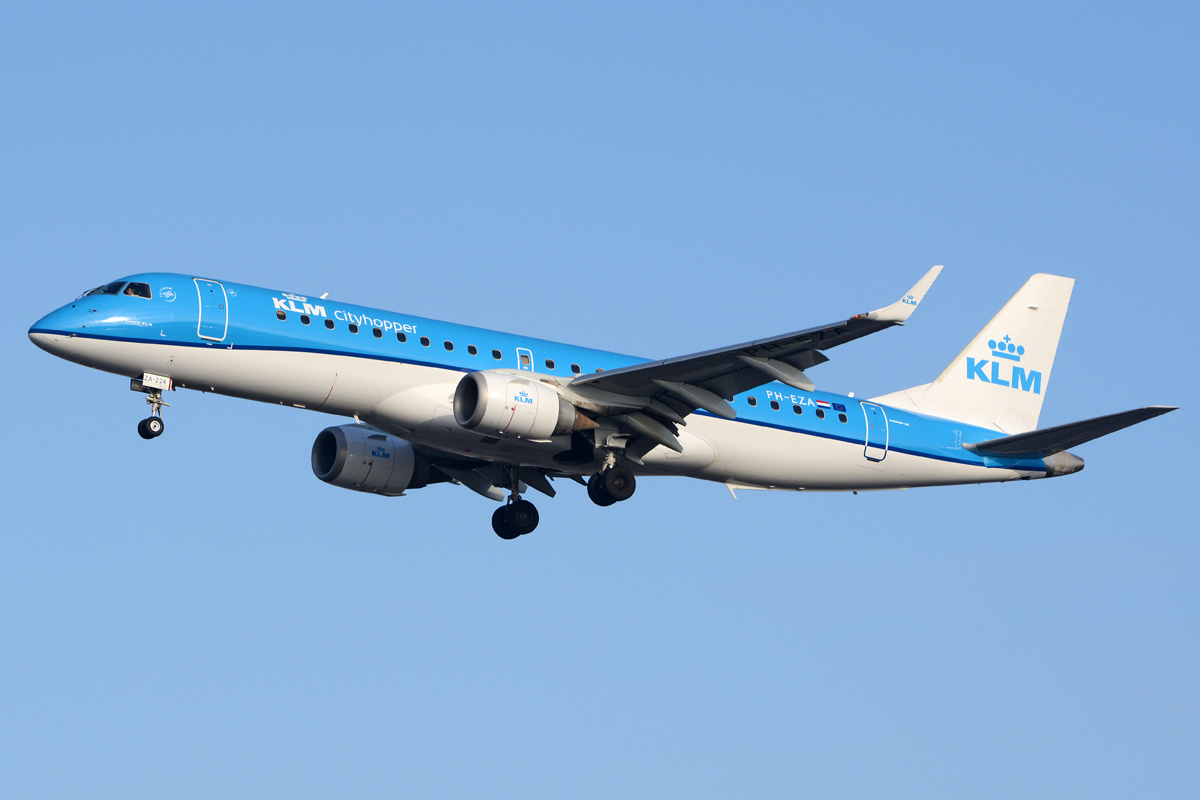
The Embraer 170 is a four-abreast, twin-engined regional jet built by the Brazilian manufacturer Embraer, and is the smallest and first member of the original E-Jet family. Designed to complement Embraer's earlier ERJ regional jets with a larger, more comfortable cabin, it became a mainstay for regional and mainline carriers flying short- to medium-range routes worldwide.
The Embraer 170 is a narrow-body, four-abreast regional jet powered by twin engines, produced by the Brazilian aerospace manufacturer Embraer as the smallest and first-flying member of the E-Jet family. It was conceived to sit above Embraer's earlier ERJ family, offering regional airlines a larger aircraft with more space and comfort while retaining the ability to serve lower-demand routes. The E170 established the platform from which the larger E175, E190 and E195 were derived, and it entered revenue service in March 2004.
During March 1997, Embraer first publicly disclosed that it was studying a new 70-seat aircraft, initially referred to as the EMB 170, announced concurrently with the development of the ERJ 135. As originally conceived, the EMB 170 was to feature a new wing and larger-diameter fuselage mated to the nose and cockpit of the ERJ 145, a derivative approach estimated to cost $450 million to develop. In February 1999 Embraer abandoned this derivative approach in favour of an all-new design. The E-Jet family was formally launched at the Paris Air Show on 14 June 1999, initially under the twin designations ERJ-170 and ERJ-190, later changed to Embraer 170 and Embraer 190. Launch customers for the airliner were the French airline Regional, which placed ten orders and five options for the E170, and the Swiss airline Crossair, which ordered 30 E170s and 30 E190s. Production of components for the prototype and test airframes began in July 2000, though difficulties with the advanced Honeywell avionics selected for the aircraft delayed the schedule from an originally planned 2000 first flight. The first prototype, registered PP-XJE, was rolled out at Sao Jose dos Campos, Brazil, on 29 October 2001, and made its maiden flight on 19 February 2002, beginning a multi-year flight test campaign involving six prototypes. Full-rate production commenced later in 2002 at a newly completed Embraer factory at Sao Jose dos Campos. Following delays in certification, the E170 received type certification from the civil aviation authorities of Brazil, Europe and the United States in February 2004. The first E170 was delivered to LOT Polish Airlines on 17 March 2004, marking its entry into revenue service. Kawasaki Heavy Industries participated in the aircraft's development as a risk-sharing partner, responsible for designing the centre section, the wing's leading and trailing edges, the flight control surfaces, and the engine pylon; Kawasaki continues to manufacture composite flight control surfaces and other components for the family. The E170 went out of production in 2017.
The E170 is the smallest aircraft in the E-Jet family, seating around 72 passengers in a typical single-class configuration, 66 in a dual-class layout, and up to 78 in a high-density arrangement. Versatile seating allows regional and mainline operators to configure the cabin with segregated premium sections and variable-pitch arrangements. All E-Jets, including the E170, are fitted with a central maintenance computer that collects fault reports, stores messages and assists troubleshooting to support efficient operations. The aircraft shares its basic architecture with the larger E175, which stretched the E170's fuselage by 1.78 metres.
The E170 forms the baseline of the E-Jet family, from which Embraer developed larger variants. Following a positive response from the airline community, Embraer launched the E175 by stretching the fuselage of the E170 by 1.78 metres, with the E175 making its first flight in June 2003 and entering service in mid-2005. The larger E190 and E195 followed later in 2004 as bigger derivatives of the same basic design, and the family also gave rise to the Embraer Lineage 1000 business jet. The E-Jet family was later succeeded by the second-generation E-Jet E2 family, featuring more fuel-efficient engines, though the first-generation E175 has remained in production to meet the needs of U.S. regional airlines operating under scope clause restrictions that limit the size of aircraft they may fly.
The E170 was the first E-Jet variant to enter revenue service, beginning operations in March 2004 with launch customer LOT Polish Airlines. It has been used by both mainline and regional airlines, with particular popularity among regional carriers, and has proven well suited to serving lower-demand routes while offering many of the amenities associated with larger jets. Other early operators and orderers included Regional and Crossair, the family's launch customers, as well as US Airways, which received early Embraer 170 deliveries. Passengers who have flown the type frequently describe a smooth, quiet cabin experience and brisk climb performance.