Departure
94%
vs 95% ▼ 1
 MY FS FLIGHTS
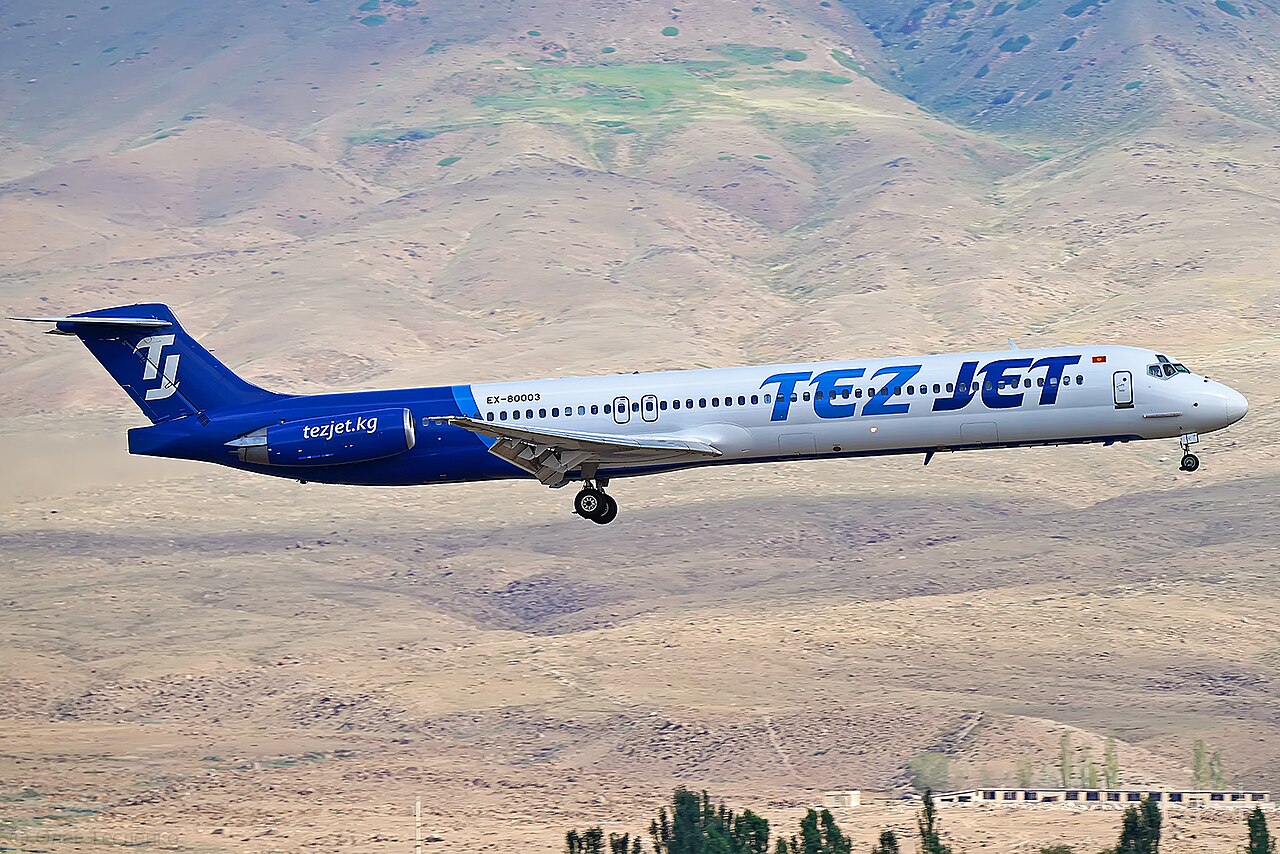
The McDonnell Douglas MD-88 was the final and most refined member of the MD-80 family, a stretched, re-engined derivative of the DC-9 developed by McDonnell Douglas and introduced with Delta Air Lines in January 1988. It combined the JT8D-219 turbofans and long fuselage of the MD-83 with a modern EFIS glass cockpit and a redesigned cabin, making it the most technologically advanced of the classic T-tailed DC-9 lineage and a long-serving domestic workhorse for Delta until 2020.
The MD-88 is a narrow-body, twin-engine, T-tailed jet airliner built by McDonnell Douglas as the last and most advanced variant of the MD-80 series, itself the second generation of the DC-9 family. It retains the five-abreast fuselage cross-section and rear-mounted engine layout of the DC-9 but is stretched and re-winged, and distinguishes itself from earlier MD-80s by its Electronic Flight Instrument System (EFIS) cockpit with cathode ray tube displays rather than the conventional analogue flight deck of the MD-81, MD-82 and MD-83. It served principally as a short-to-medium-haul domestic airliner, with Delta Air Lines as its largest and most enduring operator.
The MD-80 series originated in the 1970s as McDonnell Douglas began developing a stretched, higher-weight derivative of the DC-9-50 fitted with a larger wing, new main landing gear and higher-bypass Pratt & Whitney JT8D-200 series engines. Early studies under names such as Series 55, Series 50 and Series 60 converged on a design designated the Series 80, launched in October 1977 with Swissair as launch customer. The Series 80 family made its first flight on October 18, 1979, and was certified on August 25, 1980, entering service with Swissair on October 10, 1980. After production of the original DC-9 ended in late 1982, McDonnell Douglas adopted the MD-80 designation for the family in July 1983, though aircraft continued to be certificated under DC-9-prefixed type certificates apart from the MD-88, which was the only variant officially certified under the MD designation. The MD-88 itself was announced on January 23, 1986, and made its first flight on August 15, 1987. It received FAA type certification on December 8, 1987, and the first aircraft was delivered to Delta Air Lines on December 19, 1987, entering service on January 5, 1988. The first eight Delta aircraft were originally built as MD-82s before being brought up to MD-88 specification. Production of the type continued until the last delivery, to Onur Air of Turkey, on June 25, 1997. The wider MD-80 program passed from McDonnell Douglas to Boeing Commercial Airplanes following the 1997 merger, and overall MD-80 series production ended in 1999 after 1,191 aircraft had been built, including 150 MD-88s.
The MD-88 shares the basic five-abreast, narrow-body fuselage cross-section of the DC-9 family but is considerably stretched, with an external length of 147 ft 10 in (45.06 m) and a fuselage length some 4.62 m longer than the DC-9-50. It has a wingspan of 107 ft 8 in to 107 ft 10 in (32.82 to 32.87 m), a wing area of 112.3 sq m (1,209 sq ft), a tail height of 29 ft 7 in (9.02 m) and a fuselage diameter of 10 ft 11 in (3.34 m). The cabin measures 101 ft (30.78 m) in length, 10 ft 4 in (3.14 m) in width and 6 ft 9 in (2.05 m) in height, with coach-cabin aisles a relatively wide 22 inches. The aircraft rides on tricycle landing gear with a wheelbase of 22.05 m, chosen in part to improve ground visibility. Power is provided by two rear fuselage-mounted Pratt & Whitney JT8D-219 turbofans (described generically as JT8D-200 series), each rated at around 21,000 lbf (93 kN) thrust. Operating empty weight is quoted at 35,369 kg (77,976 lb), with a maximum take-off weight of around 149,500 lb (67,810 kg) to 160,000 lb (72,500 kg) depending on source and configuration, and a maximum landing weight of about 130,000 lb (59,000 kg). Maximum payload is 36,600 lb (16,600 kg) and fuel capacity is 7,000 US gallons (26,500 litres). Notable design features specific to the MD-88 include its EFIS glass cockpit with CRT displays, a Traffic Collision Avoidance System, an airborne wind shear warning system, and a modernised cabin interior compared with earlier MD-80 variants. All MD-80 aircraft, including the MD-88, are fitted with an AlliedSignal (Garrett) GTCP85-98D auxiliary power unit.
The MD-88 has a maximum cruise speed of about 472 kt (543 mph, 874 km/h) and a maximum operating speed figure quoted elsewhere at up to 500 kt (925 km/h) for the family, with a long-range cruise speed around 440 kt (813 km/h). Approach speed is around 130 kt (150 mph, 241 km/h). Service ceiling is 37,000 ft (11,300 m), and rate of climb is quoted at 2,700 ft/min (14 m/s). Take-off distance is approximately 7,850 ft (2,400 m) and landing distance approximately 5,200 ft (1,590 m). Range figures vary with payload and fuel configuration: a typical range with 155 passengers and reserves is quoted at around 2,050 to 2,897 km (1,564 nmi) depending on fit, extending to about 2,504 to 2,550 nmi (4,720 km) with auxiliary fuel tanks fitted, while Delta's operational figures cite a shorter typical range of around 1,800 statute miles reflecting domestic use.
The MD-88 was the final and most advanced variant of the MD-80 series, which also comprised the MD-81 (the initial production version with JT8D-209 engines), the MD-82 (fitted with more powerful JT8D-217 engines), the extended-range MD-83 (with extra fuel capacity and more efficient JT8D-219 engines), and the shorter MD-87 (17 ft shorter than the larger variants, seating around 130 passengers with a range up to 2,900 nmi). The MD-88 combined the JT8D-219 engines of the MD-83 with the modern EFIS cockpit and redesigned cabin, distinguishing it from the analogue-instrumented flight decks of the MD-81 through MD-83. Of the 1,191 total MD-80 series aircraft built, 150 were MD-88s, alongside 132 MD-81s, 569 MD-82s, 265 MD-83s and 75 MD-87s. The MD-80 series was itself succeeded by the further-stretched MD-90, powered by IAE V2500 high-bypass turbofans and featuring a similar EFIS cockpit to the MD-88, and by the shorter MD-95, later renamed the Boeing 717.
The MD-88 entered airline service with launch operator Delta Air Lines on January 5, 1988, and Delta went on to become by far its largest operator, using the type extensively across its domestic network for more than three decades. Delta's MD-88s, together with its MD-90s, carried more than 750 million passengers over their operating lifespan before the airline retired both types on June 2, 2020, an accelerated retirement driven by the reduction in capacity during the COVID-19 pandemic. Other operators of the type have included LASER Airlines and World Atlantic Airlines. The type suffered a serious incident on July 6, 1996, when Delta Air Lines Flight 1288 experienced an uncontained, catastrophic turbine engine failure during an attempted take-off from Runway 17 at Pensacola Regional Airport, Florida.
For simulator pilots, the MD-88 represents the most modern cockpit environment within the classic DC-9-derived MD-80 family, thanks to its EFIS displays with CRT presentation in place of the analogue instrumentation found in the earlier MD-81, MD-82 and MD-83. Its T-tail, rear-mounted twin JT8D-219 engines and relatively wide coach-cabin aisles are characteristic of the type, and its status as Delta Air Lines' long-serving