Departure
95%
vs 95%
 MY FS FLIGHTS
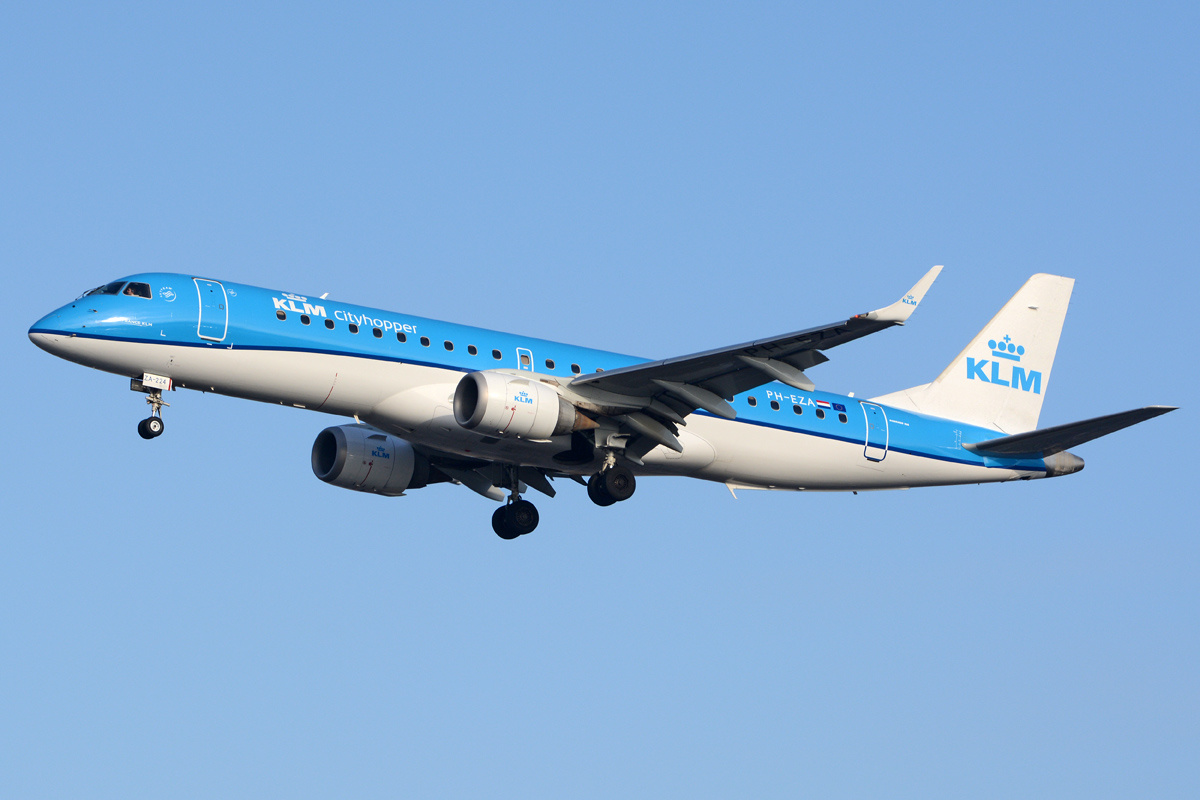
The Embraer E190 is a Brazilian-built narrow-body, twin-engine jet airliner that bridges the gap between regional and mainline aircraft, offering one of the most spacious single-aisle cabins in its class. Developed by Embraer as a stretched member of the E-Jet family, it combines regional-jet economics with mainline-style comfort and range, making it a familiar sight with carriers such as JetBlue, KLM CityHopper and BA CityFlyer. For a simulator pilot it represents a modern, twin-engine short-to-medium haul jet with a straightforward, mainline-style operating profile.
The Embraer E190 is a narrow-body, twin-engine jet aircraft manufactured by Embraer, the Brazilian aerospace company. It forms part of the E-Jet family and was conceived to fill a gap in the market for a regional aircraft with mainline capabilities. Unlike the smaller E170 and E175, the E190 (along with the larger E195) is flown on mainline routes rather than purely regional ones, and is often fitted with dedicated business-class cabins so that operators can compete directly with routes flown by larger Airbus and Boeing types.
The E190 is a stretched version of the earlier E170/E175 series. It made its first flight in March 2004, with JetBlue receiving the first delivery in 2005. The wider E-Jet programme from which it descends was formally launched at the 1999 Paris Air Show, and the first-generation E170 entered revenue service in July 2004. Embraer, founded on 19 August 1969 in Sao Jose dos Campos, Brazil, has gone on to deliver more than 8,000 aircraft and ranks as the world's third-largest manufacturer of civil airliners specialising in jets seating up to approximately 150 passengers. Building on the commercial success of the original E190, Embraer later launched the next-generation E-Jet E2 family at the June 2013 Paris Air Show, a programme representing an investment of approximately USD 1.7 billion and comprising the E175-E2, E190-E2 and E195-E2, sharing a common fuselage cross-section with the original E-Jets but differing in length, wing design and thrust rating.
The E190 has a fuselage length of 36.2 metres, a tail height of 10.6 metres and a wingspan of 28.7 metres. Maximum take-off weight is 110,900 lb. It is powered by two General Electric CF34-10E turbofans. Embraer designed the aircraft with the lowest possible operating weight so that airlines could carry more revenue-generating passengers, and it retains the E-Jet family's characteristic spacious single-aisle interior with a 2-2 abreast cabin cross-section.
The E190 has a maximum range of 2,400 nautical miles and a maximum operating speed of Mach 0.82. In its highest-density layout it can seat up to 114 passengers, though a more typical operator configuration carries around 94.
The E190 sits within the broader E-Jet family alongside the smaller E170 and E175, which are flown on regional rather than mainline routes, and the larger E195. Embraer subsequently developed the E-Jet E2 generation, including the E190-E2, which shares the same fuselage cross-section as the original E190 but differs in wing design and engine thrust rating as part of a programme aimed at improved fuel efficiency.
Primary operators of the E190 have included JetBlue, KLM CityHopper, BA CityFlyer and Air Canada. The type is also flown by Kenya Airways and, in Australia, forms part of the QantasLink fleet, operated on Qantas's behalf by Alliance Airlines on selected domestic and international routes with a 2-2 economy cabin and dedicated business seating. Its combination of mainline-style cabin comfort and regional-jet economics has allowed operators to deploy it on routes that might otherwise be served by larger narrow-body Airbus or Boeing aircraft.