Departure
90%
vs 95% ▼ 5
 MY FS FLIGHTS
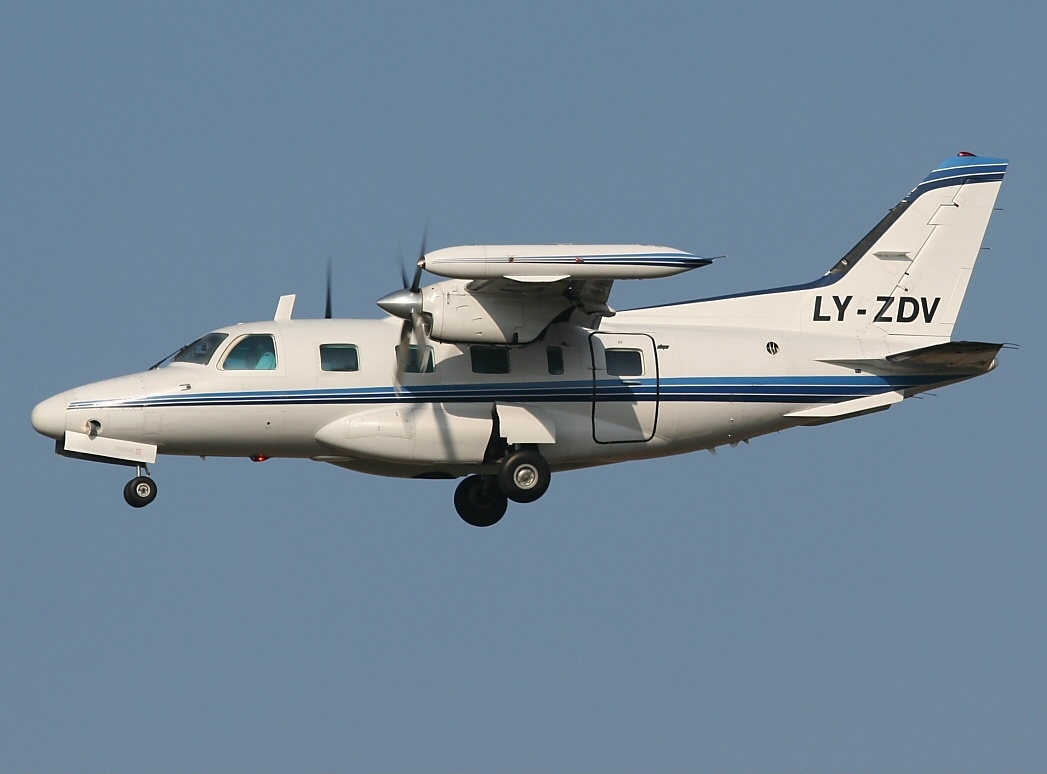
The Mitsubishi MU-2 is a Japanese high-wing, twin-turboprop, pressurised utility transport designed and built by Mitsubishi Heavy Industries from 1963 to 1986. It was Mitsubishi's first postwar aircraft design and became one of Japan's most successful commercial aircraft types, prized for combining a high cruise speed with a remarkably low landing speed through its unusual spoiler-and-full-span-flap wing. For a simulator pilot it offers a distinctive, performance-oriented turboprop experience quite unlike conventional aileron-equipped twins of its era.
The MU-2 is a high-wing, twin-engined turboprop with a pressurized cabin, manufactured by Mitsubishi Heavy Industries as the company's first indigenous postwar aircraft design. Conceived as a light twin turboprop transport suitable for a variety of civil and military roles, it was built between 1963 and 1986, with 704 examples produced in Japan and at San Angelo, Texas, in the United States. It is regarded as one of postwar Japan's most successful aircraft types and became, according to Mitsubishi Heavy Industries, Japan's first business aircraft.
Work on the MU-2 began in 1956, and the prototype first flew on 14 September 1963. The first aircraft and the three MU-2As built were powered by the Turbomeca Astazou turboprop, before production switched to Garrett-powered variants certified under the MU-2B type designation, each given a marketing suffix letter. In 1963 Mitsubishi granted Mooney Aircraft rights in North America to assemble, sell and support the MU-2, and in 1965 Mooney established an assembly facility at its new factory in San Angelo, Texas, where major components shipped from Japan were fitted with engines, avionics and interiors before flight test and delivery. By 1968 the San Angelo line was turning out four aircraft a month, with production barely keeping pace with sales, but Mooney Aircraft filed for bankruptcy in late 1969. On 14 May 1970 Mitsubishi Heavy Industries terminated the contract with Mooney and organised Mitsubishi Aircraft International, Inc. to take over the San Angelo facility, which became the sole source of MU-2 production until the line closed in 1986. The last Japanese-built aircraft was completed in January 1987. The type made its US debut as a static display at the 1964 World's Fair in New York City.
The MU-2's defining design feature is its use of over-wing spoilers instead of conventional ailerons for roll control, which allowed the use of full-span, double-slotted flaps across the entire trailing edge of the wing. This arrangement gives the aircraft a wing loading in landing configuration comparable to a Beechcraft King Air, while its wing loading in cruise is comparable to that of a light jet. The spoilers remain highly effective even when the wing is stalled, and the absence of ailerons eliminates adverse yaw. The MU-2B, the definitive production standard, had a wingspan of 11.94 m (39 ft 2 in), a length of 10.13 m (33 ft 3 in), a height of 3.94 m (12 ft 11 in) and a wing area of 16.5 sq m (178 sq ft); the stretched Marquise variant shared the same wingspan but measured 12.01 m (39 ft 5 in) in length and 4.17 m (13 ft 8 in) in height. Civil aircraft were powered by Garrett (later Honeywell) TPE331 turboprops, with power progressively increased through the production run; late short-fuselage Solitaire models used 496 kW (665 shp) TPE331-10-501M engines, while the stretched Marquise and the Solitaire's contemporaries used 533 kW (715 shp) TPE331 engines. Flightcrew comprised one or two pilots, with typical main-cabin seating for seven in short-fuselage models and up to eleven in the longer-fuselage variants; many aircraft were fitted out in various corporate configurations or used as freighters.
The MU-2's combination of over-wing spoilers and full-span flaps gives it a high cruise speed alongside a low landing speed, an unusual pairing that set it apart from contemporaries when it entered the American general aviation market in the late 1960s. At the time, the Beechcraft King Air 90 could not match the speed of the newer Japanese design, and the type has been described by pilots as offering addictive performance. Despite its capability, the MU-2's maximum takeoff weight is below 12,500 pounds, the threshold below which a type rating is not mandated in the United States, though Mitsubishi repeatedly petitioned the FAA to require one. Following accident concerns, an NTSB-recommended Special Certification Review of the design was conducted in 1983 and the aircraft came out of it with a clean bill of health.
Civil MU-2s were certified under the MU-2B type designation followed by a model number, with each variant given a separate marketing suffix letter; for example the MU-2B-10 was sold as the MU-2D, and the MU-2B-36A was marketed as the MU-2N. Thirty-four MU-2Bs were built, followed by 18 examples of the similar MU-2D. The Japanese armed forces purchased four unpressurized MU-2Cs and 16 search-and-rescue MU-2E variants, and 95 examples of the upgraded MU-2F, with slightly more powerful TPE331 engines, were sold. Beginning with the MU-2G, first flown on 10 January 1969, the fuselage was stretched by 1.91 m (6 ft 3 in) over earlier models; 46 MU-2Gs were built before being succeeded by the more powerful MU-2J, of which 108 were constructed. The MU-2L, a higher-gross-weight variant, saw 29 built, followed by the MU-2N with uprated engines and four-blade propellers, of which 39 were produced; the final stretched-fuselage model, the Marquise, used 533 kW (715 shp) TPE331 engines. Among short-fuselage models, the MU-2M, of which only 28 were built, is regarded as the toughest and most desired short-body MU-2, especially with a -10 engine conversion; it shared its engines with the MU-2K and the stretched MU-2J and had cabin pressurization increased to 6.0 psi. It was followed by the MU-2P with newer four-blade propellers, and the final short-fuselage production aircraft were the Solitaires, fitted with 496 kW (665 shp) TPE331-10-501M engines. Military variants included the MU-2S, a Japan Air Self-Defense Force search-and-rescue version of the MU-2E fitted with a thimble nose radome, increased fuel capacity, bulged observation windows and a sliding door for dropping rafts.
The Japan Self-Defense Forces are the only military operators to have flown the MU-2 in front-line service. The Japan Ground Self-Defense Force operated the four MU-2C aircraft built plus 16 MU-2Ks under the designation LR-1 as liaison and photo-reconnaissance aircraft, retiring them in 2016, with several preserved as gate guardians at JGSDF bases. The Japan Air Self-Defense Force purchased 29 MU-2Es as search-and-rescue aircraft designated MU-2S, replacing them in 2008 with the British Aerospace U-125A; some examples have been preserved. Four civilian MU-2s were used by the Argentine Air Force during the Falklands War, flown unarmed by the Escuadron Fenix in pathfinder, reconnaissance and communications-relay roles, including as guide aircraft for IA-58 Pucara replacements after losses on the raid on Pebble Island. In late 2009 the Royal New Zealand Air Force took delivery of four Mitsubishi MU-2F aircraft from the United States for use as training aids, known in New Zealand service as the Mitsubishi MU-2 Sumo. In civil use the type has served widely in corporate and utility roles, including as a medevac aircraft, such as with Thunder Airlines of Thunder Bay, Canada, and has been deployed in over 70 countries. Despite being out of production since 1986, the MU-2 fleet continues to benefit from strong factory support from Mitsubishi Heavy Industries America, which maintains a parts stock, can manufacture parts not held in stock, and works with authorized service centers and training providers to support ongoing operations under the mandatory common training and checklist requirements of SFAR 108.