Departure
89%
vs 95% ▼ 6
 MY FS FLIGHTS
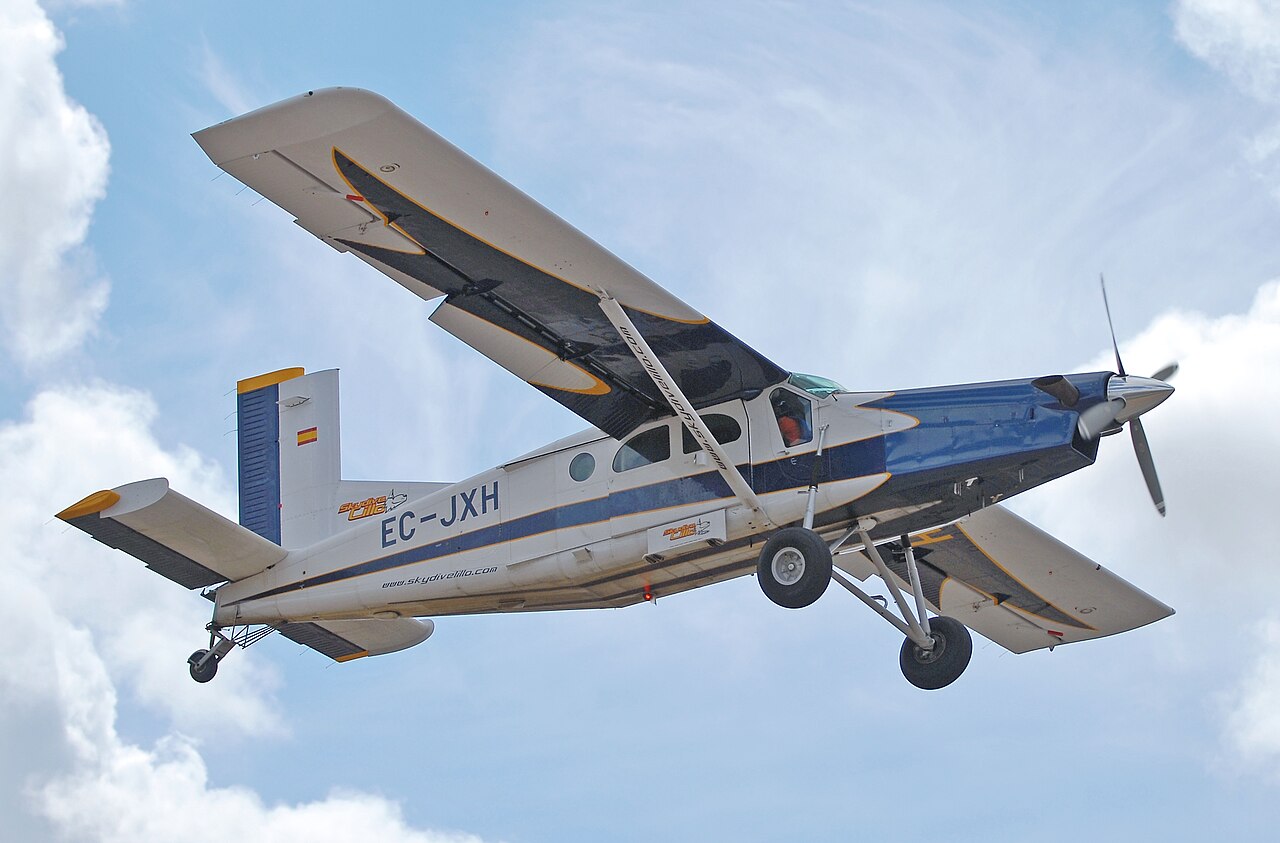
The Pilatus PC-6 Porter is a Swiss-built single-engined STOL utility aircraft designed by Pilatus Aircraft, first flown in 1959 and produced for over six decades in both piston and turboprop forms. Renowned for its rugged short-field performance from rough, unprepared strips, it has served civil operators and military air arms worldwide in roles ranging from bush flying and skydiving to survey and light transport, making it a benchmark type for STOL flying.
The Pilatus PC-6 Porter is a single-engined Short Takeoff and Landing (STOL) utility aircraft designed and built by Pilatus Aircraft of Switzerland at its Stans factory. It is a high-wing, shoulder-wing monoplane with fixed tailwheel undercarriage, built to operate passengers and cargo into and out of short, rough or unprepared airstrips, and has been produced in piston-engined and turboprop-powered forms across a production run from 1959 to 2022. It was also manufactured under licence in the United States by Fairchild Hiller, which adapted a military version for service during the Vietnam War.
The first PC-6 Porter prototype, powered by a 254 kW (340 shp) piston engine, made its maiden flight on 4 May 1959. In early May 1961 the first Turbo Porter, fitted with a Turbomeca Astazou II turboprop, flew for the first time; the turbine version offered greater gross capacity and higher top speed than the piston original, along with the benefits of the engine's automatic handling functions, though at higher purchase cost and fuel consumption. Its unit cost in 1962 was 55,000 dollars. Reliability complaints about the Astazou II led some operators, including Air America, to retrofit their aircraft with the Garrett AiResearch TPE331 engine instead. In May 1966 the first PC-6 fitted with the Pratt & Whitney Canada PT6A engine made its first flight, and this powerplant went on to power the majority of production aircraft. To manage rising Swiss labour and manufacturing costs, Pilatus dispersed production work internationally: from 1993 the Czech firm Letov Kbely undertook manufacturing on the type, and in 2013 Pilatus formed a joint venture with Beijing Tian Xing Jian Yu Science Co., Ltd. to build the PC-6 and the newer PC-12 in Chongqing, China, initially performing fuselage subassembly before adding wing and control-surface work; the first Chinese-assembled fuselage was completed on 11 December 2014, and in that year most PC-6 deliveries went to Chinese customers. By April 2016 around 20 PC-6s were operating in China, often replacing the Antonov An-2 owing to lower operating costs. Its unit cost had risen to 1,900,000 dollars by 2010. Fairchild Hiller built roughly 100 PC-6s under licence in the United States, mostly for civil customers, though a number were procured for military use during the Vietnam War as the AU-23A Peacemaker for the US Air Force, armed with a side-firing 20mm XM-197 Gatling cannon, four wing pylons and a centre fuselage ordnance station; the type proved troublesome in service and all examples were withdrawn to the continental United States after a single year of operation. In 1979 a pair of UV-20s were assigned to the Berlin Brigade's aviation detachment in Germany, valued for their suitability in restricted airspace and fitted out for cargo, up to eleven passengers, or three litters with four medical attendants. Pilatus announced it would close the PC-6 orderbook from summer 2018 after nearly 600 deliveries over six decades, including about 90 Fairchild-Hiller-built examples and 425 PT6-powered aircraft, with only 52 delivered in the preceding ten years, planning to roll off the last aircraft in early 2019 while continuing parts production for at least 20 years. Pandemic-related delays pushed the final delivery to December 2022, by which point 604 aircraft had been produced across 63 years of manufacture.
The PC-6 is a high-wing STOL utility aircraft with fixed tailwheel undercarriage, the undercarriage design giving high wing and propeller ground clearance and making it less prone to damage than conventional nosewheel types when operating from rough surfaces. The majority of aircraft are powered by a single Pratt & Whitney Canada PT6A turboprop driving a fully reversible, constant-speed, three-bladed Hartzell HC-B3TN-3D propeller (or an alternative four-bladed HC-D4N-3P) through a reduction gearbox. Early turbine models used the Turbomeca Astazou II, and the PC6/C variant used a 310 kW (575 shp) AiResearch TPE331; smaller numbers of piston-powered Porters were built with Lycoming GSO480 and IGO540 engines alongside the Turbo Porters. A commonly quoted powerplant for later production PC6/B2 variants is the Pratt & Whitney Canada PT6A-27, rated at 410 kW (550 hp) but de-rated from 507 kW (680 hp). The aircraft can be fitted with optional undercarriage types including floats for water operations and skis for snow landings, adding to its versatility across terrain and climate. Pilatus states that the PC-6 can provide surveillance and access capabilities similar to a rotorcraft at significantly lower procurement and operating cost.
The PC-6 Porter is defined above all by its Short Takeoff and Landing capability, requiring only a very short takeoff run before rotation. It is fully capable of operating from unprepared, rough airstrips in remote areas, hot climates and at high altitude, and in all-weather conditions. The turboprop-powered Turbo Porter offered increased gross capacity and higher top speed compared with the original piston-engined version, along with more consistent handling thanks to the turbine's automatic engine management functions, though this came with higher fuel consumption than the piston model.
The initial PC-6 was piston-engined, powered by a 254 kW (340 shp) engine, with some later piston Porters built using Lycoming GSO480 and IGO540 engines. The PC6/A Turbo Porter, first flown in May 1961, was powered by a 390 kW (523 shp) Turbomeca Astazou II turboprop. The majority of production shifted to the PC6/B family powered by the Pratt & Whitney Canada PT6A, following the type's first flight with that engine in May 1966. The PC6/C used a 310 kW (575 shp) AiResearch TPE331 turboprop and was first delivered in 1965. The PC6/B2H2, first flown in 1970, introduced the PT6A-27 engine and an increased maximum takeoff weight. Current-generation production settled on the PC6/B2-H4, featuring a further increase in maximum takeoff weight, a larger dorsal fin fillet, revised wingtips, strengthened airframe structure and improved undercarriage. In the United States, Fairchild Hiller built roughly 100 licensed PC-6s, including the militarised AU-23A Peacemaker gunship variant used briefly by the US Air Force during the Vietnam War, and the UV-20 utility variant used by the US Army's Berlin Brigade aviation detachment.
The PC-6 Porter has served extensively in civil aviation for roles including bush and remote-area transport, aerial survey, and parachute operations, and remains a favoured platform for skydiving due to its STOL performance and cabin capacity. Military and government users have included the Austrian Air Force, the Myanmar Air Force and the Swiss Air Force among its primary operators. During the Vietnam War, Fairchild-Hiller-built AU-23A Peacemakers were operated briefly by the US Air Force before being withdrawn from service after a single year of operation. The US Army's Berlin Brigade operated a pair of UV-20 Porters from 1979 in Germany, valued for their ability to operate within heavily restricted airspace while carrying cargo, up to eleven passengers, or litters with medical attendants. In China, the PC-6 has been adopted as a replacement for the Antonov An-2 owing to its lower operating costs, with around 20 aircraft in operation there by 2016. A PC-6/B2H2 Turbo-Porter also appeared in the opening scene of the 1995 James Bond film GoldenEye.
For a simulator pilot, the PC-6 Porter's appeal lies entirely in its STOL character: a very short takeoff roll, the ability to get in and out of rough, unprepared strips, and the reassurance of a fixed tailwheel undercarriage designed for rugged use rather than smooth runways. The turboprop-powered Turbo Porter variants, with their fully reversible, constant-speed propeller and automatic engine handling, would be expected to feel notably more forgiving and capable than the earlier piston versions, at the cost of higher fuel burn. Its enduring association with skydiving operations and remote bush flying makes it a natural choice for pilots wanting to practise short-field technique and operations into demanding, unimproved airstrips.