Departure
95%
vs 95%
 MY FS FLIGHTS
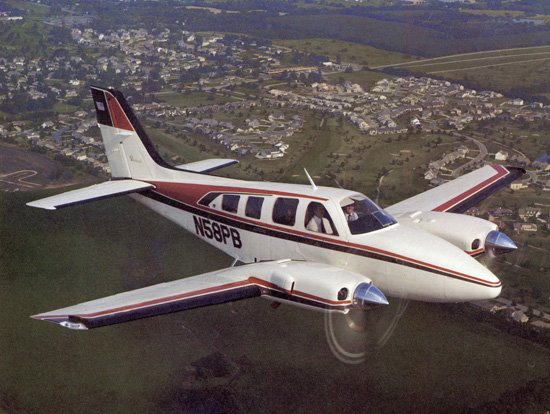
The Beechcraft Baron 55 is a light, twin-engined piston aircraft introduced by Beechcraft in 1961 as a true twin-engined derivative of the Bonanza, built around the Travel Air's fuselage with a Debonair tail. Known to owners as the 'baby Baron', it earned a reputation for sturdy build quality and satisfying handling that became a hallmark of the wider Baron line, making it a durable choice for pilots wanting genuine twin-engine performance in a compact airframe. Produced from 1961 to 1983 with 3,651 examples built, it remains a popular used-market twin among piston pilots today.
The Baron 55 is the original short-body member of the Beechcraft Baron family, a low-wing, twin-engined piston monoplane developed directly from the Beechcraft Travel Air. It was Beechcraft's first true twin-engined variant of the Bonanza lineage, combining the Travel Air's fuselage with the fully-swept vertical tail of the Debonair and streamlined engine nacelles housing six-cylinder engines. Marketed as a four to six-seat civil utility aircraft, it competed directly with the Piper Aztec and Cessna 310 in the early 1960s light-twin market.
The Baron's direct predecessor was the Beechcraft 95 Travel Air, which itself combined the Bonanza fuselage with tail control surfaces borrowed from the T-34 Mentor military trainer. To create the Baron, Beechcraft replaced the Travel Air's tail with that of the Debonair, streamlined the engine nacelles, fitted six-cylinder engines and renamed the aircraft. This response to competition came as the Piper Aztec was introduced in 1960 with two 250 hp Lycoming O-540 engines and Cessna improved its 310 with 260 hp Continental IO-470-D engines, while Beechcraft's own Bonanza had gained a Continental IO-470-N. The first model, designated the 95-55, was introduced in 1961 powered by two 260 hp Continental IO-470-L six-cylinder engines and was priced at $58,250. The type underwent continuous refinement through the 1960s and 1970s, with the model 55 line running from 1961 to 1983, during which time 3,651 aircraft were manufactured.
The Baron 55 is a low-wing twin with retractable gear, retaining the four to five-place seating layout of the Travel Air while adopting the fully-swept vertical stabiliser of the Debonair. Early variants, the 95-55, 95-A55 and 95-B55, were powered by two 260 hp Continental IO-470-L six-cylinder piston engines turning at 2,625 rpm, with gross weights ranging from 4,880 to 5,100 lb, and fuel tanks of either 116 or 136 US gallons. Later variants, the C55, D55 and E55, moved to more powerful 285 hp Continental IO-520 engines, which pushed gross weight up to 5,300 lb; the forward fuselage on these models was lengthened by 12 inches to increase baggage capacity, and fuel tankage options grew to 136, 142 or 166 US gallons, with a 172 US gallon (166 usable) interconnected tank option introduced in 1976. The D55 introduced a 'speed-slope' windshield, three-blade propellers and a revised flap configuration, while the C55 addressed a crack-prone engine air intake box design and switched from belt-driven to gear-driven alternators. Standard seating was four occupants in two rows, with a third-row fifth seat optional from the outset and a sixth seat becoming optional on the A55; however, the lack of a rear passenger door or a pass-through to the second row makes access to the rearmost seats awkward, and the tapering rear fuselage leaves little room for adult passengers there. Loading all six seats without nose baggage to counterbalance tends to push the aircraft beyond its aft centre-of-gravity limit, so many owners remove the third-row seats and use that space for extra baggage instead. The cockpit and cabin offer adjustable rudder pedals, a retractable centre armrest and generous headroom, with trim controls provided for elevator, rudder and ailerons.
The early 260 hp Baron 55 variants (55, A55 and B55) offered a typical cruise speed of 190 knots at 7,000 feet. The later 285 hp variants (C55, D55 and E55), fitted with Continental IO-520 engines, raised cruise speed to around 200 knots. Aviation Consumer notes that the Baron 55 shares the sturdy feel, solid build and satisfying handling associated with the wider Beechcraft range, though the same responsive handling that pilots find pleasant in good conditions can become demanding in poor weather or turbulent air.
The Baron 55 was produced in a succession of sub-variants across its 1961-1983 production run, all short-body types sharing the ICAO designator BE55. The 95-55, introduced in 1961 with two 260 hp Continental IO-470-L engines, was the original model, with 190 units built at a price of $58,250. The 95-A55, built 1962-1963, brought a new instrument panel, interior and exterior paint scheme at $58,950, with 309 built. The 95-B55, introduced in 1964 and produced through 1982, added a 120 lb increase in gross weight to 5,100 lb along with a new exterior scheme and interior design; priced from $59,950 in 1964 to $177,500 by 1982, it was the highest-volume sub-type with 1,951 built and ultimately accounted for about half of all model 55 sales. The 95-C55, built 1966-1967, switched to two 285 hp Continental IO-520-C engines for improved performance, lengthened the nose for baggage and weight-and-balance purposes, fixed a crack-prone air intake box and changed to gear-driven alternators; 451 were built, priced at $68,350 in 1966. This model was also built for the Brazilian Air Force under the designation C-55. The D55, built 1968-1969, introduced a new paint scheme, a 'speed-slope' windshield, three-blade propellers and a revised flap configuration, with 316 built at $73,950. The E55, introduced in 1970 and produced through 1982, brought a further new paint scheme and interior, improved avionics and panel, flush wing-tip lights and rotating beacon, a new entrance step, and from 1976 an optional 172 US gallon interconnected fuel tank arrangement; 434 were built, priced from $83,950 in 1970 to $219,500 in 1982.
The Baron 55 served primarily as a civil utility and light transport aircraft for private and business owners. Military and government operators included the Brazilian Air Force, which used the type under the designation C-55, and the Argentine Army, which operated one Baron 55 (alongside a Baron 58) until it was retired in 1983. In civilian hands the type has remained popular on the used market, where it is affectionately known as the 'baby Baron', valued for its combination of genuine twin-engine performance with a relatively compact and affordable airframe compared with the later long-body Baron 58.
Pilots consistently describe the Baron 55 as embodying the sturdy feel, solid build and satisfying handling long associated with Beechcraft light aircraft, traits that carried through the entire Baron series. That same responsiveness, prized in calm conditions, can turn into a handful in poor weather or turbulent air, so the type rewards a pilot who respects its limits. Its awkward rear-cabin access and centre-of-gravity sensitivity with all seats filled are worth bearing in mind when planning loads, and the older instrument panels and vintage autopilots typical of early-production airframes are a reminder of the type's early-1960s origins even as later variants gained improved avionics and higher-output engines.