Departure
95%
vs 95%
 MY FS FLIGHTS
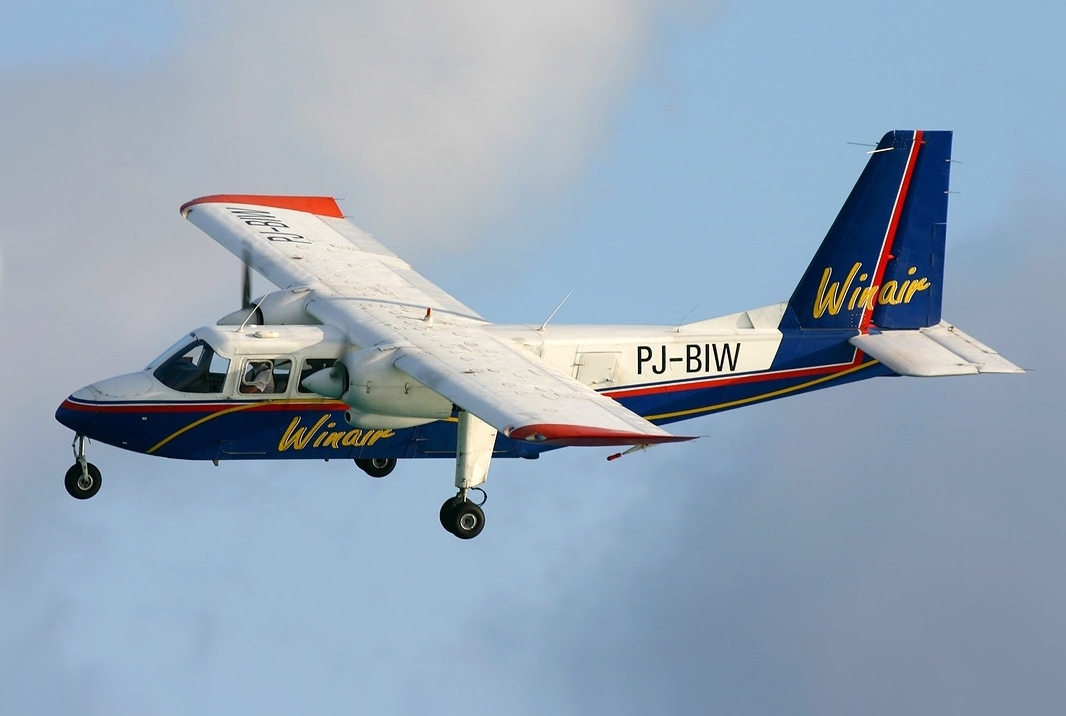
The Britten-Norman BN2P Islander is the piston-engined member of the long-running BN-2 Islander family, a rugged British twin-engine STOL utility aircraft and regional airliner built by Britten-Norman since the 1960s. Designed to prioritise payload over range or speed, it has become one of the best-selling commercial aircraft types produced in Europe and remains in production today, making it a familiar sight on island-hopping and short-field routes worldwide.
The Islander is a British twin-engine light utility aircraft and regional airliner designed and originally manufactured by Britten-Norman of the United Kingdom. The piston-powered version, distinguished in service records from the turboprop BN2T model, is a straightforward, high-wing, fixed-gear twin built for durability, easy maintenance and strong field performance rather than outright speed. It is a twin-engined ten-seat light utility aircraft and commuter airliner, and remains one of Europe's best-selling commercial aircraft designs, with over 750 examples still in service with commercial operators around the world and more than 30 military operators also flying variants of the type.
Britten-Norman was formed in 1953 to convert and operate agricultural aircraft, and in 1963 the firm began development of what would become the Islander, sensing demand for a simple, inexpensive twin-piston aircraft among the rapidly growing commuter airline sector. Founders John Britten and Desmond Norman judged that payload capacity mattered more to these operators than range or cruising speed, so the design emphasised load-carrying above all else, achieved through low wing- and span-loading. To keep manufacturing costs down, the wings and tail surfaces were given constant chord and thickness, with identical ribs throughout the wing, joined using rivets and external fishplate joints; a light alloy monocoque structure was adopted in place of an originally intended fabric-and-steel design, giving an airframe with low operating stresses and an infinite fatigue life without testing. The first prototype flew on 13 June 1965 powered by two Rolls-Royce/Continental IO-360-B piston engines, appearing at the Paris Air Show only four days later; these engines were later replaced by more powerful Lycoming O-540-E units mounted further outboard for better single-engine climb. A second prototype flew on 20 August 1966, and the first production aircraft flew on 24 April 1967, gaining UK type certification in August 1967 and US certification in December 1967. Developed as a replacement for the de Havilland Dragon Rapide, the emphasis throughout was on ruggedness, good field performance, low operating costs and ease of maintenance; one distinctive feature is the absence of a centre aisle in the main cabin, passengers instead boarding through three doors on each side of the fuselage. Demand quickly outstripped the capacity of the Bembridge, Isle of Wight factory, and a contract was placed with Intreprinderea de Reparatii Material Aeronautic (IRMA) of Romania, whose first Romanian-assembled Islander flew in August 1969; IRMA went on to become the primary production source, building more than 500 Islanders in total and receiving a further order for 100 aircraft in 1977. Britten-Norman entered receivership in October 1971 and was acquired by the Fairey Aviation Group in August 1972, after which most Islander and Trislander manufacturing moved to Avions Fairey's Gosselies factory in Belgium for finishing before aircraft were flown to the UK for certification. Ownership changed hands several more times, becoming Pilatus Britten-Norman in 1979, reverting to Britten-Norman in 1998, and passing to B-N Group Ltd in 2000 following Omani-backed investment. In September 2023, final assembly of the Islander returned to the UK after fifty-five years of overseas manufacturing. Total production across variants has reached around 1,280 aircraft, with over 1,250 built by the manufacturer's own recent account, and the type has accumulated roughly 20 million flight hours in service across more than 100 countries on six continents.
The BN2P piston Islander is a twin-engine, high-wing monoplane of light alloy monocoque construction with fixed undercarriage, built for structural simplicity and low manufacturing cost through constant-chord wing and tail surfaces and identical wing ribs. Standard piston variants such as the BN2B-26 and BN2B-20 measure 35 ft 9 in (10.9 m) in length, 14 ft 5 in (4.4 m) in height, with a wingspan of 49 ft (14.9 m) and wing area of 325 sq ft (30.2 sq m); the stretched BN2T-4S variant is 40 ft (12.2 m) long with a 53 ft (16.2 m) wingspan and 351 sq ft (32.6 sq m) wing area. The cabin measures 4 ft 2 in (1.3 m) high, 3 ft 5 in (1.1 m) wide and 15 ft 2 in (4.6 m) long, seating up to ten, with a baggage capacity of 120 lb (54.4 kg) and 25 cu ft (0.71 cu m) volume. Piston power is provided by Lycoming O-540/IO-540 six-cylinder engines: the BN-2A used two 195 kW (260 hp) Lycoming O-540-E4C engines driving two-blade constant-speed propellers, while the BN-2B-20 used two 225 kW (300 hp) Textron Lycoming IO-540-K1B5 engines; current production piston models are offered with 260 hp normally aspirated or 300 hp fuel-injected variants of the Lycoming 540 series. Maximum take-off weight for the BN2B-26 and BN2B-20 is 6,600 lb (2,994 kg), with a maximum landing weight of 6,600 lb (2,994 kg) and maximum zero-fuel weight of 6,300 lb (2,857 kg); disposable load figures reach up to 2,486 lb (1,128 kg) depending on tip-tank fitment, and fuel capacity ranges from 130 US gal (492 ltr) without tip tanks to 215 US gal (814 ltr) with them. Empty equipped weight for the BN-2A was 1,627 kg (3,588 lb), rising to 1,925 kg (4,244 lb) for the BN-2B-20. New-build Islanders are delivered with a full IFR glass cockpit as standard, including a Garmin G600 series suite with GTN 750/650 dual nav/comm/GPS, electronic engine instrument display, remote digital audio system and ADS-B Out transponder, with options including weather radar, radar altimeter and a Genesys S-Tec 3100 digital autopilot.
The piston-engined Islander is not a high-performance aircraft in terms of speed, but it delivers strong short-field capability and generous payload for its size. The BN-2A had a maximum speed of 273 km/h (147 kt), maximum cruising speed of 257 km/h (140 kt), and economical cruising speed of 246 km/h (133 kt), with an initial rate of climb of 970 ft/min and a service ceiling of 13,200 ft; range at economical cruising speed was 1,400 km (755 nm). The later BN-2B-20 improved on this with a maximum speed of 280 km/h (150 kt), maximum cruising speed of 264 km/h (142 kt), initial rate of climb of 1,130 ft/min and service ceiling of 17,200 ft, with a range of 1,136 km (613 nm) on standard fuel or 1,965 km (1,060 nm) with optional tanks. Current manufacturer figures for the BN2B-26 give a take-off ground roll of 621 ft (189 m), rate of climb of 860 ft/min on both engines (145 ft/min on one engine), an absolute ceiling of 13,600 ft (4,145 m) on both engines, maximum cruise speed of 142 kt (263 kph TAS) and stall speeds as low as 40-50 kt depending on configuration; landing ground roll is 459 ft (140 m) and range figures reach 539 nm (998 km) IFR or 675 nm (1,250 km) VFR. The BN2B-20 offers a stronger climb rate of 1,130 ft/min, an absolute ceiling of 19,700 ft (6,004 m), and slightly higher cruise speeds, with VFR range up to 639 nm (1,184 km). The type's fixed undercarriage and robust wing design allow operation from short, unpaved or grass strips, and its handling has long been valued by island and remote-community operators for reliability rather than outright pace.
The Islander family progressed through numerous piston sub-types. The original BN-2 was powered by 195 kW (260 hp) IO-540 engines; the BN-2A followed with fairings added to the main undercarriage legs, wing leading edge and flap droop, plus an increased maximum take-off weight. From 1970 the base A-model became the BN-2A-6, with the BN-2A-7 featuring extended wingtips, while the BN-2A-2 and BN-2A-3 used the more powerful 225 kW (300 hp) IO-540, the BN-2A-3 also having extended wingtips. In 1972 came the BN-2A-26 and extended-wingtip BN-2A-27 (260 hp), and the BN-2A-20 and extended-wingtip BN-2A-21 (300 hp), all at higher weights. The BN-2B range introduced higher weights again, an improved interior and instrument panel, and shorter-diameter propellers; of these, the BN-2B-27 and BN-2B-21 were later dropped, while the BN-2B-20 and BN-2B-26 remained in production. A stretched variant, the BN2T-4S, offers a longer fuselage and greater wingspan alongside higher weights. Beyond the piston line, a turboprop derivative, the BN-2T, has been built since 1981 using Allison/Rolls-Royce 250-B17C engines rated at 320 shp, and a military derivative marketed as the Defender first flew in 1970, adding underwing hardpoints and troop-transport fit-out; the related Maritime Defender was developed for search and rescue, coastal patrol and fishery protection duties. The design also spawned the three-engined Britten-Norman Trislander.
The Islander has served in commuter airline, air ambulance, freight, executive and special-mission roles, and remains in demand for point-to-point services connecting communities lacking infrastructure for larger aircraft, thanks to its ability to operate from runways as short as around 370 metres. Configurations include a nine-passenger commuter layout with a wide access door, an executive fit with four to eight leather club seats, freight variants carrying 1 to 1.6 tonnes of cargo through a wide, low-loading door, and an air ambulance configuration accommodating three stretcher patients with a medical team. More than 30 military operators worldwide have flown Defender and Maritime Defender variants for surveillance, counter-terrorism, and coastal patrol duties, exploiting the type's rugged structure for sustained operations in demanding environments. Civil operators continue to rely on the type for island-hopping and short-hop regional routes, with one well-known example being the world's shortest scheduled flight, between the Westray and Papa Westray islands in northern Scotland, flown by a BN2B-26.
For simulator pilots, the Islander represents an accessible, forgiving light twin whose real-world appeal lies in its rugged, no-nonsense STOL performance rather than speed or sophistication. Its low wing- and span-loading and fixed undercarriage make it well suited to short and unprepared strips, and its docile handling and generous payload for its size reflect the original design brief of prioritising utility over range or cruise performance. The absence of a centre aisle and use of three doors per side is a distinctive feature that carries over into any faithful cockpit and cabin modelling, while the type's long production life means it can be found flying in configurations ranging from bare-bones commuter fits to glass-cockpit equipped modern builds with Garmin avionics, giving simulator pilots a range of eras and panel layouts to explore within the same basic airframe.