Departure
92%
vs 95% ▼ 3
 MY FS FLIGHTS
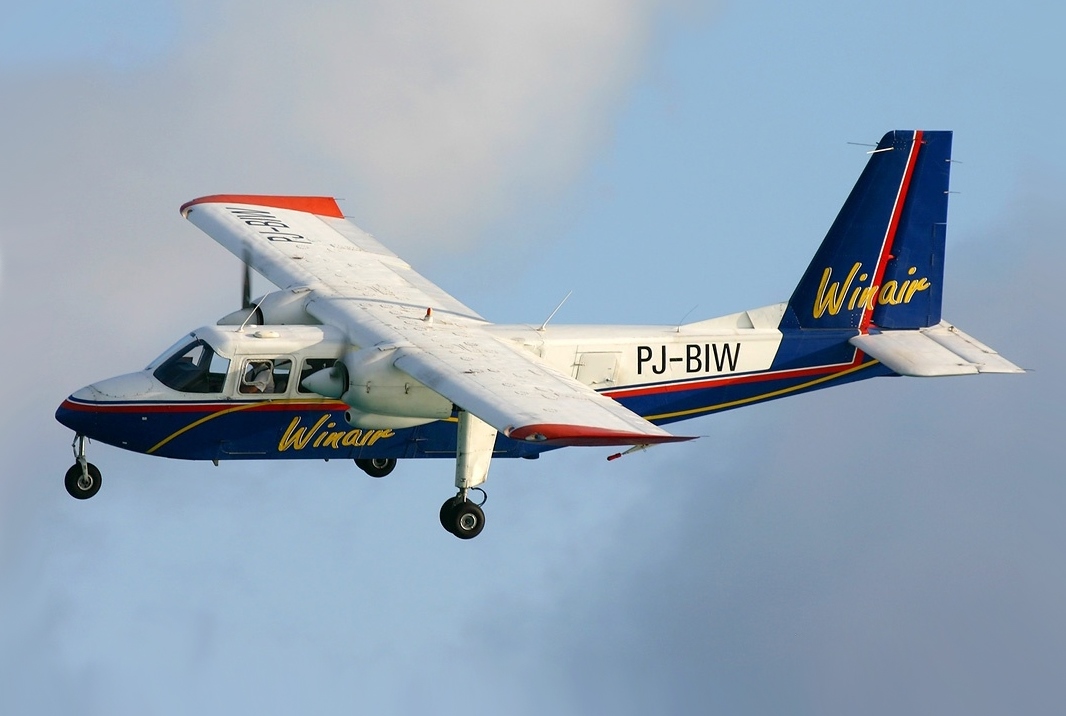
The Britten-Norman BN-2 Islander is a British twin-engine light utility aircraft and regional airliner, designed by John Britten and Desmond Norman and built at Bembridge on the Isle of Wight from the mid-1960s. Conceived as a rugged, low-cost Dragon Rapide replacement for commuter and island-hopping operators, it remains in production today and stands as one of the best-selling commercial aircraft types built in Europe. For a sim pilot it offers a distinctive slab-sided, high-wing STOL workhorse with a long service history and a huge range of military and civilian roles.
The BN-2 Islander is a twin-engine, high-wing light utility aircraft and commuter airliner produced by Britten-Norman of the United Kingdom. Designed in the early 1960s as a rugged, inexpensive replacement for aircraft such as the de Havilland Dragon Rapide, it prioritises payload and short-field capability over speed or range. It has been in continuous production since first flying in 1965, with over 1,280 built, and serves both as a commercial commuter airliner seating up to ten and as a military and special-mission platform under the Defender name.
Britten-Norman began development of what would become the Islander in 1963, having identified growth in the commuter airline sector and concluded that payload capacity mattered more to operators than range or cruising speed. The design used low wing and span loading to lift heavier payloads than comparable aircraft of similar power, weight or cost, and cost-saving measures included constant-chord wings and tail surfaces and identical wing ribs. The first prototype flew on 13 June 1965, powered by two Rolls-Royce/Continental IO-360B piston engines, and appeared at the Paris Air Show only six days later. These engines were subsequently replaced by more powerful Lycoming O-540-E units mounted further outboard for improved single-engine climb. A second prototype flew on 20 August 1966, and the first production aircraft flew on 24 April 1967, gaining UK certification in August 1967 and US certification in December 1967. Demand quickly outstripped Bembridge's production capacity, leading to a manufacturing contract with IRMA of Romania, whose first assembled Islander flew in August 1969; Romania went on to build more than 500 aircraft and became the primary production site after a 1977 order for a further 100 aircraft. Britten-Norman entered receivership in October 1971 and was bought by the Fairey Aviation Group in August 1972, becoming Fairey Britten-Norman, with much of the manufacturing transferred to Avions Fairey in Gosselies, Belgium, for finishing before UK certification flights. The company later became Pilatus Britten-Norman in September 1979, reverted to Britten-Norman in July 1998, and became the B-N Group in April 2000. Philippine Aerospace Development Corporation held a licence for production and programmed depot maintenance of the BN-2, producing 67 units between 1975 and 1995. In September 2023 final assembly of the Islander returned to the United Kingdom after fifty-five years of manufacture abroad.
The Islander is of light alloy monocoque construction, a departure from an originally intended fabric-and-steel design, and is engineered for low structural stress and an infinite fatigue life without testing. The main cabin has no centre aisle; instead there are three doors along each side of the fuselage for passenger access. Current production BN2B-26 and BN2B-20 models have a length of 35 ft 9 in (10.9 m), height of 14 ft 5 in (4.4 m), wingspan of 49 ft (14.9 m) and wing area of 325 sq ft (30.2 sq m); the stretched BN2T-4S is 40 ft (12.2 m) long with a 53 ft (16.2 m) wingspan and 351 sq ft (32.6 sq m) wing area. The cabin measures 4 ft 2 in (1.3 m) high, 3 ft 5 in (1.1 m) wide and 15 ft 2 in (4.6 m) long, seating up to ten. Piston-engined variants use Lycoming O-540/IO-540 six-cylinder engines of 260 hp (carburetted) or 300 hp (fuel injected), while the turboprop BN2T and BN2T-4S use Rolls-Royce (Allison) 250-B17 series engines rated at 320 shp or 400 shp. Maximum take-off weight ranges from 6,600 lb (2,994 kg) for the BN2B-26/-20 to 8,925 lb (4,048 kg) for the BN2T-4S, with fuel capacity of 130 US gal (492 l) standard, extendable to 215 US gal (814 l) with tip tanks, or 299 US gal (1,131 l) on the BN2T-4S. New-build aircraft come with a full IFR glass cockpit as standard, including the Garmin G600 series with G600 TXi PFD/MFD, dual GTN 750/650 nav/comm/GPS units, electronic engine instrumentation and ADS-B Out, with options such as Garmin weather radar, radar altimeter and the Genesys S-Tec 3100 digital autopilot.
Performance varies markedly between piston and turboprop variants. The BN2B-26 has a maximum cruise speed of 142 kt (263 kph TAS), an economical cruise of 126 kt (233 kph TAS) at 8,000 ft, a rate of climb of 860 ft/min on both engines, an absolute ceiling of 13,600 ft, and a range of 539 nm (998 km) IFR or 675 nm (1,250 km) VFR. The BN2B-20 offers a slightly higher cruise of 143 kt with a stronger climb rate of 1,130 ft/min and a ceiling of 19,700 ft. The turboprop BN2T reaches 170 kt maximum cruise, climbs at 1,050 ft/min, and has an absolute ceiling above 25,000 ft, while the stretched BN2T-4S cruises at up to 180 kt with a range of 805 nm (1,493 km) IFR. Take-off ground roll figures range from 621 ft (189 m) for the BN2B-26 up to 1,450 ft (442 m) for the heavier BN2T-4S, reflecting the type's strong short-field performance across the range. Earlier BN-2A production aircraft, fitted with 260 hp Lycoming O-540-E4C engines, had a maximum speed of 273 km/h (147 kt), initial rate of climb of 970 ft/min and a service ceiling of 13,200 ft, while the improved BN-2B-20 with 300 hp IO-540-K1B5 engines achieved a service ceiling of 17,200 ft and range of up to 1,965 km (1,060 nm) with optional fuel.
The initial production BN-2 used 195 kW (260 hp) IO-540 engines; the BN-2A that followed added undercarriage leg and wing leading-edge fairings, flap droop, and a higher maximum take-off weight. From 1970 the base model became the BN-2A-6, with the extended-wingtip BN-2A-7, and the 225 kW (300 hp) IO-540-powered BN-2A-2 and BN-2A-3 (the latter with extended wingtips). In 1972 came the BN-2A-26 and extended-wingtip BN-2A-27 at 260 hp, and the BN-2A-20 and extended-wingtip BN-2A-21 at 300 hp, all with higher weights. The BN-2B range brought higher weights again, an improved interior and instrument panel, and shorter-diameter propellers; of these the BN2B-20 and BN2B-26 remained in long-term production, with the -27 and -21 later dropped. The turboprop BN-2T, powered by Allison/Rolls-Royce 250 engines, has been built since 1981, and the stretched BN2T-4S extends the fuselage and wingspan for greater cabin volume and fuel capacity. The military Defender, first flown in 1970, adds underwing hardpoints and a cabin fitted for light troop transport and support duties, while the Maritime Defender is equipped for search and rescue, coastal patrol and fishery protection. A single BN-2 was experimentally fitted with Dowty Rotol ducted fans in 1977, reducing noise by around 20 decibels during an 18-month test programme, though this did not enter production. The type also spawned the three-engine Britten-Norman Trislander derivative.
The Islander has been operated by more than 30 military aviation customers worldwide, chiefly in surveillance and counter-terrorism roles via the Defender variant, alongside search and rescue, coastal patrol and fishery protection duties performed by the Maritime Defender. In civilian service it has become a mainstay of short-haul commuter and island-hopping networks, valued for its ability to operate from short and unprepared airstrips while carrying commercially useful payloads. Over 750 Islanders remain in service with commercial operators, and the type has accumulated some 20 million flight hours across more than 100 countries on six continents. Roles include scheduled commuter passenger transport for up to nine passengers, executive configurations for four to eight passengers in club seating, freight operations carrying 1 to 1.6 tonnes of cargo through wide-access doors, and air ambulance work with the extended cabin accommodating up to three stretcher patients and a medical team.
The Islander's combination of light wing loading, fixed undercarriage and simple, rugged systems gives it a reputation for benign, forgiving handling and genuine short-field capability, qualities that make it a natural fit for STOL and bush-flying scenarios in a simulator. Its unusual cabin layout, with three doors per side and no centre aisle, and its long production history spanning piston BN2B-26/-20 and turboprop BN2T/BN2T-4S variants, give modelled versions a distinct character depending on powerplant, from modest climb rates on the base piston model to markedly stronger performance on the turboprop-equipped variants. The type's popularity on real-world short hops, including the famously brief inter-island routes in northern Scotland, makes it well suited to short-sector, airstrip-to-airstrip flying rather than long-range cruising.