Departure
95%
vs 95%
 MY FS FLIGHTS
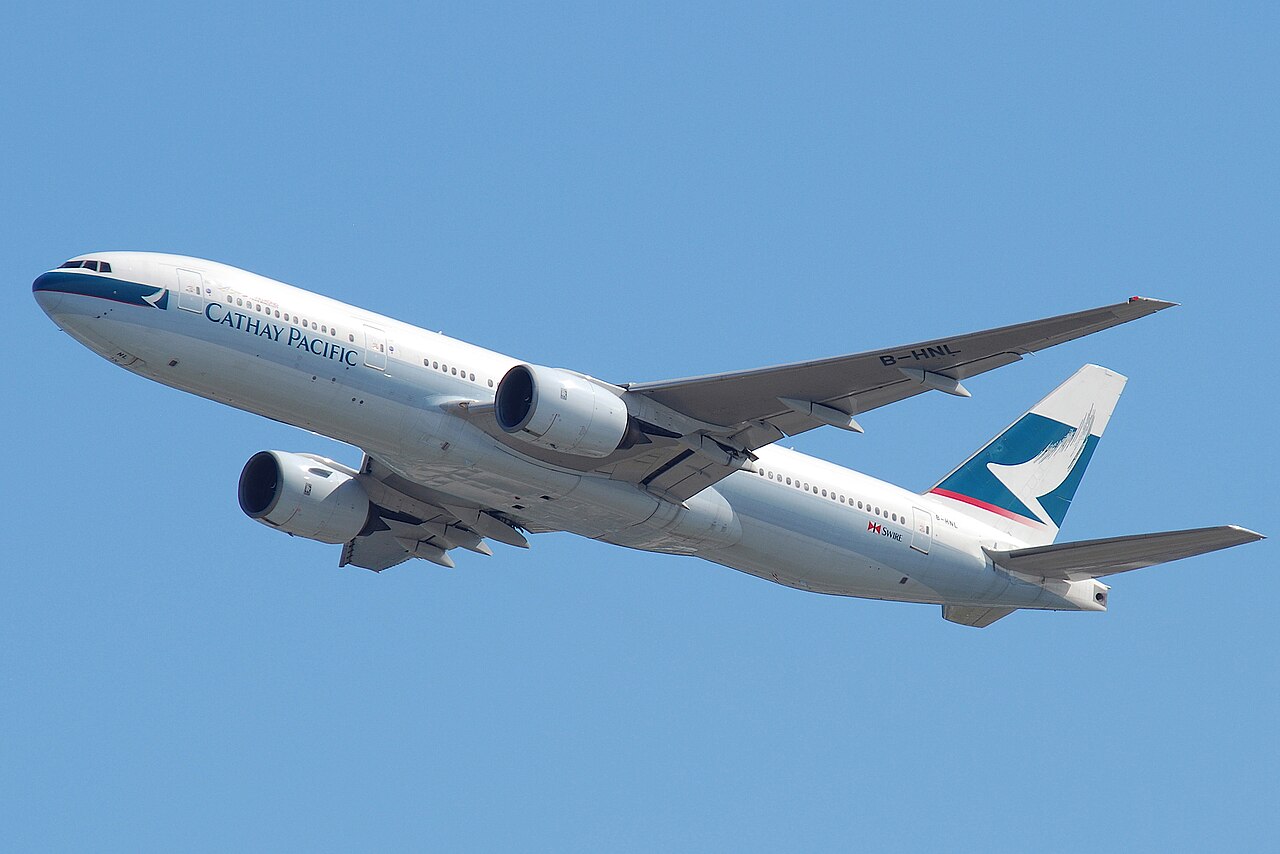
The Boeing 777-200ER is an extended-range derivative of Boeing's original 777-200 wide-body twinjet, developed to give airlines true long-haul, transoceanic capability on a twin-engine airframe. It became one of the most widely operated members of the 777 family, flown by major carriers such as British Airways, United Airlines, Air France, Emirates and KLM, and is of interest to simmers as a fly-by-wire, glass-cockpit long-haul type with distinctive six-wheel main landing gear.
The 777-200ER is a wide-body, twin-engine jet airliner built by Boeing as the extended-range version of the original 777-200. It sits within Boeing's 777 family, conceived to fill the gap between the smaller 767 and the larger 747, and is readily identified on the ramp by its six-wheel main landing gear and the absence of wingtip devices. It was among the first airliners to combine a fly-by-wire flight control system with a fully glass cockpit.
The 777 programme was conceived in the late 1980s to bridge the size and range gap between the Boeing 767 and 747. As airlines sought greater range and payload for nonstop transatlantic and transpacific routes, Boeing developed an increased gross weight derivative of the 777-200, initially known as the 777-200IGW (Increased Gross Weight), which was subsequently redesignated the 777-200ER (Extended Range). The type first flew on October 7, 1996, and entered airline service with British Airways on February 9, 1997. Boeing went on to deliver 421 additional 777-200ER airframes beyond the original -200, spread across 33 different airline customers. On April 2, 1997 a Malaysia Airlines 777-200ER named "Super Ranger" set a great circle distance record for an airliner, flying eastward from Boeing Field in Seattle to Kuala Lumpur, a distance of 10,823 nautical miles (20,044 km), in 21 hours and 23 minutes without landing.
The 777-200ER has a fuselage length of 63.7 m, a tail height of 18.5 m and a wingspan of 60.9 m. Maximum take-off weight is 656,000 lb, supported by a distinctive six-wheel main landing gear arrangement, the largest fitted to any commercial airliner, and a wing without folding wingtip devices. Fuel capacity is 45,220 US gallons (171,171 litres, or 302,270 lb / 137,460 kg), giving the aircraft its extended range over the baseline 777-200. The aircraft can be fitted with one of three engine options: Pratt & Whitney PW4090, General Electric GE90-94B, or Rolls-Royce Trent 895 (RR895), all in the very high thrust class, with the GE90 series noted as among the most powerful jet engines built. The flight deck uses a glass cockpit paired with a fly-by-wire flight control system, one of the first applications of fly-by-wire on a Boeing airliner. Passenger seating capacity ranges from around 305 up to a maximum of 440, with a more typical long-haul cabin configuration seating around 313.
The 777-200ER has a maximum operating speed of Mach 0.89 and a quoted maximum range of up to 7,730 nautical miles, roughly 2,500 nautical miles more than the standard 777-200, with a tabulated range figure of 7,065 nautical miles also cited for typical operations. This extended range, combined with ETOPS certification, allows the type to fly long nonstop overwater sectors across the Atlantic and Pacific, a capability demonstrated dramatically by the Malaysia Airlines record-distance flight of April 1997.
The 777-200ER is the extended-range derivative of the original 777-200, distinguished by a higher maximum take-off weight and greater fuel capacity that together deliver substantially increased range. Boeing later produced the further-stretched-range 777-200LR as a separate, longer-range derivative within the wider 777 family.
The 777-200ER has been operated by more than 30 airlines worldwide. Primary operators include American Airlines, British Airways and United Airlines, alongside significant fleets at Air France, Emirates, KLM and All Nippon Airways. KLM introduced its first 777-200ER in 2003 and names its aircraft after world heritage sites. Austrian Airlines operates the type on long-haul routes such as Mauritius and was the first airline worldwide to fit four of its 777-200ERs with Lufthansa Technik and BASF's AeroSHARK drag-reducing film. The type has served as a mainstay long-haul widebody for its operators, valued for its fuel efficiency and twin-engine ETOPS long-range capability.
Pilots require a specific type rating to fly the Boeing 777-200ER, which is typically obtained through airline training programmes. Its fly-by-wire flight control system and glass cockpit, advanced for its era, make it a natural long-haul type for simmers wanting to fly extended ETOPS sectors, and its six-wheel main gear and large GE90/PW4000/Trent-800-class engines give it a distinctive ground and flight profile compared with other twinjets.