Departure
93%
vs 95% ▼ 3
 MY FS FLIGHTS
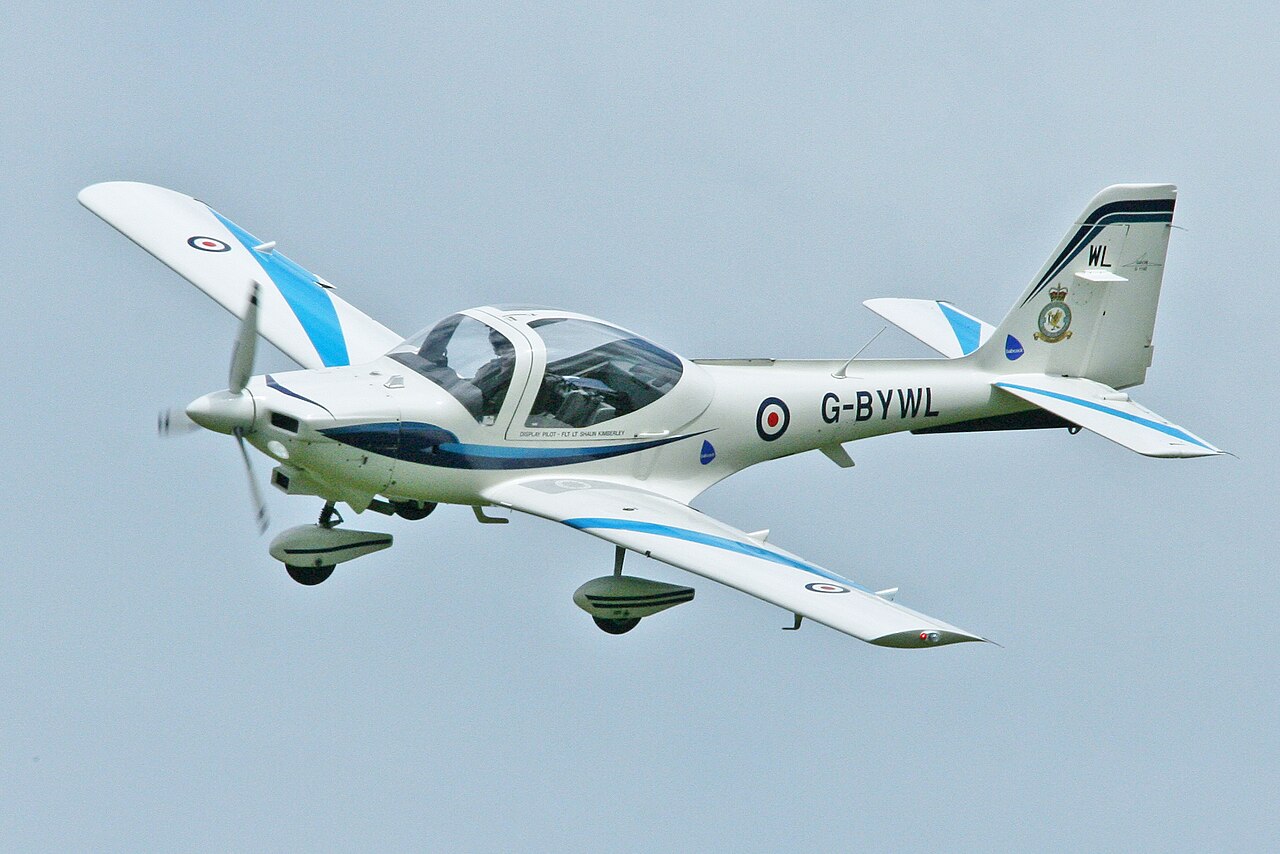
The Grob G115 is a German-built, carbon-composite low-wing basic trainer used widely for civilian and military flight instruction since the mid-1980s. It became best known in British service as the Tutor T1, the Royal Air Force, Royal Navy and Army Air Corps elementary trainer, and remains a familiar sight over UK training airfields. Its docile handling, aerobatic capability and simple systems make it a natural subject for simulated primary flying training.
The Grob G115 is a two-seat, side-by-side, low-wing general aviation aircraft built by Grob Aircraft (formerly Grob Aerospace) in Germany, designed primarily for flight training and touring. It is of composite construction with a fixed tricycle undercarriage and a single piston engine, and has served both civilian flying clubs and military elementary flying training organisations. The type is best known to British readers in its 115E form as the Tutor T1, operated for many years by the Royal Air Force, Royal Navy and Army Air Corps.
The G115 first flew in November 1985 and has been in production from that date. The initial G115 and G115A models featured an upright fin and rudder and were sold mainly to civilian aeroplane clubs in Germany, the United Kingdom and other countries. Further development produced the G115D2, known as the Heron, which was first bought by the Royal Navy; after its withdrawal five were bought by Tayside Aviation, and only six Herons are recorded as still existing, two operated by Tayside Aviation pending sale, three in private ownership and one in Germany, with one written off following an accident. The most significant derivative, the G115E, entered Royal Air Force service in 1999 as the Tutor T1, replacing the Scottish Aviation Bulldog T1 in University Air Squadron and Air Experience Flight roles under a new arrangement in which the aircraft were owned and operated by private industry under contract to the Ministry of Defence. The Tutor fleet has been owned and maintained by Babcock International under a Private Finance Initiative scheme.
The G115 is constructed of carbon composite materials, with the main fuselage and each wing spar built as a single piece. It has a fixed, sprung-steel tricycle undercarriage with spatted wheels, a short nose housing the piston engine, and a three-bladed variable-pitch propeller on the E variant. The aircraft was re-certified in 2013 with a new MT Propeller following issues with the earlier design, and the inverted oil system was redesigned to improve lubrication during aerobatic flight. The cockpit has a broad canopy arch and spine giving good forward visibility, with fixed side-by-side seating adjusted using cushions and a rudder bar adjuster. The wings are tapered with square tips, and the empennage comprises a large fin and rudder with an oblong, square-tipped tailplane mid-set to the fuselage. The engine fitted to the G115E is a Lycoming AEIO-360-B1F/B piston engine producing 139 kW (described elsewhere as 180 horsepower, 130 kilowatts). Reported dimensions for the type include a wingspan of 10.0 metres, a length of 7.59 metres, a height of 2.8 metres and a maximum weight of 990 kilograms.
The G115 is capable of basic aerobatic manoeuvres, limited to +6G and -3G. Reported performance figures for the type include a cruise speed of around 127 knots and a range of approximately 620 nautical miles.
The initial G115 and G115A models had an upright fin and rudder and were aimed chiefly at civilian flying clubs. The G115D2, named the Heron, was a further development first procured by the Royal Navy, of which only a small number remain in existence today. The G115E, known in UK military service as the Tutor T1, introduced a three-bladed variable-pitch propeller and became the standard Elementary Flying Training aircraft for the Royal Air Force, Royal Navy and Army Air Corps. Some Tutor squadrons later received Enhanced Avionics (EA) Tutors, fitted with an updated instrument panel including a Garmin GNS 430W GPS system, digital HSI and digital engine instruments, distinguished externally by an extra VHF aerial.
In UK military service, the Grob Tutor T1 was used for Elementary Flying Training by the Royal Navy, British Army and Royal Air Force, with students streamed according to ability toward fast jet, rotary wing, multi-engine or non-pilot roles. This training was previously delivered at RAF Cranwell and RAF Barkston Heath by the joint 3 Flying Training School, involving 703 Naval Air Squadron, 674 Squadron Army Air Corps and 57 RAF Reserve Squadron, before the Tutor was replaced in 2018 by the more advanced turboprop Grob G120TP Prefect; some Elementary Flying Training on the Tutor continues with 16 Squadron at RAF Wittering. Until 2005 the Tutor was used by University Air Squadrons to provide Elementary Flying Training to university students, many sponsored by the RAF; from 2006 UAS students instead followed an unassessed 36-hour flying syllabus. The Tutor is also used by Air Experience Flights to provide flying experience for Air Training Corps and Combined Cadet Force cadets, having replaced the Bulldog in this role, with the final AEF conversion occurring at 10 AEF, RAF Woodvale, in 2001. Five Tutor T1s are operated by 727 Naval Air Squadron of the Fleet Air Arm for trainee pilot grading at RNAS Yeovilton. Beyond the UK, the type has served with operators including the Egyptian Air Force, with 74 aircraft, and the Finnish Air Force, with 28 aircraft bought from UK stocks, as well as a number of civilian flying schools and clubs in countries such as Australia, Belgium, Canada and Kenya.
As modelled in FlightGear, the G115 is presented as a general aviation trainer with a full 3D model and sound, with around 90 percent of cockpit knobs, switches and instruments functional, including 38 working circuit breakers, reflecting the type's role as a systems-representative primary trainer. Starting procedure in this implementation requires the battery master switch to be set to the on position before selecting both magnetos and then engaging the starter, a small but characteristic quirk for anyone used to other simulated types. The aircraft's docile, aerobatic-capable handling and straightforward single-engine piston systems make it a natural fit for basic instrument and handling practice, mirroring its real-world role as an elementary military and civilian trainer.