Departure
87%
vs 95% ▼ 8
 MY FS FLIGHTS
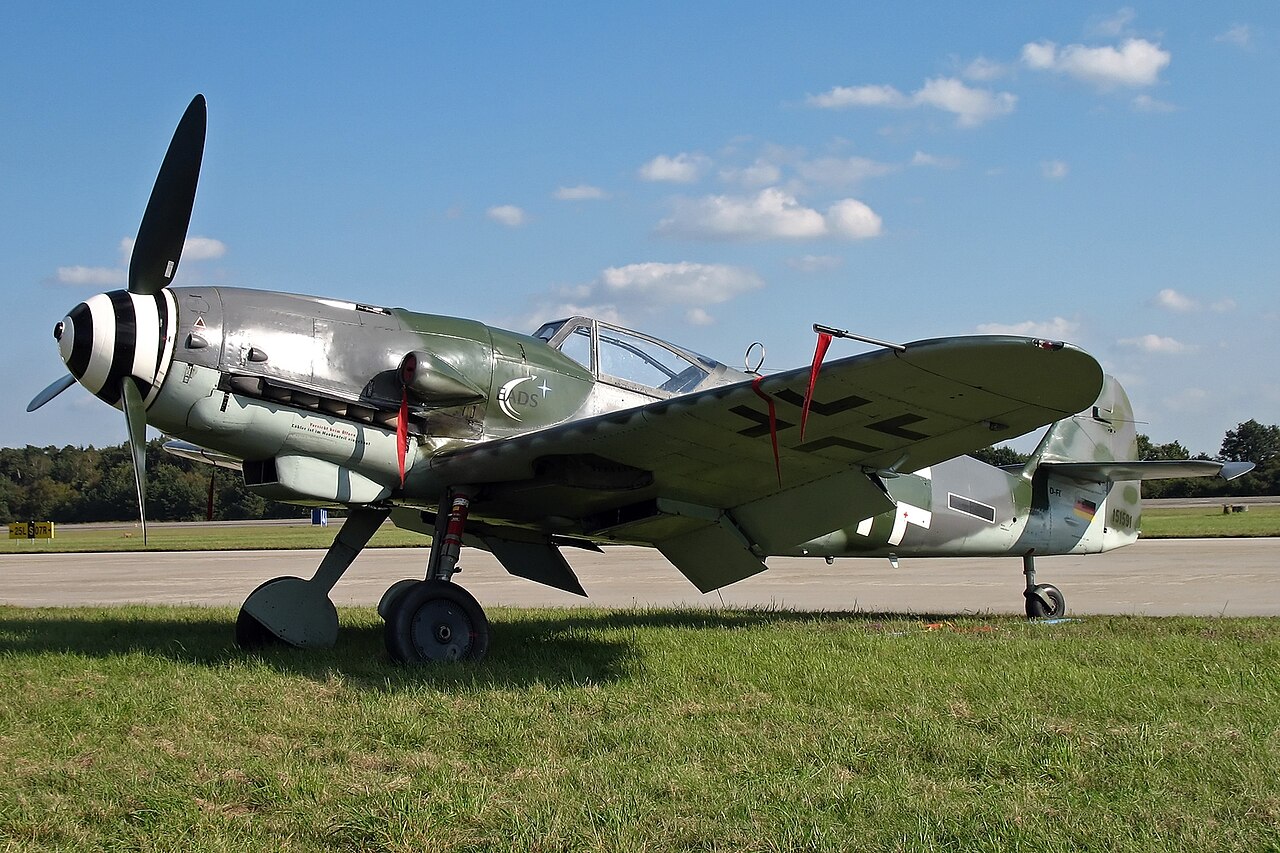
The Messerschmitt Bf 109G, nicknamed the Gustav, was the most numerous version of Willy Messerschmitt's classic Luftwaffe fighter, powered by the more potent Daimler-Benz DB 605 engine in place of the earlier DB 601. It became the backbone of German fighter strength from mid-1942 onward, flown by virtually every top-scoring ace of the war including Erich Hartmann, and remains the variant most associated with the type's legendary combat record on the Eastern Front and in North Africa.
The Bf 109G is a sub-type of the Messerschmitt Bf 109, the single-seat, low-wing monoplane fighter designed by Willy Messerschmitt and Robert Lusser and produced by Bayerische Flugzeugwerke (BFW), later Messerschmitt AG. Alongside the Focke-Wulf Fw 190, the Bf 109 formed the backbone of the Luftwaffe's fighter force through the Second World War, and the G-series, powered by the Daimler-Benz DB 605 engine, became by far the most numerous sub-variant, serving as interceptor, bomber-destroyer, escort fighter, fighter-bomber and reconnaissance aircraft on every European front.
The Bf 109 lineage traces back to a 1933 Reichsluftfahrtministerium requirement for a short-range single-seat interceptor, issued under the Rustungsflugzeug III programme, which called for a top speed of 400 km/h at 6,000 m and an operational ceiling of 10,000 m. BFW, Arado, Heinkel and later Focke-Wulf competed for the contract, with the prototype V1 first flying on 29 May 1935. Through the B, C, D, E and F series the design was progressively re-engined and strengthened, moving from the Junkers Jumo 210 through the Daimler-Benz DB 601 to, in the G-series, the more powerful DB 605. The Bf 109G entered Luftwaffe service in North Africa in June 1942 and saw major combat on the Eastern Front from the summer of 1942, where it proved superior to most contemporary Soviet fighters. It became the most heavily produced sub-type of the Bf 109, with around 23,500 G-series airframes built between 1942 and 1945; the G-6 alone accounted for roughly 12,000 aircraft manufactured from March 1943 to the end of the war, making it the single most numerous Bf 109 model of all.
The Gustav retained the all-metal monocoque airframe, closed canopy and retractable undercarriage of earlier Bf 109 models but was built around the larger, more powerful Daimler-Benz DB 605A inverted V-12, liquid-cooled and supercharged engine, rated at around 1,800 hp in the surviving Museum example. A representative G-4 has a length of 29 ft 4 in, a wingspan of 32 ft 6.5 in, an empty weight of about 7,000 lb and a loaded weight of about 8,100 lb. Standard armament comprised two 7.92 mm machine guns mounted in the upper engine cowling synchronised to fire through the propeller arc, together with a single 20 mm cannon firing through the propeller hub via the engine. The airframe could also carry external ordnance, including a bomb of up to 550 lb (250 kg) or smaller bombs on a belly rack, anti-personnel grenade dispensers, and underwing 21 cm mortar tubes intended as a stand-off weapon against Allied bomber formations. Later production blocks introduced detail refinements such as the Erla Haube clear-view canopy and, on the G-10, a taller wooden fin and rudder to counter the additional torque and weight of the later engine fits.
Performance figures recorded for a Bf 109G-4 give a cruising speed of 344 mph and a maximum speed of 428 mph, a range of 350 miles, a service ceiling of 39,000 ft and an initial rate of climb of 3,956 ft per minute. The type retained excellent high-altitude performance and, in the hands of a skilled pilot, remained a highly capable fighter throughout the later war years, its powerful armament proving devastating against Il-2 Sturmoviks and early Yak and LaGG fighters on the Eastern Front. By the closing stages of the war, however, the accumulated weight of armament, armour and equipment fitted to successive G sub-variants had pushed the design toward the limits of its original lightweight concept, and its continued competitiveness increasingly depended on raw engine power and the diminishing pool of experienced Luftwaffe pilots able to exploit it.
The G-series ran through numerous sub-types, including the G-1 through G-6, the G-10 and the G-14, distinguished by engine sub-variant, cockpit pressurisation, canopy type and equipment fits denoted by Rustsatz and Rustzustand suffixes; the G-2/R1, for example, was a long-range fighter-bomber carrying a 500 kg bomb and drop tanks on a strengthened, jettisonable undercarriage. The G-6 was the most numerous single sub-type, with about 12,000 built. The G-10 introduced the Erla Haube canopy and a taller, wooden fin and rudder, and could be factory-converted with a Motorkanone 20 mm or 30 mm cannon firing through the propeller spinner, denoted by the /U4 suffix. After the war, Czechoslovakia continued building modified Bf 109G-14 derivatives as the Avia S-99 and S-199, the latter fitted with the inferior Junkers Jumo 211F engine and notorious for poor handling on landing; several S-199s were later sold to Israel, forming the basis of its fledgling air force. In Spain, the related Bf 109G-2 was licence-built as the Hispano Aviacion HA-1112, in both the original-engined
The Bf 109G entered frontline Luftwaffe service in North Africa in June 1942, where it flew alongside surviving Bf 109F models during the retreat to Tunisia, and reached the Eastern Front in strength from the summer of 1942 onward. It became the mount of the war's leading aces, with Erich Hartmann scoring the overwhelming majority of his 352 victories in Bf 109G variants, and Gerhard Barkhorn also amassing large scores flying the type against the numerically superior Soviet Air Force. Beyond German service, the Bf 109G was flown by the air forces of Hungary, Romania, Bulgaria, Croatia, Slovakia and Italy. Neutral Switzerland also operated the type, and Swiss Bf 109G pilots shot down both USAAF bombers that violated Swiss airspace and Luftwaffe aircraft, one of the few instances of a neutral nation using German fighters against Germany itself. After the war, surviving and licence-built derivatives continued in service for years: Czechoslovak-built S-199s served as trainers into the 1950s and equipped the earliest Israeli Air Force, while Spanish-built HA-1112s remained in Spanish Air Force service into the 1960s.
Flying accounts of the Bf 109G emphasise a fighter that, in a good pilot's hands, remained highly capable even late in the war, with its DB 605 engine and powerful nose-and-cowling armament giving it a real edge against opposing bomber formations and lower-powered Soviet fighters. Its performance depended heavily on pilot skill and currency, a point underlined by observations that by late 1944 the airframe itself was still competitive but the Luftwaffe's pool of experienced pilots able to exploit it had shrunk badly. Detail changes through the G production run, such as the clearer-view Erla Haube canopy and the taller tail fitted to the G-10, offer a way to trace the type's evolution across variants, while the surviving flying and static examples in museums, several rebuilt around original or substitute DB 605 powerplants, keep the Gustav's handling character and history alive for those studying or flying it today.