Departure
97%
vs 95% ▲ 2
 MY FS FLIGHTS
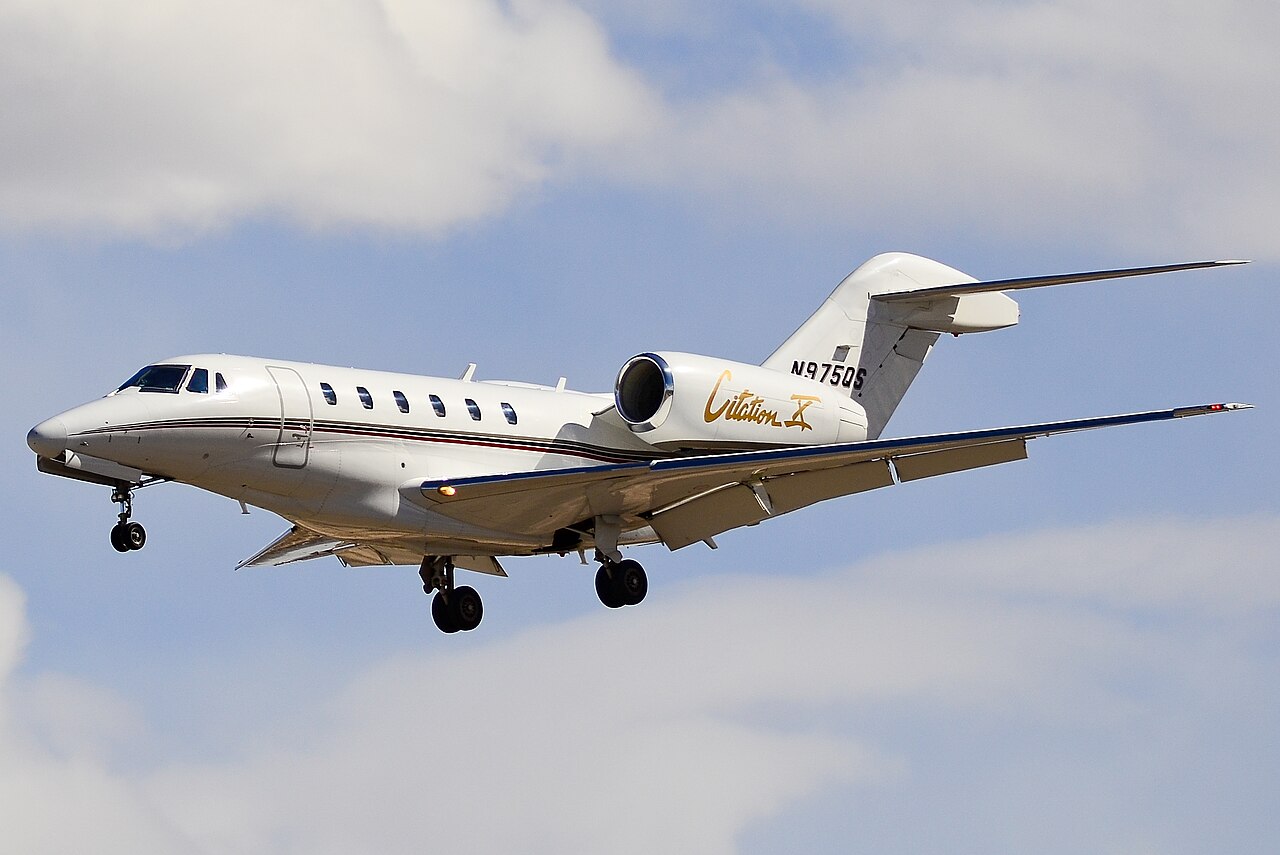
The Cessna 750 Citation X is a swept-wing, T-tailed business jet developed by Cessna as the fastest civilian aircraft in production, capable of cruising at up to Mach 0.935. Derived from the Citation III fuselage but fitted with an entirely new wing and twin Rolls-Royce AE 3007 turbofans, it was built to shed the Citation family's reputation for being slow and instead offer airliner-like speed with a comfortable stand-up cabin. For a sim pilot it represents a high-performance, high-altitude corporate jet with genuine speed-record pedigree.
The Cessna 750 Citation X is an American mid-size to large-cabin business jet produced by Cessna as part of the wider Citation family, developed from the Citation III but re-engineered with a new high-speed wing. It is a twin-engine, T-tailed design intended from the outset for high-speed cruise performance rather than the low-speed handling ease that characterised earlier Citations, and it became known as the fastest certified civilian jet of its era.
The Citation X was announced at the NBAA convention in New Orleans in October 1990, growing out of a 1990 proposal Cessna made to its Customer Advisory Council for an improved Citation 650-series model with increased speed and a pressurized baggage compartment. This pushed Cessna toward an entirely new 750 series. Engine development was carried out on a Cessna 650 Citation III testbed flown with mismatched engines, a standard Garrett TFE731 on one pylon and the larger Rolls-Royce AE 3007 destined for the Citation X on the other, allowing flight test engineers to expose the new engine to temperatures, pressures and loads that could not be replicated on the ground. The first Citation X prototype flew on 21 December 1993. Certification, originally targeted for August 1995, slipped repeatedly because of difficulties integrating the avionics and engines, high-altitude/low-speed engine flameout caused by insufficient airflow at high angles of attack, engines not meeting bird strike criteria, directional stability issues, and efforts to raise maximum take-off weight by about 800 pounds to permit a full-fuel, seven-passenger payload of 1,400 pounds while still controlling cabin noise. Type certification (FAA FAR Part 25, Amendment 74, Certification 3) was finally achieved on 3 June 1996, and the first aircraft was delivered in July 1996 to golfer and long-time Cessna customer Arnold Palmer. In September 1997 Palmer set a speed record of 473 knots (876 km/h) on a 5,000 km closed course, and in February 1997 the Citation X design team received the National Aeronautic Association's Robert J. Collier Trophy. The type was approved by Transport Canada on 22 May 1998 and by the European Joint Aviation Authorities in 1999. In October 2000 Cessna announced an upgrade for all Citation Xs delivered after 1 January 2002, comprising a 5 percent increase in thrust, a 400 lb increase in maximum take-off weight, and improved Honeywell avionics. In 2010 Cessna launched a major update, initially known as the Citation Ten, which became the Citation X+: it introduced upgraded AE3007C2 engines with new fans, Garmin G5000 flight displays with three 14-inch screens, an autothrottle system, standard elliptical winglets (previously an aftermarket option), and a fuselage stretch of about 14-15 inches for improved passenger comfort. The Citation X+ first flew on 17 January 2012. Production of the Citation X and X+ together ran from 1996 to 2018, with 339 aircraft built in total: 310 Citation X and 29 Citation X+.
The Citation X retained the fuselage cross-section of the Citation III but was fitted with an entirely new 37-degree swept wing with an area of 527 sq ft (49 sq m), married to a T-tail. It was the first Cessna aircraft powered by Rolls-Royce engines, using two pod-mounted AE 3007 turbofans on the rear fuselage: initial aircraft (up to serial 750-172) used the AE 3007C rated at 6,442 lb thrust, later aircraft (750-173 onward) the AE 3007C1 rated at 6,764 lb, and the Citation X+ introduced the AE 3007C2 with new fans and a nominal 7,034 lbf (31.29 kN) rating. On the original Citation X, wingspan was 63 ft 7 in, overall length about 72 ft 4 in, tail height 19 ft 2 in, cabin width 5 ft 5 in, cabin height 5 ft 7 in and cabin length 25 ft 2 in, with maximum take-off weight of 36,100 lb, maximum landing weight of 31,800 lb, maximum payload of 2,350 lb and fuel capacity of 1,930 US gallons. The Citation X+ grew the airframe further, with height increased to 19 ft 3 in, length to 73 ft 7 in, wingspan expanded to 69 ft 2 in with standard elliptical winglets, and maximum take-off weight raised to 36,600 lb. The X+ also brought Garmin G5000 avionics with three 14-inch screens and an autothrottle, replacing the earlier Honeywell-based avionics suite.
The Citation X was designed around a very high maximum operating Mach number, reaching Mach 0.935 on the X+ (Mach 0.92 is also cited for the standard X), making it one of the fastest certified civilian jets. Maximum cruise speed for the original Citation X is given as 528 knots (608 mph, 978 km/h), with a service ceiling of 51,000 ft and a rate of climb around 3,650 ft/min. Typical operational figures quote an approach speed of 86 knots, a take-off distance of 5,150 ft and a landing distance of 2,750 ft, with a range of roughly 3,125 nautical miles. The Citation X+ improved on this further: cruise speed at FL490 rose from 460 to 479 knots, maximum cruise speed at FL350 reached 527 knots (606 mph, 976 km/h), and range increased by 190 nmi to about 3,242 nautical miles at MTOW with full fuel and optimal climb and descent at Mach 0.82 cruise; a maximum range figure of 3,460 nmi is also associated with the type. Early flight testing revealed handling issues at high altitude and low speed, including engine flameout caused by insufficient airflow at high angles of attack, together with directional stability challenges, both of which had to be resolved before certification.
The baseline production version was the Citation X (Model 750), certified in 1996 with AE 3007C or later AE 3007C1 engines and Honeywell-based avionics, receiving a mid-life upgrade from 2002 with 5 percent more thrust, higher MTOW and improved avionics. The Citation X+, offered from 2012 (initially referred to during development as the Citation Ten), introduced AE 3007C2 engines with new fans, Garmin G5000 glass cockpit displays, an autothrottle system, standard elliptical winglets and a fuselage stretch of around 14-15 inches, along with the associated increases in payload, cruise speed and range described above.
The Citation X entered service in July 1996 with its first delivery to Arnold Palmer, and the type went on to be operated by a range of corporate flight departments and charter operators valuing its speed advantage over competing business jets. Known operators of the Citation X and X+ family have included NetJets, XOJET, AirX Charter, Wheels Up and Baker Aviation. Its speed made it particularly attractive for time-sensitive executive travel and charter work, and it set multiple point-to-point and closed-course speed records during its service life, reinforcing its position as a benchmark for high-speed business aviation.
The Citation X's defining characteristic, an unusually high cruise Mach number for a business jet, along with its high service ceiling and strong climb performance, make it a jet whose appeal in the simulator lies chiefly in that speed envelope and the discipline required to manage a swept-wing, T-tailed airframe at the upper edges of its flight envelope. Its development history, including the high-altitude, low-speed flameout and directional stability issues encountered during certification, reflects an aircraft that rewards careful energy and angle-of-attack management at altitude rather than forgiving, docile handling, which is part of its draw for pilots wanting a demanding, fast-jet type of business-jet experience.