Departure
81%
vs 96% ▼ 16
 MY FS FLIGHTS
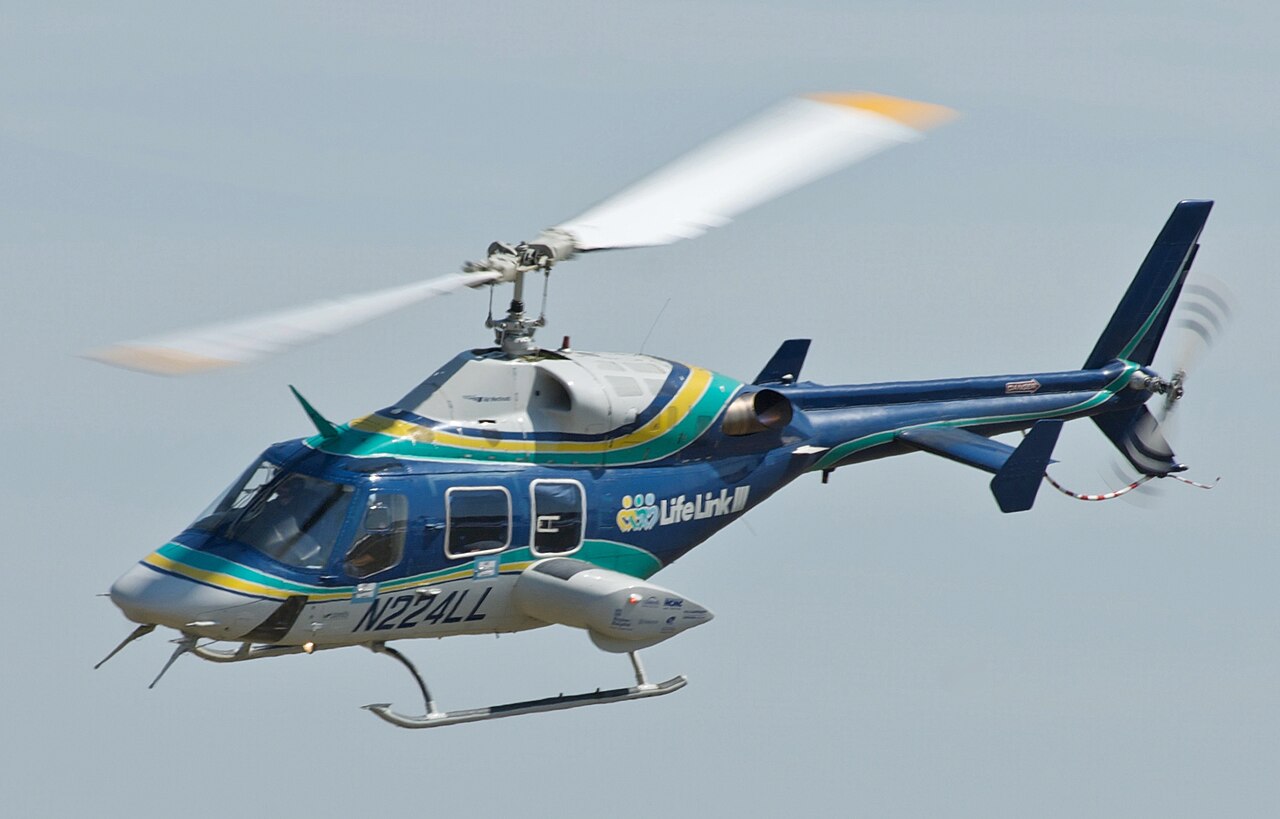
The Bell 222B is an American twin-engine light helicopter built by Bell Helicopter, the uprated version of the Bell 222, itself the first light commercial twin-turbine helicopter developed in the United States. Aimed at the corporate and executive charter market as well as utility and EMS work, the 222B combined more power and a larger main rotor with the striking sponson-and-retractable-gear styling that made the family one of the best-known civil helicopters of its era. For a sim pilot it offers a distinctive late-1970s twin design with dual hydraulic and electrical systems and a semi-rigid two-blade rotor derived from military practice.
The Bell 222 family comprises American twin-engine light helicopters built by Bell Helicopter for the executive and utility transport market. The original Model 222 was the first light commercial twin-turbine helicopter developed in the United States, and the 222B, introduced in 1982, is the improved, more powerful version distinguished by a larger main rotor and uprated engines. The type sits alongside the utility-oriented 222UT and was later developed into the re-engined Bell 230 and the stretched Bell 430.
Bell began designing a new twin-turbine light helicopter in the late 1960s, displaying a mockup at a helicopter convention in January 1974, after which the company announced the Model 222. Manufacturing began in 1975 and the prototype first flew on 13 August 1976. The type received FAA certification on 16 August 1979, was approved for VFR use on 20 December 1979, and deliveries began on 16 January 1980; single-pilot IFR approval followed on 15 May 1980. The more powerful 222B was introduced in 1982 with a larger-diameter main rotor, and the skid-equipped 222UT utility variant followed in 1983. A total of 199 Bell 222s were built between 1980 and 1991. The design was subsequently developed into the Bell 230, first flown as a converted 222 prototype on 12 August 1991 and certificated in March 1992, and later into the stretched Bell 430, launched in 1995.
The 222B retains the family's advanced-for-its-time features: dual hydraulic and electrical systems, sponsons housing the retractable main landing gear, and the Noda Matic vibration reduction system carried over from the Bell 214ST. The main rotor is a two-blade, semi-rigid, high-kinetic-energy system of stainless-steel-fibreglass construction with preconing and underslinging, using lubricant-free elastomeric bearings for the hub springs and the flapping and pitch-change bearings, a design similar to that used on the AH-1 Cobra; rotor speed is 348 rpm at 100 percent engine speed. A pusher-type two-blade tail rotor is mounted on the left side of the tailboom, turning at 3396 rpm. The 222B is powered by two Honeywell (formerly Lycoming) LTS101-750C turboshaft engines with a takeoff rating of 680 hp each (quoted elsewhere as 684 shp / 510 kW), an increase over the original 222's LTS101-650C-3 engines rated at 618 hp takeoff and 591 hp maximum continuous; engine output reaches 100 percent of rating at 9598 rpm, with two independent driveshafts feeding the transmission. Fuel is carried in three tanks, one in the fuselage and one in each sponson, into which the main rear landing gear retracts. The cabin can hold up to ten occupants, with one or two pilots and eight to nine passengers; standard seating provides for a pilot and seven passengers, while executive seating accommodates one or two pilots and five to six passengers. The 222B has a maximum takeoff weight of 8,250 lb.
The 222B cruises normally at 142 kt and has a range of 313 nm. Typical executive seating is for five, with a maximum of nine occupants aboard. Historical operating cost data quotes a variable cost of $1,672 per hour for the type.
The original Model 222, sometimes unofficially called the 222A, was powered by two 618 hp takeoff-rated LTS101-650C-3 turboshafts. The 222B, introduced in 1982, added a power upgrade to two 680 hp LTS101-750C engines and a larger main rotor; a 222B Executive offered improved systems and a luxury interior. The 222UT, introduced in 1983 and based on the 222B, replaced the retractable gear with skids, allowing larger auxiliary fuel tanks; only 70 examples of the 222UT were built. The Bell D-292 was a 1985 all-composite Advanced Composite Airframe Program (ACAP) proof-of-concept that used the 222's engines, transmission, rotors, tailboom, vertical fin and rotor pylon on a new composite airframe. Some 222s were later retrofitted with Bell 230-standard Allison 250-C30G engines for improved single-engine performance and redesignated 222SP. The design evolved into the Bell 230 in 1991, with Allison 250 turboshafts and other refinements, offered in Executive, Utility and EMS versions, and finally into the stretched, four-blade Bell 430 in 1995.
The Bell 222 family has served a large number of civil operators in executive, utility and air ambulance roles, but has seen only limited military service. Recorded military or government use includes Albania, where an example operated by Albtransport crashed in 2006, and Ecuador, which evaluated the type in 1994 only. The type's combination of cabin size, twin-engine safety and distinctive styling made it a popular choice for corporate transport, and it has been described as one of the best-looking civil helicopters produced.
The Bell 222B has been modelled for X-Plane by CowanSim, offered both as a standalone 222B and paired with the skid-equipped 222UT in a combined package, reflecting how closely related the two variants are beneath the skin. Reviewers note that although the airframe is a mid-1970s design, the cockpit and instrument panel present a more modern look and feel in operation. The type is often likened to a larger, twin-engine sibling of the Bell 206 JetRanger, requiring a step up in size and power to accommodate its larger cabin, and the UT package's lack of retractable gear and larger auxiliary tanks give it a slightly different operational character to the wheeled 222B.zzz