Departure
90%
vs 95% ▼ 5
 MY FS FLIGHTS
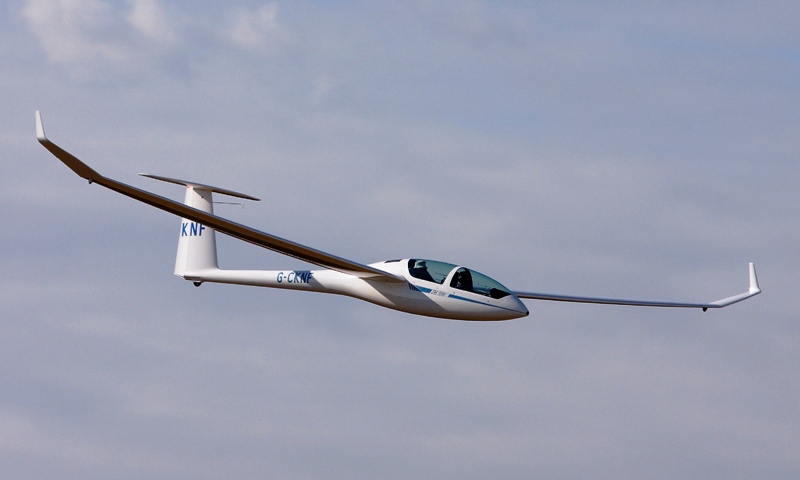
The DG Flugzeugbau DG-1000 is a German two-seater class sailplane that first flew in July 2000 at Speyer, offered with either 18 or 20 metre wings and available in unpowered, self-launching and electric-sustainer forms. It has become a widely used training, competition and aerobatic glider, notably serving as the standard soaring trainer at the United States Air Force Academy under the designation TG-16A.
The DG-1000 is a two-seater class glider designed and built by DG Flugzeugbau of Germany. It is a mid-wing, T-tail sailplane produced in four principal models fitted with either 18-metre or 20-metre wings using the HQK-51 aerofoil, designed by DLR Braunschweig. Versions range from a pure unpowered glider to variants with a retractable pylon-mounted engine or a front electric sustainer, giving the type a broad role spanning basic instruction, competition soaring and aerobatics.
The DG-1000 first flew in July 2000 at Speyer in Germany. It was developed as a successor within DG Flugzeugbau's two-seat line, and the refined DG-1001 variant, featuring electric landing gear retraction, went on to replace the earlier DG-505 in production. The type has continued to evolve, with the DG-1001e neo, fitted with a front electric sustainer, due to fly in 2020. A turbojet-powered research variant, the DG-1000J or Akaflieg Karlsruhe AK-9, registered D-KAKJ and named "Jet", was produced fitting a 0.400 kN (90 lbf) AMT Titan turbojet engine from the Dutch producer Draline, developed in cooperation with the Institute for Thermal Flow Engines at KIT to research and improve the engine's behaviour and fit it with an exhaust attenuator.
The DG-1000 is built with an 18 m or 20 m wingspan of HQK-51 profile and a wing area of 17.5 m2, giving an aspect ratio of 22.8. The airframe has a length of 8.57 m and a height of 1.6 m (given elsewhere as 1.83 m). Empty weight is 461 kg and maximum takeoff weight is 750 kg, with provision for up to 160 kg of water ballast. With the 18 m wingspan the aircraft is fully certified for aerobatics to +7/-5 g, while with the 20 m wingspan it is certified for limited aerobatics to +5/-2.65 g. The powered DG-1000T variant carries a retractable engine mounted on a pylon aft of the double cockpit, driving a two-blade carbon-fibre composite propeller, designed and produced in-house by DG, through a 2.3:1.0 reduction gear. Wing loading is 32 kg/m2 with an 80 kg payload.
The DG1000T has a maximum and never-exceed speed of 270 km/h (170 mph, 150 kn), a cruise speed of 111 km/h (69 mph, 60 kn) and a stall speed of 68 km/h (42 mph, 37 kn) with the 20 m wing extension fitted. Maximum glide ratio is 46.5, with a rate of sink of 0.61 m/s (120 ft/min) engine off and retracted, and a rate of climb of 1.3 m/s (260 ft/min) with the engine running in still air. G limits are +7/-5. The type is described as finely balanced between performance and forgiving handling, qualities that suit it equally to training, competition soaring and aerobatic flying.
The DG-1000S is the basic unpowered variant, using a tandem gear configuration with provision for a retractable landing gear. The DG-1000T adds a retractable pylon-mounted engine aft of the cockpit, with a 2.3:1 reduction gear driving the DG-built two-blade carbon-fibre propeller. The DG-1001 is a refined version with electric landing gear retraction, which replaced the DG-505 in production. The DG-1001e neo is fitted with a front electric sustainer. The TG-16A is the United States Air Force designation used to train cadets in soaring at the United States Air Force Academy, replacing the LET TG-10 Blanik. The DG-1000J, also known as the Akaflieg Karlsruhe AK-9 and registered D-KAKJ, is a turbojet-powered research variant named "Jet".
In 2011 the DG-1000 was selected by the USAF as a replacement for the Blanik TG-10, and it now serves as the basic soaring trainer for cadets at the United States Air Force Academy, operated by the 94th Flying Training Squadron under the designation TG-16A; it is also the primary competition platform for the USAF Academy Aerobatic Demonstration Team. Military and academy operators include the Royal Australian Air Force's Australian Air Force Cadets, the French Armee de l'Air et de l'Espace's Ecole de l'air et de l'espace, and the Indonesian Air Force Academy.
The DG-1001e neo was added to Microsoft Flight Simulator with Sim Update XI in November 2022 as part of the base simulator's 40th Anniversary content, created by Flight Sim Studios, and comes bundled with seven dedicated glider-training lessons covering aerotow, winch launch, basic handling, slipping approach and landing, thermal identification and ridge soaring. In the simulator it is presented as a high-performance yet forgiving sailplane, with its front electric sustainer allowing pilots to boost altitude when unable to find lift or to provide power in an emergency, climbing at up to 260 ft/min under internal electric power. Freeware DG-1000 models have also circulated for older platforms including X-Plane 10 and Microsoft Flight Simulator 2004.