Departure
97%
vs 95% ▲ 2
 MY FS FLIGHTS
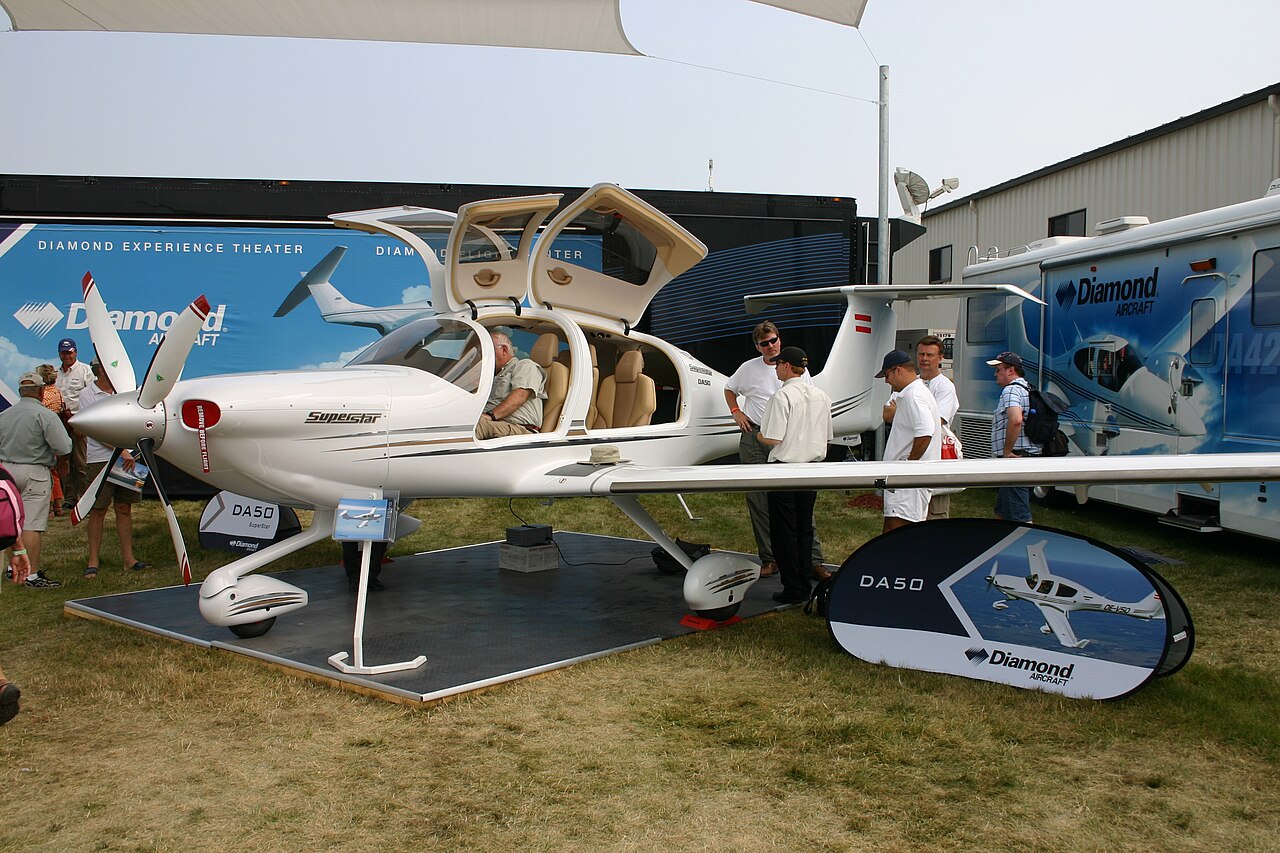
The Diamond DA50 is an Austrian five-seat, single-engine composite aircraft built by Diamond Aircraft Industries, ultimately certified in production form as the DA50 RG with retractable gear and a Continental CD-300 diesel engine. Conceived as a large-cabin step up from Diamond's four-seat singles without going all the way to a twin, it is of interest to the simulator pilot as a modern, jet-fuel-powered complex single with a fully integrated Garmin G1000 NXi flight deck and composite airframe heritage shared with the DA62.
The Diamond DA50 is a five-seat, single-engine aircraft of composite construction, designed and built by Diamond Aircraft Industries of Austria. It occupies a niche above Diamond's fixed-gear four-seat singles, offering one of the largest cabins in its class along with retractable landing gear, positioning it as an aircraft for pilots who have outgrown a fixed-gear single but do not want to step up to a twin. The production version, the DA50 RG, is powered by a single Continental CD-300 jet-fuel diesel engine and built on the same composite airframe philosophy that runs through the Diamond line, including the twin-engine DA62.
The DA50 Super Star prototype was unofficially first shown in December 2006 at a Diamond company Christmas party, with the design intended from the outset to accommodate gasoline, turboprop or diesel engines up to 260 kW (350 hp) and to offer one of the largest cabins among the new generation of general aviation aircraft. The avgas-powered version was originally to be fitted with a FADEC-equipped Continental TSIO-550-J twin-turbocharged engine producing 260 kW (350 hp), with a planned wingspan of 11.67 m (38.3 ft), fuselage length of 8.84 m (29 ft) and maximum takeoff weight of 3,527 lb (1,600 kg); it was also intended to be pressurized and to offer an optional Ballistic Recovery Systems parachute. The aircraft made its first test flight on 4 April 2007 at Wiener Neustadt East Airport, Austria, followed by its public debut at AERO Friedrichshafen on 19 April 2007 and its North American debut at Airventure in July 2007. The project was put on hold in 2009 as the Great Recession took hold and Diamond's attention turned to the D-Jet. On 19 January 2015 the prototype, redesignated DA50-JP7 and fitted with an Ivchenko-Progress Motor Sich AI-450S turboprop, resumed test flying at Wiener Neustadt, with certification then expected near the end of 2016. At the April 2017 AERO Friedrichshafen show, Diamond announced a family of diesel-powered variants: the four-seat DA50-IV, five-seat DA50-V and seven-seat DA50-VII, the DA50-V having first flown in March 2017 and being displayed at that show, with certification then planned for 2018. By April 2019 no DA50 had been produced beyond the single prototype, and Diamond instead announced a new version with fully retractable landing gear and a Continental CD-300 diesel engine at the 2019 AERO Friedrichshafen show. This retractable-gear prototype first flew on 28 October 2019, with Diamond planning to open orders at the April 2020 Friedrichshafen show and expecting European certification and introduction in the third quarter of 2020. EASA certification of the DA50 RG was announced on 9 September 2020, with deliveries planned from the first quarter of 2021, and FAA certification together with the type's first US sale followed in July 2023.
The DA50 RG airframe is constructed predominantly of composite (carbon fibre) material, following the same crashworthy composite airframe philosophy used throughout the Diamond range. It is powered by a single 220 kW (300 hp) Continental CD-300 diesel engine, a geared, liquid-cooled, turbocharged, Jet-A1-fuelled powerplant controlled by two redundant full FADEC units, driving a three-blade MT hydraulic variable-pitch composite propeller. Fuel capacity is 190 L (50 US gal). The design features double-slotted electrically-operated flaps, hydraulic retractable landing gear, electrically adjustable rudder pedals for both pilot and co-pilot, and a Garmin G1000 NXi flight deck with two 10-inch displays, a GFC 700 automatic flight control system with yaw damper, GTX 345R ADS-B in/out transponder, Garmin ChartView, Flight Stream 510, Synthetic Vision Technology, Electronic Stability and Protection, and an Automatic Level Mode (
The DA50 RG cruises at 180 kn (333 km/h), with a maximum speed of 181 kts at 16,000 ft at maximum continuous power, and a stall speed in landing configuration of 57 kts. It has a service ceiling of 20,000 ft and a maximum rate of climb at mean sea level of 1,050 ft/min. Range is quoted at 750 nmi (1,389 km), with fuel economy of 34 L (9 US gal) per hour at max-range power, equating to roughly 12 US gal per hour at typical cruise settings. Useful load is 560 kg (1,232 lb). Diamond and operator material describes the aircraft as offering an exceptional combination of handling, stability and control, aerodynamic efficiency, and ease of operation, with the single-lever power control automatically managing thrust and propeller RPM to reduce pilot workload. In 2021 a factory demonstrator DA50 RG completed a long-distance delivery flight from the Austrian factory to the China AirShow in Zhuhai, Guangdong, covering 13,025 km (7,033 nmi) over 45 flight hours and eight days with 12 en-route stops, demonstrating its cross-country capability.
The DA50 SuperStar was a pressurized version powered by a Teledyne Continental TSIOF-550J, with US FAA certification initially forecast for 2012. The DA50 Magnum was an unpressurized version with a standard integral oxygen system, powered by an Austro Engine AE 300 of 130 kW (170 hp), with certification originally forecast for mid-2010. The DA50-JP7 was a seven-seat version powered by a 350 kW (465 hp) FADEC-controlled Ivchenko-Progress Motor Sich AI-450S turboprop, with two planned sub-variants, a rugged-gear tundra version and a high-performance training/private version, certification initially targeted for mid-to-end 2016. The DA50-IV was a four-seat version powered by a 170 kW (230 hp) SMA SR305-230 diesel engine, announced in April 2017. The DA50-V was a five-seat version powered by a 190 kW (260 hp) SMA Engines diesel, first flown in March 2017 and introduced at AERO Friedrichshafen in April 2017, with certification then planned for 2018. The DA50-VII was a seven-seat version proposed with an SMA SR460 diesel of 270 kW (360 hp), a 280 kW (375 hp) Lycoming gasoline engine, or a 340 kW (450 hp) Ivchenko-Progress Motor Sich AI-450S turboprop, also announced in April 2017. The DA50 RG is the production five-seat version with retractable gear powered by the Continental CD-300 diesel, certified by EASA in September 2020 and by the FAA in 2023.
The DA50 RG is marketed as a first-class piston single for private owners, positioned for pilots moving up from fixed-gear singles such as the Cirrus SR22T but not wanting the step to a twin. Its large cabin, accessed through two forward gull-wing doors and a rear cargo door, seats five with a 60/40 split-folding rear bench, and it is pitched for cross-country travel with family, friends or gear. The type's first notable long-distance operational flight was a factory demonstrator's delivery from Austria to the China AirShow 2021 in Zhuhai, Guangdong. The aircraft has entered the used and new private aircraft market, with new units listed around 1.15 million US dollars and used examples typically trading above one million dollars.
Pilots and reviewers describe the DA50 RG as offering outstanding handling, stability and control along with ease of operation, aided by its single-lever power control that automatically manages thrust and propeller RPM, reducing workload compared with conventional complex singles. The fully integrated Garmin G1000 NXi flight deck, complete with GFC 700 autopilot, Synthetic Vision Technology and Electronic Stability and Protection, gives the type a thoroughly modern glass-cockpit character. Owners transitioning from aircraft such as the Cirrus SR22T have compared the DA50 RG's performance, handling and overall flying experience directly against that type, and the retractable gear, turbodiesel jet-fuel powerplant and large, well-finished cabin are frequently cited as the aircraft's most distinctive features for anyone stepping up from a fixed-gear single.