Departure
97%
vs 95% ▲ 2
 MY FS FLIGHTS
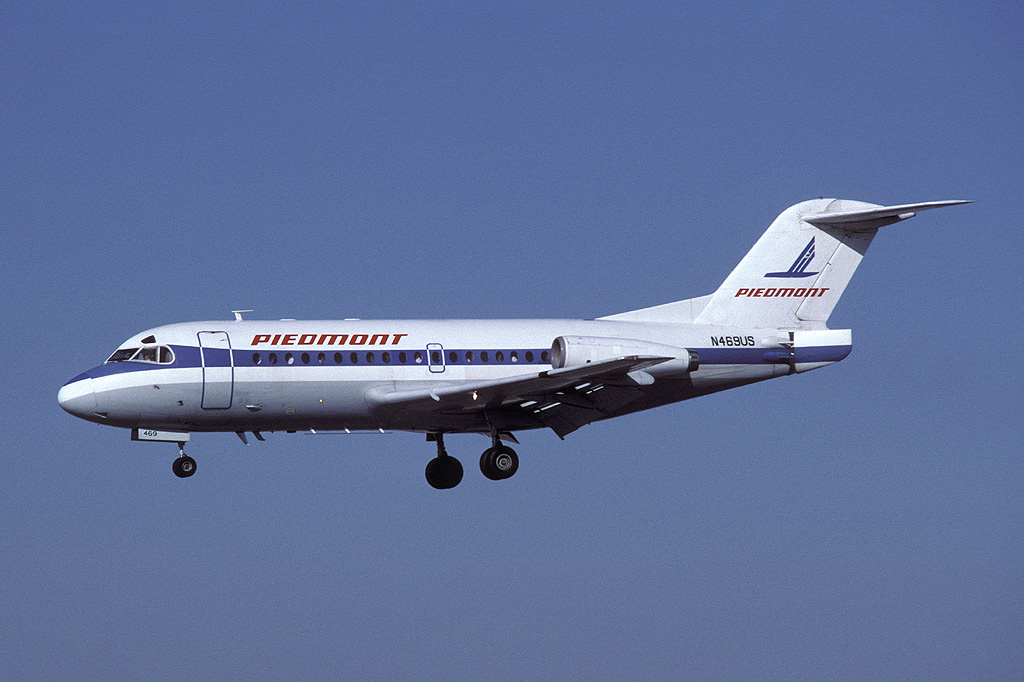
The Fokker F28 Fellowship is a twin-engined, short-range jet airliner designed and built by the Dutch manufacturer Fokker, developed as a turbofan-powered complement to the company's successful F27 Friendship turboprop. Aimed squarely at regional operators needing speed without sacrificing access to shorter runways, it competed directly with the Douglas DC-9 and BAC 1-11, and 241 were built between 1967 and 1987. For simmer pilots it offers a compact, mechanically distinctive 1960s-70s European regional jet with an unusual tail-mounted airbrake and a still-active presence with a small number of operators.
The Fokker F28 Fellowship is a twin-engined, short-range regional jet airliner produced by the Dutch manufacturer Fokker, built as a jet-powered complement to the earlier F27 Friendship turboprop. It seated between roughly 65 and 85 passengers depending on variant and was designed to operate from many of the same shorter regional airfields already served by the F27 and the Douglas DC-3, while offering considerably higher speed. It sat within the same market segment as the Douglas DC-9 and British BAC 1-11, though it was deliberately slower than those types in exchange for simplicity and short-field capability. The type led directly to the later Fokker 70 and Fokker 100 derivatives.
By 1960 Fokker was already established as a manufacturer of the commercially successful F27 Friendship turboprop, and around that time British European Airways issued a specification for a high-speed regional airliner powered by turbofans, prompting Fokker to develop its own short-haul jet. In April 1962 Fokker formally announced the launch of the F28 Fellowship, publicly unveiling the project at the Hannover Air Show. The programme was a multinational collaboration between Fokker, the West German companies Messerschmitt-Bölkow-Blohm (MBB) and VFW-Fokker, and Short Brothers of Northern Ireland, with substantial government backing: the Dutch government funded around 50% of Fokker's stake, and the West German government covered about 60% of the German partners' contribution. Fokker had also approached Sud Aviation and Hawker Siddeley about involvement. Design and production responsibilities were split between the partners, with Fokker building the nose section, centre fuselage and inner wing, MBB/Fokker-VFW producing the forward fuselage, rear fuselage and tail assembly, and Shorts building the outer wings; final assembly took place at Schiphol Airport. Early design work centred on a 50-seat aircraft with a range of up to 1,650 km (1,025 mi), but market research, especially in North America, led Fokker to enlarge the design to a 65-seat, five-abreast layout, broadly comparable in capacity to the Vickers Viscount. Fokker had at one stage intended to power the aircraft with Bristol Siddeley BS.75 turbofans, but when contract negotiations opened Bristol Siddeley withdrew the engine from the market; Rolls-Royce subsequently offered the Spey Junior, a simplified derivative of the Rolls-Royce Spey, and from the first prototype onward the F28 was exclusively powered by Spey variants. The first commercial order came from the German charter airline LTU on 17 November 1965. The prototype F28-1000, registration PH-JHG, made its maiden flight on 9 May 1967. On 24 February 1969 Fokker board member Kees van Meerten received the Certificate of Airworthiness from Willem Jan Kruys, Director General of the Dutch National Aviation Authority, and the type entered revenue service with Braathens SAFE on 28 March 1969. American manufacturer Fairchild Aircraft at one point considered building its own derivative, the Fairchild 228, but this did not reach production and Fairchild instead acted as a distributor for the existing F28. Fokker went on to develop stretched and re-engined variants through the 1970s, and production ended in 1987 after 241 airframes had been built, with the design lineage carried forward into the Fokker 70 and Fokker 100.
The F28 is a low-wing cantilever monoplane of relatively straight, low-speed-optimised planform, fitted with a T-tail and retractable tricycle landing gear. Its wing was kept deliberately simple, without leading-edge slats, and Fowler flaps were used for high-lift performance; de-icing was achieved using engine bleed air rather than more complex mechanical systems. The aircraft was powered throughout its production life by variants of the Rolls-Royce Spey turbofan, mounted in pods either side of the rear fuselage; the F28-1000 used two Rolls-Royce RB.183 Spey Mk 555-15 low-bypass turbofans, each rated at 9,850 lbf (43.9 kN) of thrust. The later F28-4000 introduced quieter Rolls-Royce Spey 555-15H engines together with a redesigned cockpit and a modified, larger wing with additional overwing exits. A notable and unusual design feature was the hydraulically operated tail airbrake, in which the two halves of the tail cone opened to increase drag; this arrangement, later echoed on the BAe 146/Avro RJ, also allowed engines to be kept at higher power settings during critical phases of flight such as approach, reducing spool-up lag if a go-around was needed.
The F28 was designed to be markedly faster than the turboprop types it was intended to complement, notably the F27 Friendship and Douglas DC-3, while remaining deliberately slower in cruise than many contemporary pure jets such as the DC-9 and BAC 1-11. This trade-off allowed the use of a relatively straight, low-mounted wing and gave favourable low-speed handling characteristics, enabling the aircraft to operate from around 85% of the airfields already used by the F27 and DC-3. Fokker and industry commentary at the time noted that the design could achieve roughly double the productivity of the preceding F27 on comparable routes.
The F28-1000 was the original production version, powered by Rolls-Royce Spey Mk 555-15 turbofans and seating up to around 65 passengers. The F28-2000 was a stretched derivative with an extended fuselage, first flown on 28 April 1971, increasing capacity to up to 79 passengers. The F28-3000 followed as a further development within the same family. The F28-4000, first flown on 20 October 1976, combined the stretched Mk 2000 fuselage with a larger wing, additional overwing exits and quieter Rolls-Royce Spey 555-15H engines, raising seating capacity to up to 85 passengers; it became the most commercially successful and most widely built F28 variant. A locally produced American derivative, the Fairchild 228, was considered by Fairchild Aircraft but never entered production, Fairchild instead distributing the standard F28. A carrier onboard delivery (COD) proposal for the US Navy, featuring folding wings, strengthened landing gear and an arresting hook, was put forward by Fokker in 1981 but was not adopted.
The F28 entered airline service with Braathens SAFE on 28 March 1969 and went on to be operated by a wide range of carriers across Europe, South America, Africa and the Asia-Pacific region, reflecting its suitability for shorter regional routes and less developed airfields. Notable operators included Garuda Indonesia and Biman Bangladesh Airlines, while Swedish carrier Linjeflyg was one of the largest operators of the type. In the United States, Piedmont Airlines flew the F28-1000. Production ended in 1987 after 241 aircraft had been completed, with the type's role subsequently taken over by the derivative Fokker 70 and Fokker 100 designs. Into the 2020s a small number of F28s remained in limited government and military service, including with Argentina's LADE.
The F28 is being modelled for Microsoft Flight Simulator by Just Flight as the F28 Professional, covering all four production variants from the Mk 1000 through to the Mk 4000, developed with reference to a real ex-airline aircraft, PH-CHN, at AM&TS (Curio) Woensdrecht. The add-on reproduces the type's distinctive systems and mechanical features in detail, including its dynamic wing-flex, lift dumpers and the characteristic tail-mounted airbrake, together with custom-coded hydraulic, electrical, fuel and pressurisation systems modelled on real-world Flight Crew Operating Manuals. The cockpit is built around Captain, Co-Pilot and jump seat positions with fully animated switches and period-authentic navigation equipment such as RMI and HSI displays, with optional modern GNS430 or UNS-1 FMS navigation fits available for those wanting updated capability. Because the many real-world operators configured their F28s differently over the decades, the simulated cockpit has been set up to match the specific reference aircraft visited during development, giving a consistent and authentic environment for study and route flying of this short-field-capable regional jet.