
Departure
99%
vs 95% ▲ 3
Track every flight, analyse your performance,
and master your flying skills with My FS Flights
Get 10 flights free every month!
Tracked and analysed flights over miles
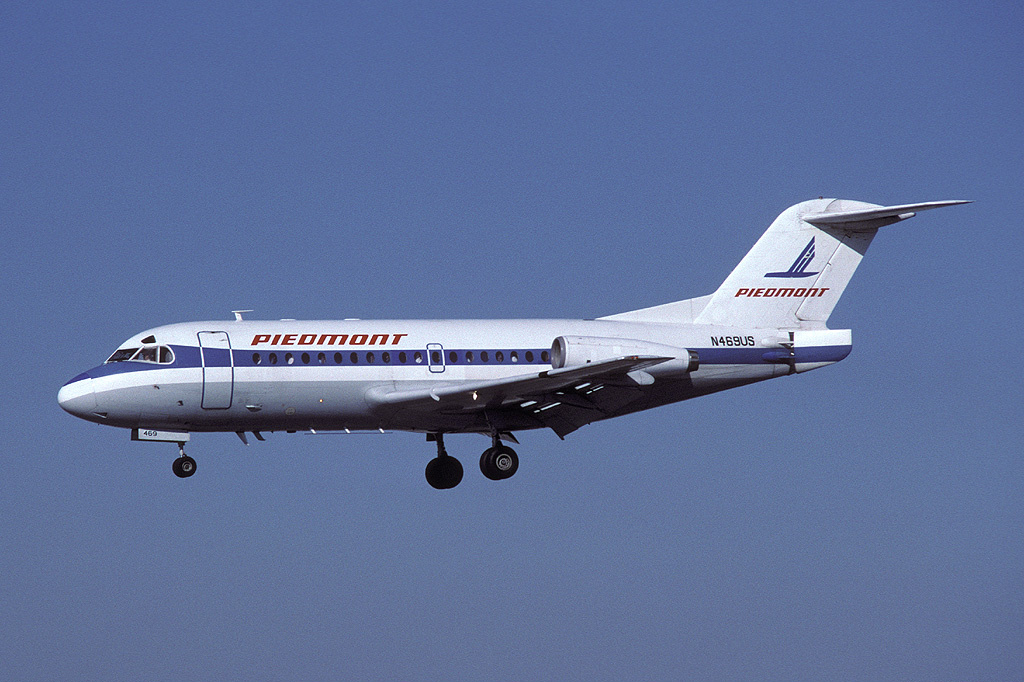
The Fokker F28-4000 was the stretched, higher-capacity development of the Dutch Fellowship regional jet family, combining the longer fuselage of the Mk 2000 with structural and systems refinements that made it the best-selling F28 variant. Built by Fokker with West German and Northern Irish partners, it served short-haul regional routes worldwide and became the direct technical ancestor of the later Fokker 100.
The Fokker F28-4000 is a low-wing, twin-engined regional jet airliner built by the Dutch manufacturer Fokker, distinguished by its T-tail, rear-mounted engines and tricycle undercarriage. It was designed as a jet-powered complement to Fokker's successful F27 Friendship turboprop, aimed at operators needing fast, simple short-haul equipment able to use a large proportion of the airfields already served by the F27 and the Douglas DC-3. The Mk 4000 combined the stretched fuselage introduced on the Mk 2000 with further structural and systems improvements, and it went on to become the most commercially successful of all F28 variants.
Fokker had enjoyed strong sales with its F27 Friendship turboprop and, sensing demand for a small jet commuter airliner, began researching the market in the early 1960s, partly in response to British European Airways issuing a requirement for a high-speed turbojet regional airliner in 1960. The new type was formally announced in April 1962, with Fokker seeking feedback from customers, particularly in North America, during development. Production of the F28 family as a whole ran from 1967 to 1987, spanning just over twenty years and yielding 241 airframes across all variants; other figures put total production at 243. The F28-4000 itself first flew on 20 October 1976. Manufacture was a genuine international collaboration: Fokker built the nose section, centre fuselage and inner wing; the West German firms Messerschmitt-Bolkow-Blohm (MBB) and VFW-Fokker produced the forward fuselage, rear fuselage and tail assembly; and Short Brothers of Northern Ireland supplied the outer wings. The Netherlands government funded half of Fokker's share of the programme, and the West German government funded 65 percent of the West German companies' share. Final assembly took place at Fokker's plant at Amsterdam Schiphol Airport. From 1986 the production lines were adapted to build the new F.28-0100, later renamed the Fokker 100, bringing F28 series production to a close; the design lessons and operational feedback from the F28-4000 fed directly into that successor and into the later, shorter Fokker 70.
The F28-4000 retained the Fellowship family's basic layout: a low, slightly crescent-swept wing, twin rear-fuselage-mounted Rolls-Royce Spey turbofans, and a T-tail. It had a two-crew cockpit and could seat up to 85 passengers, with other sources citing a maximum of 68. The airframe was 29.6 m (97 ft 2 in) long, with a wing span of 25.7 m (82 ft 3 in), a wing area of 79 m2 (850 ft2) swept at 16 degrees with an aspect ratio of 8:1, a tail height of 8.47 m (27 ft 9.5 in) and an internal cabin width of 3.1 m (11 ft 1 in). Empty weight was 17,611 kg (38,825 lb), maximum take-off weight 33,110 kg (73,000 lb), and maximum payload 10,556 kg (23,307 lb). Fuel capacity across the family was 13,040 litres (2,869 imp gal; 3,445 US gal). Power came from two Rolls-Royce Spey Mk 555-15H turbofans, each rated at 43.9 kN (9,850 lbf) thrust, an upgrade over the standard Spey 555-15 fitted to other marks, which together with a larger, more reinforced wing enabled the higher passenger capacity. The wing used a simple flap system with outboard ailerons that operated in unison with the flaps, but no leading-edge slats, keeping the design deliberately simple. Lift dumpers, arranged in five sections, could be deployed only on the ground to assist braking, since conventional thrust reversers were omitted to save weight, reduce complexity and avoid the risk of debris being thrown up on unprepared strips. Instead the aircraft used a distinctive hydraulically operated tail air brake, in which the two halves of the tail cone opened to increase drag; unlike the wing lift dumpers this could be used in flight, allowing rapid descent from cruise altitude and letting the engines be kept at a higher, more responsive power setting during approach. Antiskid brakes and large, low-pressure tyres were fitted to give good short-field performance on unprepared airstrips, and airframe de-icing was provided by engine bleed air.
The F28-4000 had a maximum cruise speed of 436 knots (502 mph, 808 km/h), a service ceiling of 35,000 ft (10,670 m), a take-off distance at maximum take-off weight of 1,676 m (5,500 ft) and a landing distance of 1,065 m (3,495 ft). Fully laden range was 1,668 km (900 nm). The type was noted as being slower than contemporary larger jets but faster than the turboprop Vickers Viscount of similar size, reflecting Fokker's intent to build a simple, robust short-haul jet rather than an outright high-performance one.
The F28 family comprised several marks. The Mk 1000 first flew on 24 February 1969 and 97 were built, seating around 65 passengers. The Mk 2000, first flown 28 April 1971 with 10 built, introduced the stretched fuselage later carried over to the Mk 4000, seating 79. The Mk 3000, first flown 19 July 1978 with 22 built, was based on the shorter Mk 1000 fuselage. The Mk 4000, first flown 20 October 1976, combined the stretched Mk 2000 fuselage with a larger, more reinforced wing and the more powerful Spey Mk 555-15H engines, seating up to 85 passengers, and with around 112 to 115 built it became the most numerous and commercially successful variant. Fokker also developed the F28-5000, an updated version of the Mk 1000, and the F28-6000, an updated version of the Mk 2000 fitted with wing leading-edge slats; neither achieved commercial success, with no 5000s built and only two 6000s completed.
The F28-4000 and its siblings were used almost exclusively on short-haul regional passenger routes, exploiting the type's ability to operate from a high proportion of the smaller airfields also served by the F27 and DC-3. Garuda Indonesia was the largest operator of the F28 overall, at one point flying 62 aircraft. Major operators of the Mk 4000 specifically included Linjeflyg, Garuda Indonesia, Piedmont Airlines, USAir and Turkish Airlines, alongside carriers such as NLM CityHopper, Flight West Airlines, East-West Airlines, Aero Continente, Air Mauritanie and Altair Airlines. Some F28s were also configured in VIP layouts for heads of state; one such aircraft, operated by the Argentine government, became the first jet to land on the Antarctic continent on 28 July 1973, and repeated the feat on 10 August that year carrying the Argentine president and members of his cabinet, marking the first time a head of state had landed there. Across its career the wider F28 fleet was involved in 17 accidents, 14 of them fatal.
The F28-4000 offers the simulator pilot a distinctive short-haul jet-handling experience built around features not found on more conventional rear-engined twins of its generation. In place of thrust reversers it relies on wing-mounted lift dumpers for ground braking and the unusual hydraulically operated tail air brake, formed by the two halves of the tail cone opening, for in-flight drag and rapid descent management, a system that also lets the engines be held at a higher, more responsive power setting on approach. The absence of leading-edge slats and the simple flap-and-outboard-aileron arrangement reflect the type's design ethos of mechanical simplicity, while the reinforced wing and uprated Spey 555-15H engines of the Mk 4000 give it the highest payload and passenger capacity of the family. Its antiskid brakes and low-pressure tyres, intended for unprepared strips, are a reminder of Fokker's original brief to match the field performance of the F27 and DC-3 it was designed to complement.