Departure
91%
vs 95% ▼ 4
 MY FS FLIGHTS
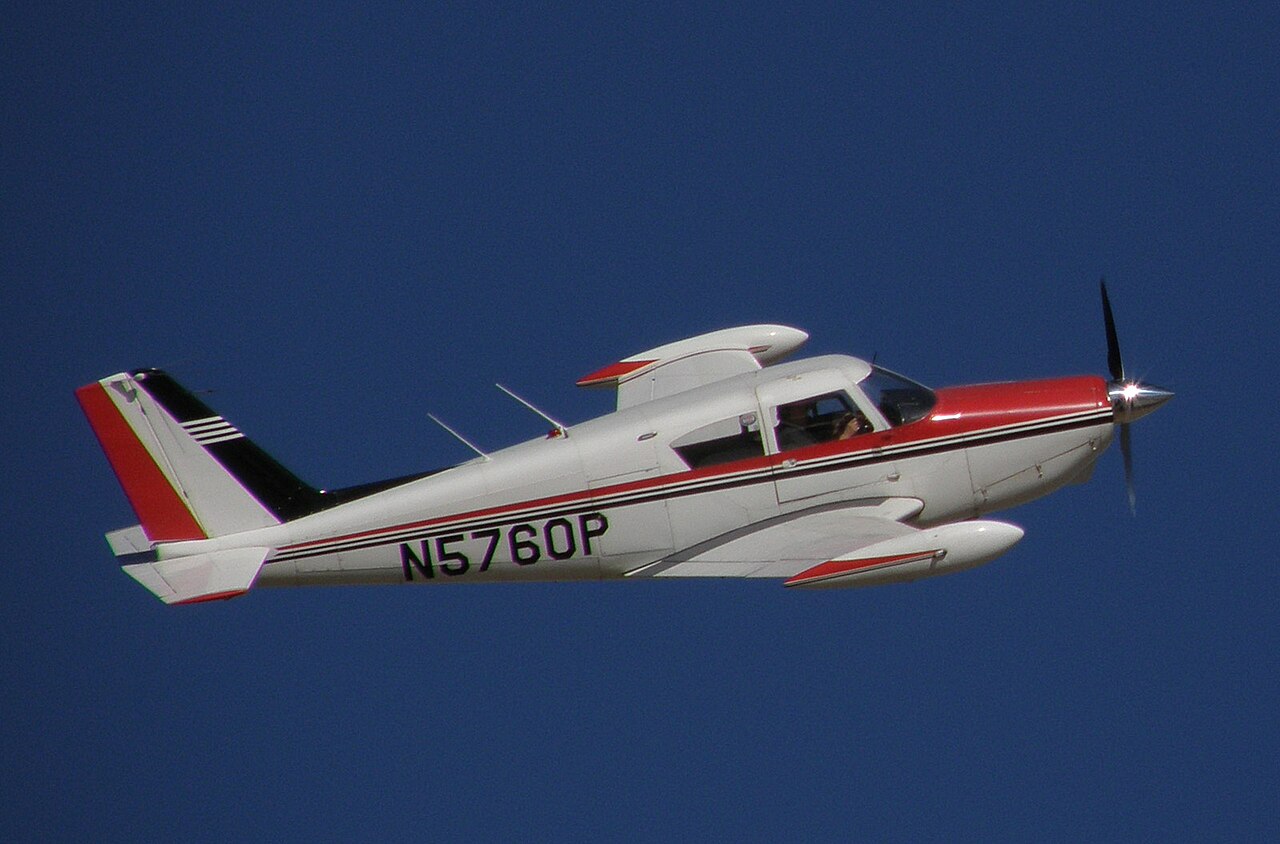
The Piper PA-24 Comanche is an American single-engine, low-wing, all-metal monoplane built by Piper Aircraft between 1957 and 1972 as a retractable-gear, four- to six-seat high-performance tourer intended to challenge the Beech Bonanza. It combined a laminar-flow wing, an all-flying stabilator and tricycle retractable gear with a range of Lycoming engines from 180 to 400 horsepower, making it one of Piper's most capable cross-country singles and the forerunner of the PA-30 and PA-39 Twin Comanche twins.
The PA-24 Comanche is a civil utility monoplane of semimonocoque, all-metal construction, with a low wing, tricycle retractable landing gear, and seating for four or, in later variants, up to six. Manufactured by Piper Aircraft from 1957 to 1972, it represented Piper's first low-wing single-engine design and a deliberate move away from the tube-and-fabric, high-wing aircraft such as the Tri-Pacer and Super Cub that had preceded it. Alongside its twin-engined derivatives, the PA-30 and PA-39 Twin Comanche, it formed the core of Piper's high-performance lineup through the 1960s and into the early 1970s.
Two prototypes were built in 1956, the first completed by June 20, 1956, and the type first flew on May 24, 1956. The first production aircraft, designated PA-24-180 and powered by a 180 hp Lycoming O-360-A1A engine, flew on October 21, 1957, with deliveries beginning shortly after. In 1958 Piper introduced a more powerful variant with a 250 hp Lycoming O-540-A1A5 engine; this model had originally been intended to carry the designation PA-26 before Piper elected to retain the PA-24 designation. The 400 hp PA-24-400 followed in 1964, and in 1965 the PA-24-250 was superseded by the PA-24-260, fitted with a Lycoming IO-540 engine of 260 hp. A turbocharged version using Rajay turbochargers was introduced in 1970. Production of the Comanche, and of the related Twin Comanche, ended abruptly in 1972 when torrential rain from Hurricane Agnes caused the Susquehanna River to flood Piper's Lock Haven plant, destroying airframes, parts and much of the tooling required for production. Rather than rebuild the tooling, Piper discontinued the Comanche and Twin Comanche lines and concentrated on two newer designs already in production at its Vero Beach, Florida plant, the PA-28R-200 Arrow and the twin-engined PA-34 Seneca.
The Comanche is of all-metal, semimonocoque construction with a low, laminar-flow wing, a swept tail and an all-flying stabilator in place of a conventional elevator. Landing gear is tricycle-type and fully retractable. Early PA-24-180s used manually actuated flaps operated by the same Johnson-bar mechanism as the Piper Cherokee; electrically actuated flaps became standard from the 1962 model year. Standard fuel capacity on early models was 60 US gallons, with a 90-US-gallon auxiliary system offered from 1961; the PA-24-400 carried between 100 and 130 US gallons. Powerplants varied by model: the PA-24-180 used a carburetted 180 hp Lycoming O-360-A1A; the PA-24-250 a 250 hp Lycoming O-540-A1A5, mostly carburetted with a small number fuel-injected; the PA-24-400 a purpose-built 400 hp Lycoming IO-720 eight-cylinder engine driving a three-bladed propeller; and the PA-24-260 family a 260 hp Lycoming IO-540, with the turbocharged 260TC using an IO-540-R1A5 fitted with dual Rajay turbochargers. Typical dimensions include a wingspan of 36 ft 1 in (11.00 m) and an overall length of about 25 ft (7.62 m), with the 260B some 6 in longer due to a lengthened propeller spinner rather than a stretched fuselage. Empty weight for the 260 series was around 1,700 to 1,728 lb, rising to a maximum gross weight of 2,550 lb on the original PA-24-180, 2,900 lb on the early 260, 3,100 lb on the 260B and 3,200 lb on the 260C, the latter also gaining cowl flaps, an aileron-rudder interconnect and a distinctive Tiger Shark cowling. The PA-24-400 featured a strengthened tail structure with an additional nose rib in the vertical stabilizer and stabilator to cope with its higher performance.
Handling and performance varied considerably across the model range as engine power grew. The PA-24-180 cruised between 116 and 139 knots with fuel burn of 7.5 to 10.5 gallons per hour at 55 and 75 percent power, and offered a range of 700 nautical miles with 45 minutes reserve on standard fuel, with a full-fuel payload of 715 lb. The PA-24-250 was advertised with a top cruise speed of 160 knots. The 260-series aircraft were advertised at cruise speeds of 142 to 161 knots with fuel burn of 10 to 14 gallons per hour, the 260B at 140 to 160 knots burning 11 to 14 gallons per hour, and the 260C at 150 to 161 knots burning 12.5 to 14.1 gallons per hour. The PA-24-400 was notably fast, with a cruise speed of 185 knots and a top speed of 194 knots, though its large IO-720 engine consumed fuel at a high rate and suffered rear-cylinder cooling problems. General performance figures quoted for the 260 with the IO-540 include a maximum cruise speed of 169 knots, a service ceiling of 22,000 ft, a rate of climb of 1,500 ft/min, a range of around 1,064 nautical miles, and takeoff and landing distances of roughly 1,410 ft and 1,210 ft respectively.
The line began with the PA-24-180, of which 1,143 were built, followed by the PA-24-250, the most numerous variant with 2,537 built. The PA-24-400, fitted with the eight-cylinder Lycoming IO-720 and a strengthened tail, was produced in far smaller numbers, with 148 built despite Piper's claim that it was the fastest production four-seat single of its day. The 260 hp series comprised the PA-24-260 (1965), PA-24-260B (1966-1968), PA-24-260C (1969-1972) and the turbocharged PA-24-260TC (1970-1972), which used dual Rajay turbochargers on a Lycoming IO-540-R1A5; twenty-six 260TCs were built. Across the 260 line a total of around 1,029 aircraft were sold. Total production of the PA-24 family reached 4,857 aircraft. The Comanche's layout and systems were developed further into the twin-engined PA-30 and PA-39 Twin Comanche, and later informed the Ravin 500.
The Comanche was aimed squarely at private owners and flight schools seeking a fast, comfortable, retractable-gear touring single, and was designed to compete directly with the established Beech Bonanza. It became popular for cross-country travel thanks to its favourable cruise speeds and useful load, and many airframes remain in active private ownership today. Its economical operating costs and roomy cabin, wider and taller than contemporary Mooneys, have kept it a respected choice among owners of vintage high-performance singles long after production ended.
Flying the Comanche means working with an all-flying stabilator rather than a conventional elevator, a laminar-flow wing that rewards accurate speed control, and, on early 180 and 250 models, a manually operated Johnson-bar flap lever like that of the Cherokee. The cabin is noticeably roomy for the class, and the type is regarded as one of the more economical four-place retractables to operate, with the 260-series models offering brisk cruise speeds around 150 to 161 knots. Owners of the real aircraft have noted that its original instrument layout is a scattered panel, and many recommend converting to a modern T-panel arrangement for better scan discipline, a detail that gives a sense of the aircraft's era and the kind of workload a pilot should expect when operating one, whether on the ramp or at the yoke.