Departure
95%
vs 95%
 MY FS FLIGHTS
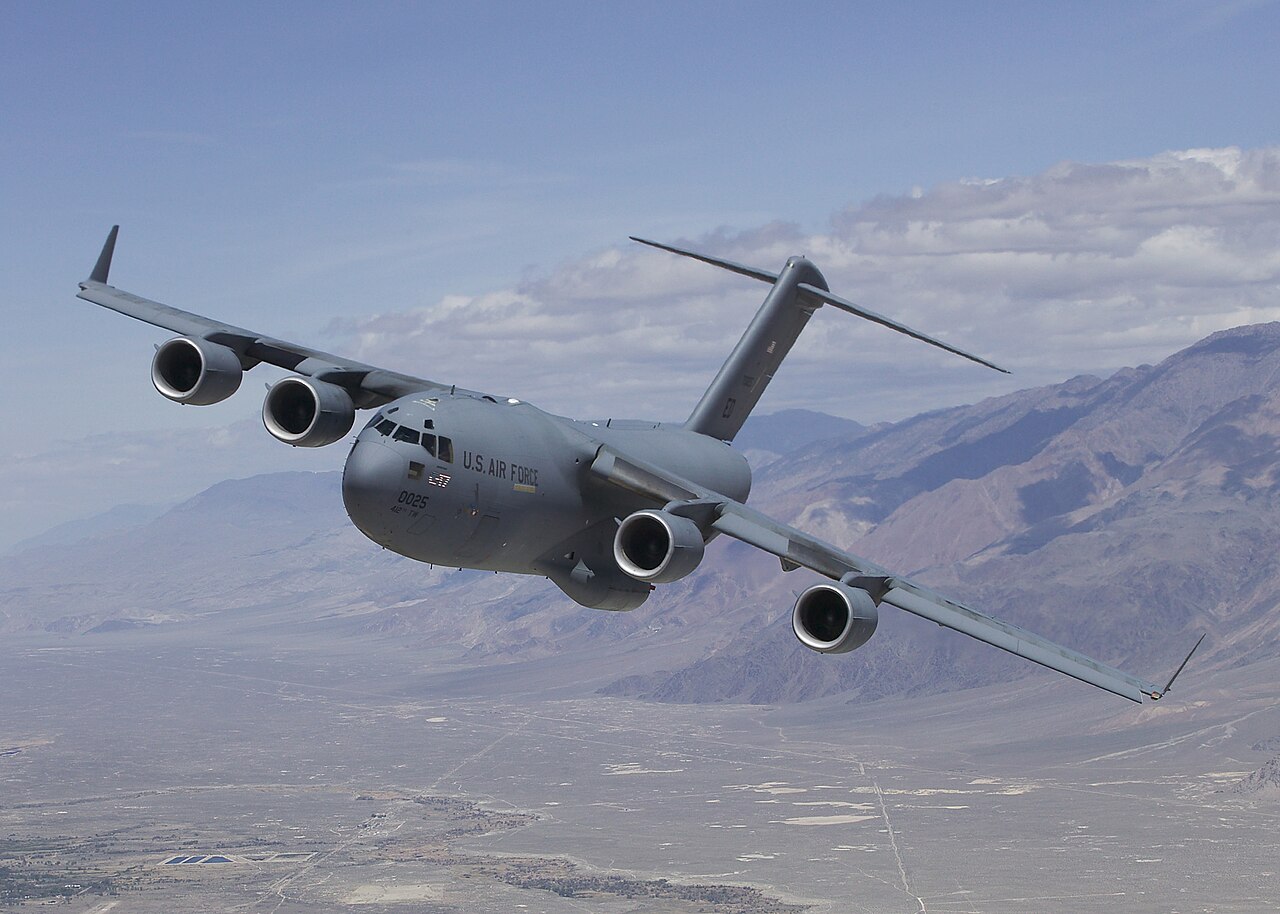
The Boeing (originally McDonnell Douglas) C-17 Globemaster III is a large four-engine military transport aircraft built for the United States Air Force, designed to combine long-range strategic airlift with the ability to operate tactically into short, austere airfields. It has become the backbone of American and allied strategic airlift, carrying troops, vehicles and outsized cargo worldwide, and its combination of size, short-field performance and reliability make it one of the most capable transport types ever built.
The C-17 Globemaster III is a high-wing, four-engine, T-tailed strategic and tactical airlifter developed for the United States Air Force by McDonnell Douglas, with production continuing under Boeing after the 1997 merger. It carries forward the Globemaster name from the earlier piston-engined Douglas C-74 Globemaster and Douglas C-124 Globemaster II. Designed to replace the Lockheed C-141 Starlifter and to take on some of the duties of the Lockheed C-5 Galaxy, the C-17 bridges the gap between strategic intercontinental airlift and tactical delivery directly to forward airfields, a combination that sets it apart from most other large military transports.
The C-17 traces its origins to the McDonnell Douglas YC-15, a smaller prototype airlifter developed in the 1970s for the Advanced Medium STOL Transport competition, which was cancelled before a winner was chosen. The USAF launched the C-X program in November 1979 to develop a larger, longer-range aircraft to augment its aging fleet of C-141 Starlifters, issuing a request for proposals in October 1980. McDonnell Douglas based its C-X entry on the YC-15 but enlarged it, gave it swept wings and fitted more powerful engines; Boeing offered an enlarged three-engine version of its YC-14, and Lockheed offered both a C-5-based design and an enlarged C-141. McDonnell Douglas was selected on 28 August 1981 to build its proposal, designated C-17. Limited budgets delayed the programme by around four years, and a full-scale development contract was awarded in December 1985 under Program Manager Bob Clepper, with first flight then planned for 1990. Development was troubled: a static test of the wing in October 1992 failed at 128 percent of design limit load against a 150 percent requirement, prompting a roughly $100 million redesign; a second test in September 1993 failed at 145 percent, though a review of the test data later showed the wing had not been loaded correctly and did in fact meet the requirement. These and other issues caused McDonnell Douglas to incur a loss of nearly $1.5 billion on the programme's development phase. In April 1990, Secretary of Defense Dick Cheney reduced the planned order from 210 to 120 aircraft. The maiden flight took place on 15 September 1991 from the Long Beach, California plant, about a year behind schedule. The first airframe, T-1, together with five further production aircraft (P1-P5), undertook extensive flight testing and evaluation at Edwards Air Force Base, while two complete airframes were built purely for static and repeated load testing. The C-17 formally entered USAF service on 17 January 1995. Production continued for more than two decades under McDonnell Douglas and then Boeing, with the final aircraft, the last of 279 built, completed at Long Beach and flown in November 2015, ending as the last C-17 delivered to the Indian Air Force following a $366 million Foreign Military Sale approved in June 2017 and delivered on 26 August 2019.
The C-17 is a high-wing, four-engine, T-tailed transport with a swept wing derived conceptually from the YC-15 but enlarged and fitted with more powerful engines. It is powered by four Pratt & Whitney PW2040 turbofans, military designation F117-PW-100, each producing 40,440 pounds of thrust. The aircraft has a wingspan to winglet tip of 169.8 feet (51.8 metres), a length of 174 feet (53 metres), a height at the tail of 55.1 feet (16.8 metres), a fuselage diameter of 22.5 feet (6.9 metres) and a wing area of 3,800 square feet (353 square metres). It employs a quadruple-redundant electronic flight control system with a mechanical backup, digital navigation electronics, two full-time all-function head-up displays and four multifunction active matrix liquid crystal displays, together with an integrated radio management system. The flight deck is crewed by two pilots plus two observer positions. The cargo hold can be configured with 54 permanently installed sidewall seats (27 each side, 18 inches wide with 24-inch centre-to-centre spacing) and 48 additional centreline seats stored on board in sets of six back-to-back, or arranged to carry 80 passengers on eight pallets alongside 54 sidewall passengers. It can accommodate large equipment such as main battle tanks in two side-by-side rows, and its rear ramp allows rapid loading and offload in austere environments.
The C-17 can carry payloads up to 164,900 pounds (74,797 kilograms) and can fly more than 6,200 nautical miles with no payload, with aerial refueling extending its range virtually without limit. It cruises at speeds between Mach 0.74 and 0.77. It is capable of single airdrops of up to 60,000 pounds (27,216 kilograms) and sequential load drops totalling 110,000 pounds (49,895 kilograms) for mass delivery operations. Despite its size, the aircraft retains genuine short-field capability, able to take off and land on runways as short as 3,500 feet (1,064 metres) and as narrow as 90 feet (27.4 metres), by day or night, on unpaved or paved strips, and it can perform unusual manoeuvres for an aircraft of its class such as steep tactical approaches, pinnacle landings and backing up on a slope. Its combination of strategic range and short-field, high-angle handling has given it a reported 92 percent probability of successful mission completion.
The Globemaster III programme produced 279 aircraft between 1991 and 2015, all broadly of the same basic C-17A configuration, though the type has given rise to specialized modifications over its service life, including dedicated medical evacuation (MEDEVAC) fits alongside its standard cargo, troop and airdrop roles.
The C-17 formally entered USAF service on 17 January 1995 and has since become the USAF's principal strategic and tactical airlifter, transporting troops and cargo worldwide and performing medical evacuation and airdrop duties in addition to routine logistics. It played a key logistical role during Operation Enduring Freedom in Afghanistan and Operation Iraqi Freedom in Iraq, and has been used extensively for humanitarian relief, including the 2010 Haiti earthquake, the 2011 Sindh floods and the 2023 Turkey-Syria earthquakes. Around 275 C-17s currently operate worldwide, with the United States Air Force the largest customer, operating 223 aircraft from 12 bases. International operators include the United Kingdom, Australia, Canada, Kuwait, Qatar, the United Arab Emirates and India, along with the Europe-based multilateral Heavy Airlift Wing and the 12-nation Strategic Airlift Capability. India's fleet reached 11 aircraft following delivery of the very last C-17 built, delivered on 26 August 2019 under a Foreign Military Sale contract completed after approval in June 2017. Boeing continues to provide life-cycle sustainment for the global fleet under the Globemaster III Sustainment Program, covering logistics, sustaining engineering and depot-level maintenance, and the fleet is noted for a best-in-class combined dollar-per-flight-hour cost and mission-capable rate.
For anyone flying the C-17 virtually, the aircraft's appeal lies in the unusual combination of characteristics it brings to a transport type: genuine long-range strategic reach alongside tactical short-field performance, including steep approaches, pinnacle landings and operations from strips as short as 3,500 feet and as narrow as 90 feet. The quadruple-redundant electronic flight control system with mechanical backup, twin head-up displays and multifunction liquid crystal displays give the flight deck a modern, highly automated character quite different from older piston-engined Globemasters, while the rear-ramp loading system and capacity for palletized cargo, vehicles and airdrops make cargo operations and airdrop procedures a distinctive part of flying the type.