
Departure
95%
vs 95%
Track every flight, analyse your performance,
and master your flying skills with My FS Flights
Get 10 flights free every month!
Tracked and analysed flights over miles
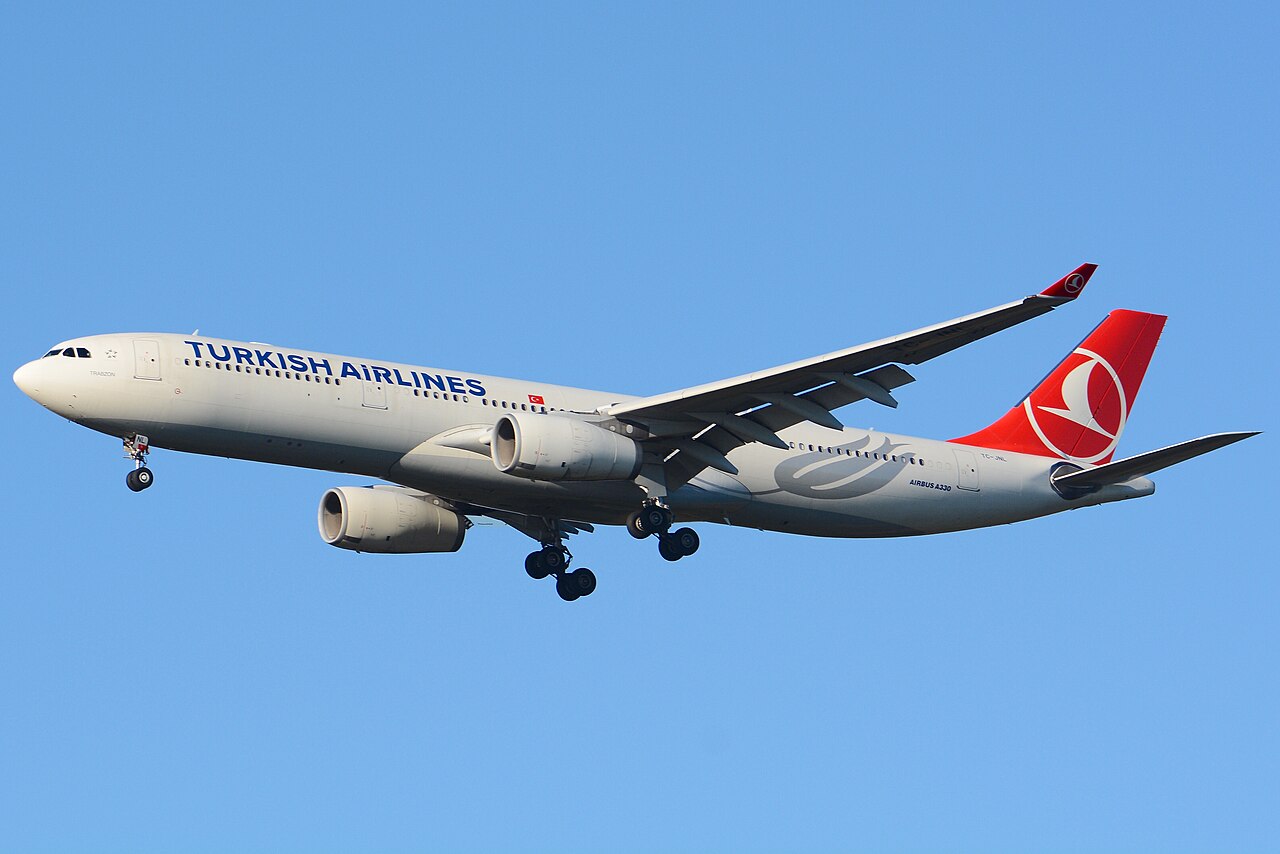
The Airbus A330 is a wide-body, twin-engine airliner developed and produced by Airbus, derived from the A300 lineage and sharing much of its wing and structure with the four-engined A340. Entering service in 1994, it became one of the most widely operated long- and medium-haul jets in the world, prized by airlines for its versatility across route lengths and by pilots for its fly-by-wire controls and Airbus-standard glass cockpit.
The A330 is a wide-body twinjet airliner manufactured by Airbus, developed as a derivative of the A300 alongside its four-engined sibling, the A340. It is a twin-aisle aircraft used for medium- and long-haul passenger and cargo operations, and is the second most delivered wide-body airliner after the Boeing 777. It competes with larger variants of the Boeing 767, smaller variants of the 777, and the 787, and is complemented in the Airbus range by the larger A350.
Airbus began studying larger derivatives of the A300 in the mid-1970s, work that produced the A300B9 project, a lengthened A300 with the same wing fitted with the most powerful turbofans then available, targeted at transcontinental trunk routes as a more fuel-efficient replacement for the McDonnell Douglas DC-10 and Lockheed L-1011 TriStar. In parallel Airbus developed a four-engined 200-seat design, the B11, which became the A340; the two aircraft were redesignated TA9 and TA11 (twin-aisle) and were developed together, sharing the same fuselage and wing to save an estimated US$500 million in development costs. Airbus launched both the A330 and A340 together, along with their first orders, in June 1987. The A330-300, the first variant, first flew on 2 November 1992 and entered service with Air Inter on 17 January 1994. The shorter, longer-range A330-200 followed in 1998, with Canada 3000 as launch operator. In July 2014 Airbus announced the re-engined A330neo, comprising the A330-800 and A330-900, which entered service with TAP Air Portugal in December 2018.
The A330 shares many underpinnings with the early A340, most notably the same wing components and, by extension, the same structure, though the A330 has two main landing gear legs instead of three, lower weights, and slightly different fuselage lengths. Both types use fly-by-wire flight controls and a similar glass cockpit to maximise commonality. The A330 was Airbus's first airliner offered with a choice of three engine types: the General Electric CF6, the Pratt & Whitney PW4000, or the Rolls-Royce Trent 700. The A330neo instead uses the exclusive Rolls-Royce Trent 7000, which has a bypass ratio of 10:1, the highest of any Trent engine, and the aircraft gains a new wing with sharklets. For the A330-200: overall length is 58.82 m (193 ft 0 in), cabin length 45.00 m (147 ft 8 in), fuselage width 5.64 m (18 ft 6 in), maximum cabin width 5.26 m (17 ft 3 in), wingspan 60.3 m (197 ft 10 in), height 17.39 m (57 ft 1 in), wheelbase 22.18 m (72 ft 10 in) and track 10.68 m (35 ft 1 in). Its maximum ramp weight is 251.90 tonnes, maximum take-off weight 251.00 tonnes, maximum landing weight 186.00 tonnes and maximum zero fuel weight 176.00 tonnes, with a maximum fuel capacity of 139,090 litres (36,750 US gallons). Underfloor cargo capacity is 27 LD3 containers, or 8 pallets plus 3 LD3, with a water volume of 178 m3. The A330-300 fuselage, at 63.69 m long with the same 60.3 m wingspan, is the largest of the twin-engined family.
The A330-300 has a range of 11,750 km (6,340 nmi; 7,300 mi) carrying 277 passengers, while the shorter-fuselage A330-200 can cover 13,450 km (7,260 nmi; 8,360 mi) with 247 passengers, and Airbus quotes the A330-200 as capable of routes up to 8,150 nm (15,094 km) with a maximum operating Mach number (Mmo) of M0.86. The A330neo variants extend this further: the A330-800 has a range of 8,100 NM with a maximum take-off weight of 251 tonnes, and the A330-900 a range of 7,350 NM with a maximum take-off weight of 253 tonnes. Airbus states the A330neo delivers up to 14 per cent better fuel economy per seat than the earlier A330ceo generation, and the aircraft is designed to fly efficiently from sectors as short as 30 minutes up to around 17 hours.
The A330-300 was the original, longer-fuselage variant, followed by the shorter, longer-range A330-200. Both together are now referred to as the A330ceo (current engine option) following the launch of the re-engined A330neo family, comprising the A330-800 and A330-900, which use the Rolls-Royce Trent 7000 and a new wing with sharklets. Other variants include the A330-200F dedicated freighter, the A330 MRTT military tanker-transport, the CC-330 Husky military variant, and the ACJ330 corporate jet. Typical passenger capacity ranges up to 406 seats for the A330-200 in high-density configuration, up to 465 seats for the A330-900, and up to 480 seats quoted for larger A330 family members in Airbus material.
The A330 entered airline service with Air Inter in January 1994 and has since become a mainstay of medium- and long-haul widebody operations, with more than 1,975 orders placed, 1,671 aircraft delivered and 1,402 in service with 150 operators as of mid-2026, and a global fleet that has accumulated more than 72 million flight hours. Delta Air Lines is the largest operator of the family, with 81 aircraft in its fleet, ahead of Turkish Airlines as the second-largest operator; other operators include Qatar Airways, Cathay Pacific, Singapore Airlines, KLM, Swiss, Virgin Atlantic, Saudia and Malaysia Airlines. In the military sphere, the A330 MRTT tanker was proposed as the EADS/Northrop Grumman KC-45 for the US Air Force's KC-X tanker competition, initially winning before losing on appeal to the Boeing KC-46.
Because the A330 shares its wing structure, fly-by-wire flight control system and a broadly similar glass cockpit with the four-engined A340, pilots moving between Airbus widebody types find a high degree of commonality in flight deck layout and handling philosophy. Airbus markets the type's versatility as one of its defining traits, with the airframe cleared to fly everything from 30-minute domestic hops to long intercontinental sectors of up to around 17 hours, which in practical terms gives a sim pilot a wide spread of realistic route options to fly, from short regional legs to long-haul crossings near the aircraft's maximum range figures.