Departure
95%
vs 95%
 MY FS FLIGHTS
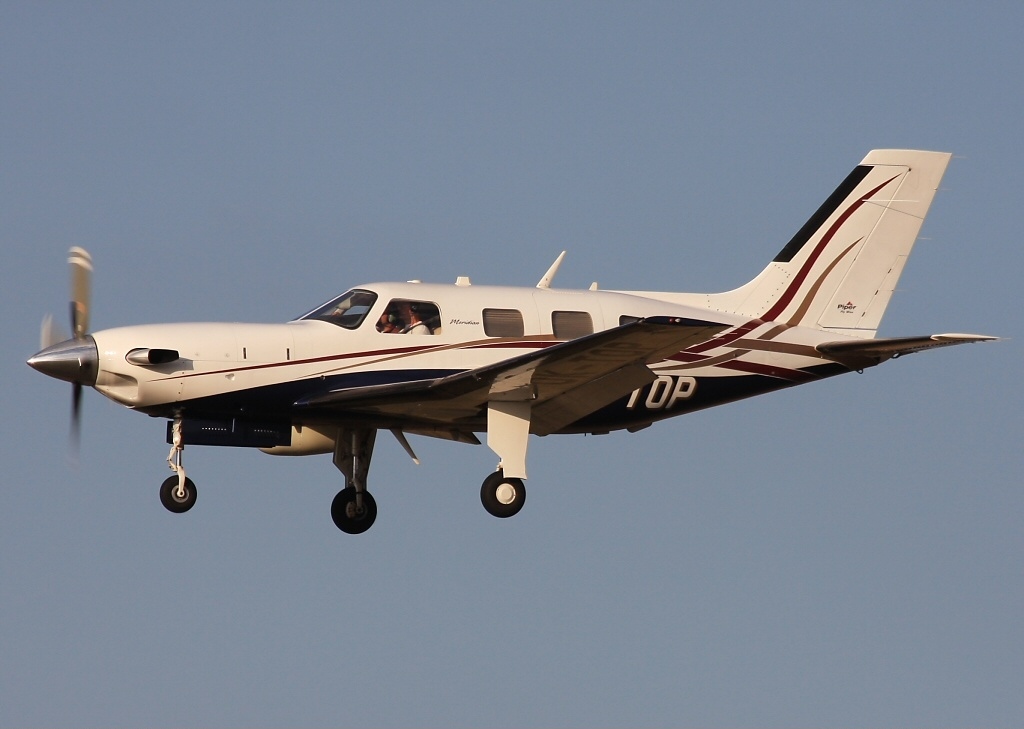
The Piper PA-46 is a family of American six-seat, cabin-class single-engine aircraft built by Piper Aircraft of Vero Beach, Florida, encompassing the pressurised piston Malibu and Malibu Mirage (now M350) and the turboprop Malibu Meridian, M600 and M700 Fury (now M500, M600 and M700). Conceived to rival Cessna's pressurised P210 Centurion, it has remained in continuous production since 1983 and is prized by owner-pilots for combining airline-style cabin comfort with genuine cross-country speed. For a simulator pilot it represents the archetypal high-performance personal transport single, offering pressurised high-altitude cruise, a glass cockpit and, in its turboprop guises, genuine business-aircraft performance.
The PA-46, marketed today as the Piper M-Class, is a family of American light aircraft manufactured by Piper Aircraft of Vero Beach, Florida. All variants are single-engined and seat six (pilot plus five passengers), and the line has been built continuously since the early 1980s. Twentieth-century production was exclusively piston-engined, sold as the Malibu and later Malibu Mirage, but the range now also includes turboprop-powered variants marketed as the M500, M600 and M700 Fury, alongside the current piston model, the M350. The M350 is the only pressurised piston-engined aeroplane in current production, giving it extended range and a more comfortable cabin than most of its certified light-aircraft peers, and the type is recognised as one of the safest single-engine aircraft by the airplane insurance industry.
Work on the PA-46 began in the late 1970s as Piper sought a high-performance, high-altitude single to compete with Cessna, whose pressurised P210 Centurion had been certified in August 1977. Piper hired Cessna's Jim Griswold as Director of Engineering in 1978, and two competing in-house designs were developed, one in Vero Beach under Griswold and one in Lakeland under Grahame Gates; the Vero Beach design was selected in early 1979 and given the designation PA-46-300T. The unpressurised prototype, powered by a 300 hp Lycoming IO-540-K1G5 and built using poplar wood for the fuselage and an oil drum for the fuel tank, first flew on 30 November 1979. It was subsequently modified with a revised tail and a Continental TSIO-520 engine, and a pressurised pre-production prototype named the Malibu, with the finalised high-aspect-ratio 43-foot wing, first flew on 21 August 1982 as the PA-46-310P. Piper announced the new model publicly in November 1982, promoting its ability to carry six people in a cabin pressurised to 5.5 psi differential well into the flight levels. Certification followed on 27 September 1983 under Type Certificate A25SO, and the first production Malibu shipped in March 1984 at an initial base price of $275,000. Piper shipped nearly 400 Malibus between 1984 and the end of production in 1988; Wikipedia records 404 aircraft built with the Continental engine. The Continental TSIO-520-BE proved troublesome, with issues affecting piston pins and crankshaft bearings compounded by pilot-induced problems with lean-of-peak operating procedures, leading to a series of accidents; one resulted in Teledyne Continental Motors paying a $32,125,000 settlement to an injured pilot. The Malibu was discontinued after the 1988 model year in favour of the Lycoming-powered PA-46-350P Malibu Mirage, which had first flown on 21 December 1987 and entered production in October 1988 for the 1989 model year with a new wing, revised electrical system and updated interior. Piper's designers had considered a turboprop PA-46 as early as the mid-1980s, but the company's 1991 bankruptcy delayed the project until the emergence of New Piper Aircraft in 1995. Piper announced the turboprop Malibu Meridian in 1997 and flew a prototype in 1998 powered by a Pratt & Whitney Canada PT6A-42A of 500 shp; certification followed in September 2000 with deliveries beginning that November. An unpressurised derivative of the Mirage, the Matrix (PA-46R-350T), was announced in October 2007 and produced from 2008 to 2015. The Meridian was progressively developed, gaining wing root fillets for extra wing area and fuel capacity, a larger tailplane, and a reinforced wing spar and landing gear that raised maximum take-off weight to 4,850 lb and later, from 2003, to 5,092 lb. In 2015 Piper introduced the M600 (PA-46-600TP) as an upgrade to the M500, with a 600 hp PT6A-42A, Garmin G3000 avionics, a new wing and increased fuel capacity, offering greater range and a slightly higher top speed. The M700 Fury, a high-performance development of the M600, was announced in February 2024 and received FAA certification on 29 February 2024, with an unpaved-field operations approval following in August 2024. The first production M700, PA-46-701TP serial number 003, holds the distinction of being the 1,000th PA-46 turboprop built, a milestone reached at the same time as the M700's launch. Piper no longer markets the line under the Malibu, Mirage or Meridian names, having rebranded the family as the M-Class, comprising the M350, M500, M600 and M700.
The PA-46 is a low-wing, cabin-class single with retractable landing gear and, in its pressurised variants, an air-stair cabin entry seating a pilot and up to five passengers. The signature high-aspect-ratio wing, spanning 43 feet in its original form, gave the aircraft strong high-altitude performance from the outset. The PA-46-310P Malibu had a wing area of 16.3 square metres (175 square feet) and was powered by a Continental TSIO-520-BE turbocharged, fuel-injected flat-six developing 310 hp (230 kW) at 2,600 rpm with 38 inches manifold pressure, maintained from sea level to 24,000 feet, driving a two-blade constant-speed Hartzell propeller. The cabin was pressurised to a 5.5 psi differential. The PA-46-350P Malibu Mirage retained the same wing area but was slightly longer, at 8.81 metres (28 feet 11 inches), and replaced the Continental with a 350 hp (260 kW) Textron Lycoming TIO-540-AE2A, along with a revised electrical system. Avionics evolved considerably over the model's life: earlier Mirages had an all-King panel, later replaced largely by Garmin equipment, with the Garmin G1000 glass cockpit now standard; the pilot's windshield changed from acrylic with a heat-strip overlay to a glass assembly in 1995, and numerous switches were relocated to an overhead console in 1996. In 1999 the Mirage adopted the strengthened wing developed for the turboprop Meridian. The turboprop Malibu Meridian introduced larger wings and tail surfaces to suit the Pratt & Whitney Canada PT6A-42A of 500 shp, and later gained wing root fillets that added wing area and 342 lb (155 kg) of fuel capacity, together with a larger tailplane and a reinforced wing spar and landing gear, raising maximum take-off weight first to 4,850 lb (2,200 kg) and then, from 2003, to 5,092 lb (2,310 kg). From 2009 the Meridian could be specified with a three-screen Garmin G1000 suite including the Garmin GFC 700 autopilot in place of the earlier Avidyne Entegra system. The unpressurised Matrix, designated PA-46R-350T, shared the Mirage's 350 hp turbocharged Lycoming but dispensed with cabin pressurisation. The M600 (PA-46-600TP) introduced a further-developed wing, a 600 hp PT6A-42A and Garmin G3000 avionics with additional fuel capacity.
The production PA-46-310P Malibu had a service ceiling of 25,000 feet, a maximum take-off weight of 4,100 lb, a cruise speed of 215 KTAS on 15 gallons per hour, and a range of 1,555 nautical miles; other figures give a maximum speed of 434 km/h (234 kt), a maximum cruising speed of 398 km/h (215 kt) and a long-range cruise speed of 363 km/h (196 kt), with a maximum cruising range, with reserves, of 1,550 nautical miles (2,870 km). The type's efficiency and lean-of-peak capability were demonstrated in three world speed records set by Steve Stout in his 1986 Malibu, N9114B: Seattle to New York on 23 November 1987 at 259.27 mph (417 km/h), Detroit to Washington DC on 4 January 1989 at 395.96 mph (637 km/h), and Chicago to Toronto on 8 January 1989 at 439.13 mph (707 km/h). The PA-46-350P Malibu Mirage initially had a shorter maximum cruising range of only 1,055 nautical miles (1,954 km), a figure since increased, in the current M350, to 1,345 nautical miles (2,491 km), with the M-Class overview quoting a maximum range of 1,343 nautical miles. The Malibu Meridian, in its developed form, cruises at up to 260 knots (480 km/h) maximum, with a typical 1,000 nautical mile trip requiring 985 lb (447 kg) of block fuel at a block speed of 233 knots (432 km/h). More broadly, the PA-46 family is recognised for its combination of pressurised comfort and genuine speed, with piston variants capable of over 200 knots and trips of around 1,100 nautical miles, credentials that let it outperform cabin-class twins on economy while edging toward entry-level turboprop performance.
The line began with the unpressurised PA-46-300T prototype of 1979, followed by the pressurised PA-46-310P Malibu, the initial production version certified in 1983 and powered by a 310 hp Continental TSIO-520-BE. This was succeeded in 1988 by the PA-46-350P Malibu Mirage (now M350), fitted with a 350 hp Lycoming TIO-540-AE2A and a new wing, and progressively updated with new avionics and systems through the 1990s and 2000s. The PA-46-500TP Malibu Meridian (now M500), certified in September 2000, introduced Pratt & Whitney Canada PT6A-42A turboprop power with enlarged wing and tail surfaces, and was later refined with additional fuel capacity, a strengthened structure and updated Garmin avionics. An unpressurised derivative of the Mirage, the Matrix (PA-46R-350T), was produced between 2008 and 2015. The M600 (PA-46-600TP), introduced from 2015, is an extended-range, higher-powered development of the M500 with a 600 hp PT6A-42A, Garmin G3000 avionics and a new wing. The most recent variant, the M700 Fury (PA-46-701TP), announced in February 2024, is a high-performance development of the M600 and was certified for unpaved-field operations in August 2024.
The PA-46 family has served predominantly as an owner-flown personal and business transport, valued for letting a single pilot carry family or colleagues in pressurised comfort well above the weather while covering long distances efficiently. The piston Malibu and Mirage established the type as a genuine alternative to cabin-class twins, trading an extra engine for lower operating costs at broadly comparable cabin comfort and speed. The turboprop Meridian, M500, M600 and M700 Fury extended this appeal into the entry-level turboprop segment, offering higher cruise speeds and altitudes while remaining within reach of an owner-pilot rather than requiring a professional crew. The M350 remains, as of 2026, the only pressurised piston-engined aeroplane in current production, sustaining the type's niche among high-altitude-capable singles, and the PA-46 series overall is regarded by the aviation insurance industry as one of the safest single-engine types flying.
For a simulator pilot, the PA-46 offers the experience of a genuine cabin-class single: a tall stance on its gear, an air-stair cabin entry, and a pressurised cockpit intended for serious instrument flying rather than short local hops. The piston variants demand attention to engine management, since the type's early history was shaped by the Continental engine's sensitivity to piston pin and crankshaft bearing wear and to incorrect lean-of-peak leaning technique, issues that eventually saw that powerplant replaced by the more robust Lycoming in the Mirage. Across the family the appeal lies in the combination of a high-aspect-ratio wing built for efficient high-altitude cruise with modern Garmin glass cockpit avionics, including the GFC 700 autopilot in later Meridians, M500s, M600s and M700s, making the type a natural fit for pilots wanting to fly long IFR cross-country legs at genuine business-aircraft speeds while retaining single-engine simplicity.