Departure
95%
vs 95%
 MY FS FLIGHTS
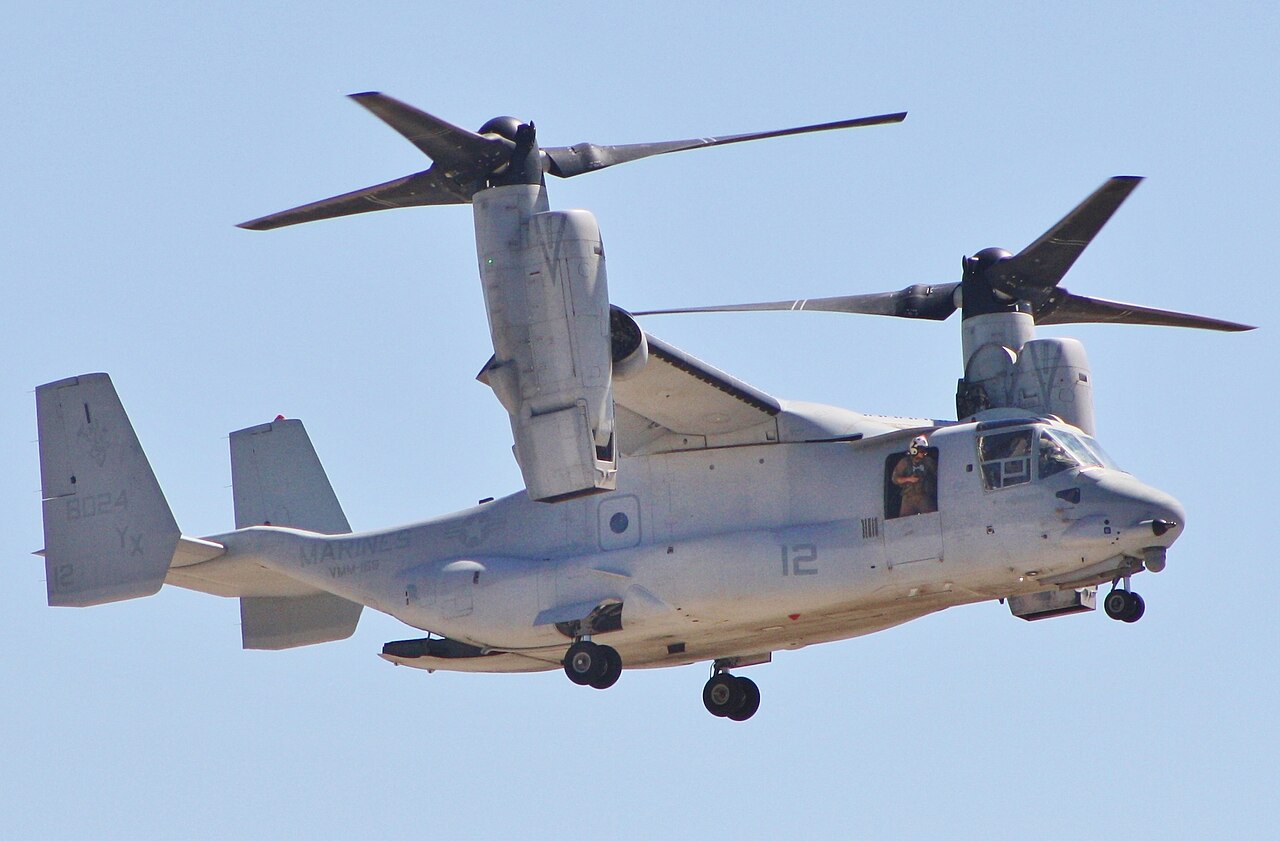
The Bell Boeing MV-22B Osprey is the United States Marine Corps' tiltrotor transport, built jointly by Bell Helicopter and Boeing to combine helicopter-style vertical takeoff and landing with the range and cruise speed of a turboprop aircraft. Developed from the JVX program of the early 1980s and first flown in 1989, it entered Marine Corps service in 2007 as the replacement for the CH-46E Sea Knight. For a simulator pilot it offers a rare combination of rotary and fixed-wing flight regimes within a single airframe, governed by fly-by-wire controls.
The V-22 Osprey is a multi-use, tiltrotor military transport and cargo aircraft with both vertical takeoff and landing (VTOL) and short takeoff and landing (STOL) capabilities, designed to combine the functionality of a conventional helicopter with the long-range, high-speed cruise performance of a turboprop aircraft. It is manufactured jointly by Bell Helicopter and Boeing Defense, Space and Security under the Bell Boeing partnership, and was the first production aircraft of its type. The MV-22B is the United States Marine Corps variant, one of several service-specific versions that also include the USAF's CV-22B and the US Navy's CMV-22B, alongside a modified version operated by the Japan Ground Self-Defense Force.
The failure of Operation Eagle Claw, the 1980 Iran hostage rescue mission, demonstrated to the US military a need for an aircraft that could take off and land vertically while carrying combat troops at speed. The Department of Defense began the Joint-service Vertical take-off/landing Experimental (JVX) aircraft program in 1981 under US Army leadership, with the Navy and Marine Corps given the lead in 1983. A request for preliminary design proposals was issued in December 1982, and although Aerospatiale, Bell, Boeing Vertol, Grumman, Lockheed and Westland expressed interest, only one proposal was submitted: a partnership between Bell Helicopter and Boeing Vertol offering an enlarged version of the Bell XV-15 prototype, submitted on 17 February 1983. A preliminary design contract was awarded on 26 April 1983. The JVX aircraft was designated V-22 Osprey on 15 January 1985, and by March of that year the first six prototypes were in production. Full-scale development began in 1986, and on 3 May 1986 Bell Boeing was awarded a $1.714 billion contract by the US Navy. The first V-22 was publicly rolled out in May 1988, the same year the US Army left the program to focus its budget on more immediate aviation priorities. The first of six MV-22 prototypes flew on 19 March 1989 in helicopter mode, followed by its first flight as a fixed-wing aircraft on 14 September 1989. The third and fourth prototypes completed the Osprey's first sea trials aboard USS Wasp in December 1990. The complexity of developing the first tiltrotor for military service, along with a number of accidents, led to a long and difficult development period. The USMC began crew training for the MV-22B in 2000 and declared Initial Operational Capability in June 2007, with the aircraft supplementing and then replacing the CH-46 Sea Knight. The USAF fielded its CV-22B variant in 2009, and the US Navy began operating the CMV-22B for carrier onboard delivery duties from 2021. By 2020 around 400 V-22s had been built, with more than 475 ordered by 2023.
Production of the Osprey is split between the two partner companies: Bell Helicopter manufactures and integrates the wing, nacelles, rotors, drive system, tail surfaces and aft ramp, integrates the Rolls-Royce engines, and performs final assembly, while Boeing Helicopters manufactures and integrates the fuselage, cockpit, avionics and flight controls. Final assembly, flight testing and delivery take place in Amarillo, Texas, known as Rotor City USA, with other components produced in Philadelphia, Pennsylvania, and Grand Prairie and Fort Worth, Texas. The aircraft is powered by two Rolls-Royce AE1107C Liberty engines, each rated at 6,150 shaft horsepower (4,586 kilowatts). With rotors turning the aircraft spans 84.6 feet (25.8 metres); stowed for shipboard storage, with rotors folded and wing rotated, this reduces to 18.4 feet (5.6 metres) in width and 63 feet (19.2 metres) in length. Rotor diameter is 38.1 feet (11.6 metres), and fuselage length is 57.3 feet (17.47 metres). Height to the top of the nacelles in vertical mode is 22.1 feet (6.7 metres), or 17.9 feet (5.5 metres) to the tail stabiliser. Maximum gross weight for a vertical takeoff is 52,600 pounds (23,859 kilograms), with published figures for a short takeoff of 57,000 pounds and a self-deploy weight of 60,500 pounds. The MV-22 accommodates a crew of two, compared with three on the CV-22 and two on the CMV-22, and can carry up to 24 personnel. The aircraft is equipped with modern fly-by-wire flight controls, aerial refuelling capability using high-speed drogues, and corrosion-resistant coatings for shipboard operation, with rotors and wings that fold for storage aboard carriers and assault ships. Compared with the CH-46E it replaced, the MV-22B delivers roughly twice the speed, six times the range and three times the payload.
The Osprey operates like a helicopter for vertical takeoff, landing and hover, then converts in flight to airplane mode to achieve nearly twice the speed of typical helicopters along with far greater range, and it is capable of cruising effectively at high altitude. Aerial refuelling via high-speed drogues extends mission endurance for prolonged or transoceanic self-deployment flights. The type's runway independence, combined with its speed and reach, is cited as a particular advantage for time-critical missions such as medical evacuation, where rapid response within the first
The USMC operates the MV-22B, the basic transport variant, including VIP-configured examples; the original requirement was for 552 aircraft, later reduced to 360. The USAF operates the CV-22B for special operations forces insertion, extraction and support, fielded from 2009. The US Navy operates the CMV-22B, a variant of the MV-22B that replaced the C-2A Greyhound in the carrier onboard delivery role; compared with the MV-22B it has extended operational range, a beyond line-of-sight HF radio, improved fuel dump capability, a public address system for passengers and an improved cargo lighting system, and it can transport up to 6,000 pounds of cargo or personnel to a range of 1,150 nautical miles. The CMV-22B declared Initial Operational Capability in 2021, with the Navy planning to procure 44 aircraft. A proposed SV-22 anti-submarine warfare variant was studied by the Navy in the 1980s as a potential replacement for the S-3 and SH-2 but was not built. The Japan Ground Self-Defense Force operates a modified MV-22, which first flew in August 2017 with deliveries beginning in 2020, though deployment of the first five aircraft was delayed amid local opposition in Saga Prefecture.
The MV-22B achieved Initial Operational Capability in June 2007 and had three successful combat deployments to Iraq between October 2007 and April 2009 with squadrons VMM-263, VMM-162 and VMM-266. VMM-263 undertook the type's first shipboard deployment with the Bataan Ready Group in May 2009 as part of the 22nd Marine Expeditionary Unit. Since entering service, the Osprey has been used in transportation and medevac operations over Iraq, Afghanistan, Libya and Kuwait, and has supported earthquake relief and hurricane response operations. The CMV-22B has provided carrier onboard delivery and logistics support to naval strike groups since 2021, transporting personnel, mail and priority cargo between shore bases and the fleet. Across the type's service life the fleet has surpassed 700,000 flight hours. The aircraft's development and service have been accompanied by safety concerns; it has been involved in 13 crashes causing 32 fatalities since becoming operational in 2007, and following a fatal crash in Japan in November 2023 the type was grounded for three months. The V-22 has also taken part in training exercises in the United Kingdom, during which its downwash was found to disrupt landing mats, and it was considered as a possible contender for the UK's New Medium Helicopter program before being eliminated from contention.
Flying the MV-22B means managing two distinct flight regimes in one airframe: a helicopter-like vertical mode for takeoff, landing and hover, and a fixed-wing airplane mode reached by rotating the nacelles forward for cruise. The aircraft's fly-by-wire flight controls are designed to reduce pilot workload and improve situational awareness during this conversion, which is the defining handling characteristic of the type compared with either a conventional helicopter or a turboprop transport. Its folding rotors and wing, needed for shipboard stowage, and its aerial refuelling capability via high-speed drogue also shape the kind of long-range, ship-based and special operations missions the aircraft is built to fly.