Departure
94%
vs 96% ▼ 2
 MY FS FLIGHTS
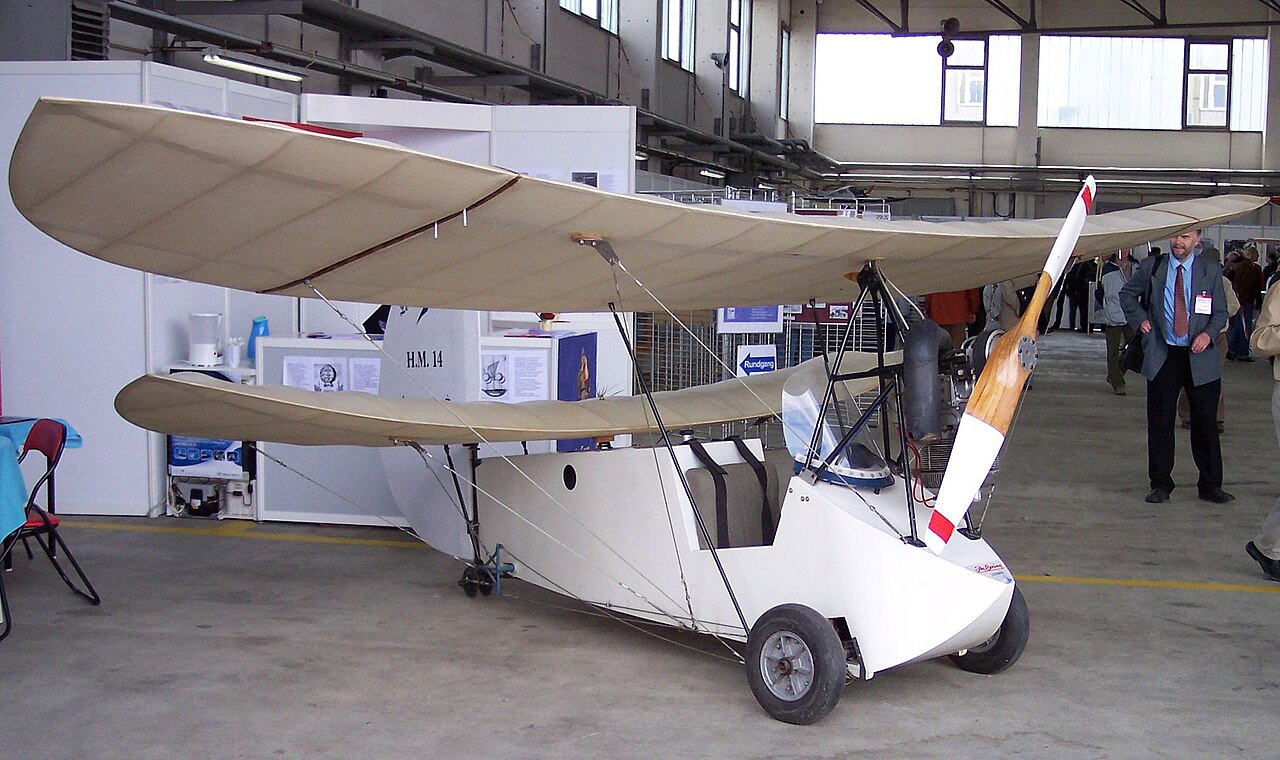
The HM.14 Flying Flea (Pou du Ciel) is Henri Mignet's tiny tandem-wing homebuilt, first flown in 1933 and conceived as a 'Model T of the air'. The Rotax-powered form pairs the classic HM.14 look with a Rotax 447 two-stroke and, typically, the safer wing arrangement of later Mignet designs such as the HM.360. For a sim pilot it offers a very simple, two-axis way of flying, with no ailerons, no elevator and no rudder pedals.
The Flying Flea is a large family of light homebuilt aircraft designed by the Frenchman Henri Mignet and first flown in 1933. The name comes from the French Pou du Ciel, 'Louse of the Sky', itself a play on Pou de la Route, the nickname for the Ford Model T. Mignet wanted to build an aeroplane for the common man. The name originally applied only to the HM.14 but now covers the whole family of similar-configuration aircraft designed by Mignet and others. The HM.14 is a wood-and-fabric tandem-wing aeroplane. Its forward wing is mounted higher than the aft wing, and the main wing overlaps the rear one, so it is often described as a highly staggered biplane without a horizontal tail. The Rotax-engined version is the modern interpretation of that retro layout, built or flown by enthusiasts who want the look of the original with a more reliable powerplant.
Between 1920 and 1928 Mignet built prototypes from the HM.1 to the HM.8, a monoplane that was the first of his designs to fly properly. He published building instructions for the HM.8 Avionnette in a self-produced book. Mignet felt he was not a very good pilot and disliked coordinating stick and rudder on a conventional aeroplane, so he sought a simpler solution. From 1929 to 1933 he built and tested many unusual configurations in a large field near Soissons, and the result was the HM.14. He flew it successfully and demonstrated it publicly in 1933, with a first flight date of 10 September 1933. In 1934 he published plans and building instructions in his book Le Sport de l'Air. It was translated into English in Britain in 1935 and serialised in Practical Mechanics in the US, which prompted hundreds of people worldwide to build their own Fleas. In the UK in 1935 and 1936 Stephen Appleby, John Carden and L.E. Baynes carried out many aerodynamic and engine developments. The original HM.14 had a serious flaw. With the front wing at a high angle of attack for climbing, the fast airflow deflected by the front wing increased lift on the upper surface of the rear wing and pushed the nose down. A pilot who instinctively pulled the stick back made it worse, because the way out was to reduce the front wing incidence. Builders who modified components, such as curving up the wingtips, made matters worse still. Fatal accidents led authorities to ban further construction. Wind-tunnel studies in the UK and France identified the problem and the design was corrected. The bad publicity nevertheless dogged Mignet for the rest of his life. The basic configuration has since proved safe in hundreds of homebuilt aircraft and factory-built microlights. Modern HM.14 builders generally adapt the airfoil and rigging, or even the whole wing, from later Mignet models such as the HM.360 to the HM.14 fuselage, producing a safe and reliable aircraft with the original's retro look.
Mignet made the aircraft deliberately simple: two wings and a rudder, with no ailerons or other control surfaces, and construction in wood and fabric. The original was a single-seater with two-axis controls. The main wings have substantial dihedral. The original HM.14 prototype used a 17 hp (13 kW) Aubier-Dunne 500 cc two-stroke motorcycle engine. It had a wingspan of 19.5 ft (5.9 m), a length of 11.5 ft (3.5 m) and a gross weight of 450 lb (204 kg). The Rotax-engined version uses a Rotax 447 two-cylinder, two-stroke engine of 40 hp. A Rotax-powered HM.14 replica has a design empty weight of 350 lb. The rudder had to be quite large because the fuselage is very short, which reduces its leverage, and because it must produce the roll as well as the yaw.
The original HM.14 had a usable speed range of 25 to 62 mph (40 to 100 km/h). The control stick is conventional in appearance but works differently. Fore-and-aft movement alters the angle of attack of the front wing, which sits ahead of the centre of gravity, so it raises and lowers the nose by changing that wing's lift. Side-to-side movement operates the large rudder. Because of the wings' dihedral, yaw-roll coupling then produces a stable rolling motion for a banked turn. That roll is not readily available on take-off or landing, so the aircraft tolerates crosswinds poorly and cannot be landed or taken off in substantial crosswinds. It should be flown into wind from a large open field, as was normal in the 1930s. The pitch behaviour of the early HM.14 is the lesson of its history. In a nose-down tendency the correct response is to reduce front wing incidence, not to pull back.
The HM.14 led to more than 300 different models of the Flying Flea. Examples include the HM.16 Pou-Bebe (Baby Pou) of 1936 and the HM.18 of 1937, a single-seater with an enclosed cockpit and a 35 hp Mengin engine. Later Mignet designs include the HM.360 and HM.380, and the HM.1000 Balerit. Builders of modern HM.14s commonly borrow the HM.360 wing arrangement. A streamlined-fuselage HM.14 was still offered as a kit or plans in 2012, and other Flea derivatives have flown with larger engines such as a 90 hp Continental in a popular two-seater.
The Flying Flea has served as a sport, personal and trainer aircraft, and above all as a homebuilders' aeroplane. After the 1930s publication of the plans, hundreds were built around the world, and the type is still built and flown. Enthusiasts fly them in places such as Australia, and French enthusiasts hold an annual meeting every June. Mignet's basic layout has also fed through into factory-built microlights.
Flying the HM.14 in a simulator is about unlearning conventional habits. There are no rudder pedals and no ailerons: the stick pitches the front wing, and sideways movement yaws and rolls the aircraft through the rudder and dihedral. Turns are gentle, and take-offs and landings call for a runway or field aligned with the wind, as crosswinds are poorly tolerated. With a modest 40 hp Rotax 447 and a design empty weight of 350 lb, it suits low, slow and relaxed local flying. Treat any nose-down tendency by easing the stick forward, and not by pulling back..