Departure
94%
vs 95% ▼ 1
 MY FS FLIGHTS
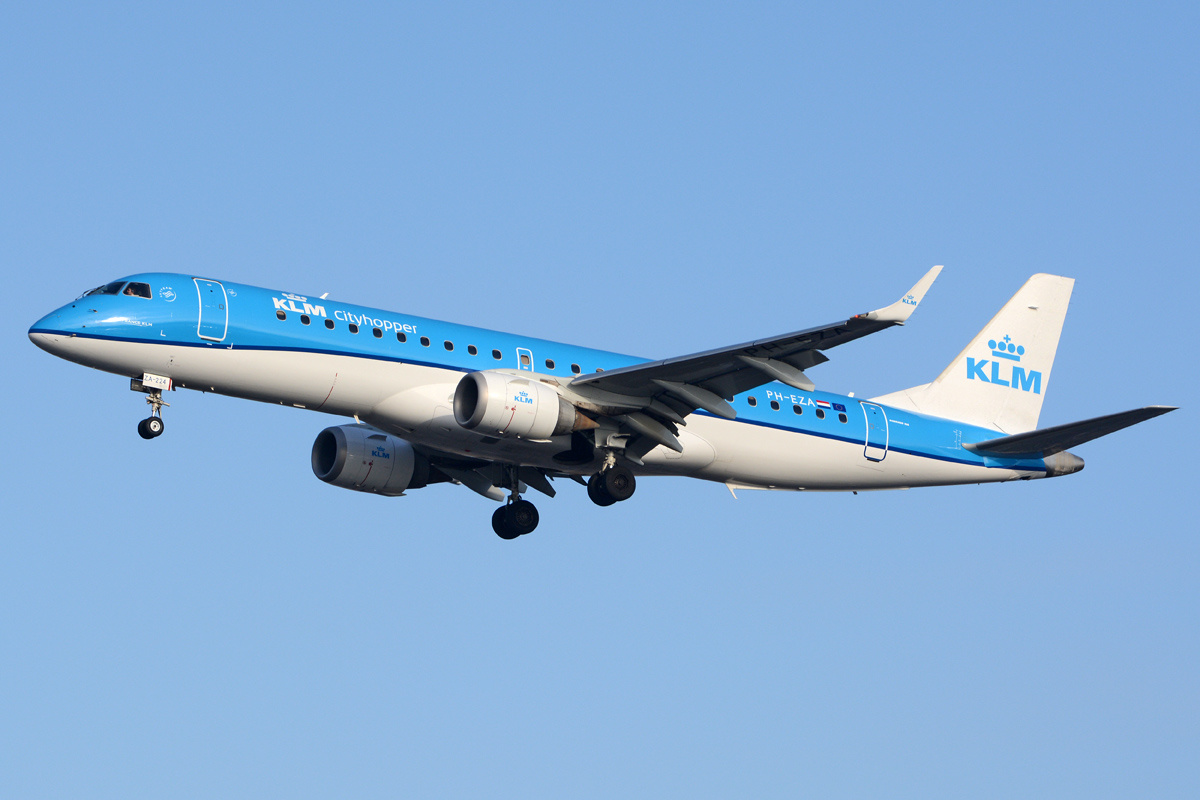
The Embraer E195 is the largest member of the first-generation E-Jet family, a four-abreast, narrow-body, twin-engined regional jet developed by the Brazilian manufacturer Embraer and introduced in 2004. Built to offer mainline-style comfort and economics on lower-density routes, it shares near-total commonality with its E190 sibling and has since been joined by the re-engined, fly-by-wire E195-E2, making it a type of interest to pilots who fly across both first- and second-generation E-Jets.
The E195 is a four-abreast, narrow-body, short- to medium-range regional jet powered by two turbofan engines, produced by the Brazilian manufacturer Embraer as the largest and highest-capacity member of the original E-Jet family. It was designed to sit between traditional regional jets and mainline narrow-bodies, offering capacity similar to early versions of the McDonnell Douglas DC-9 and Boeing 737 while retaining the operating economics of a smaller aircraft. Embraer markets it as a high-capacity regional jet particularly suited to low-cost operators, and it incorporates fly-by-wire flight controls intended to reduce pilot workload and improve aircraft performance.
The E195 emerged from the E-Jet programme, which Embraer unveiled in March 1997 as a complement to its earlier ERJ family, initially studied as a stretched derivative before the company opted for an all-new design in February 1999. The E-Jet family, then carrying the twin designations ERJ-170 and ERJ-190, was formally launched at the Paris Air Show on 14 June 1999. The first E-Jet prototype flew on 19 February 2002, beginning a multi-year test campaign with six prototypes, and the first aircraft, an E170, was delivered to LOT Polish Airlines on 17 March 2004. The larger E190 and E195 variants entered service later that same year. Embraer subsequently developed a second generation, the E195-E2, as part of the wider E-Jet E2 programme launched at the Paris Air Show in June 2013; the E195-E2 received certification in April 2019, with Azul Brazilian Airlines as its first operator.
The E195 shares near-total commonality with the E190, including identical fuselage cross-section and avionics, while the E190/E195 pairing shares around 89 percent commonality with the smaller E170/E175 pairing. As the largest first-generation E-Jet, the E195 is fitted with a larger wing, horizontal stabiliser and landing gear structure than the base E170/E175 models to support its greater size and weight. The aircraft features fly-by-wire flight controls, which Embraer states help reduce pilot workload and improve aircraft performance. Embraer has also developed the E195F, a freighter conversion of the passenger aircraft, offering a payload capacity of 12,300 kg (27,100 lb); this variant made its first flights in April 2024 with certification expected to follow. The later E195-E2 uses a redesigned, higher-aspect-ratio wing with raked wingtips and is powered by Pratt & Whitney PW1900G geared turbofans, each rated at 98 kN (22,000 lbf) with a 190 cm (73 in) fan and a 12:1 bypass ratio; its wing has a span of 33.7 m (111 ft), giving it the highest aspect ratio of any airliner wing, with the E195-E2 variant featuring a longer wingtip extension than the E190-E2.
Embraer states the E195 offers a range of up to 2,300 nm. The later E195-E2 increased maximum take-off weight to 61,500 kg (135,600 lb) and extended range to 2,600 nmi (4,800 km). During E2 flight testing, an E190-E2 prototype reached Mach 0.82 and climbed to 12,000 metres (41,000 ft) while exercising the fly-by-wire system in normal mode, giving an indication of the family's cruise performance envelope.
The original E-Jet family comprises the E170 and E175, which form the smaller base models with 95 percent commonality between them, and the E190 and E195, which form the larger, stretched versions powered by different engines and fitted with a larger wing, horizontal stabiliser and landing gear. The E195 is the largest first-generation model, seating between 120 and 146 passengers depending on configuration. Embraer has introduced the E195F, a freighter conversion of the passenger E195, offering a 12,300 kg (27,100 lb) payload, alongside a corresponding E190F with 10,700 kg (23,600 lb) payload. The family was superseded by the E-Jet E2 generation, of which the E195-E2 is the largest variant, seating up to 150 passengers in a single-class layout; it introduced a new wing, fly-by-wire controls, updated avionics and PW1900G engines, and was certified in April 2019 with Azul Brazilian Airlines as launch operator of that specific model.
The E195 entered airline service in 2004 following the earlier delivery of the first E170 to LOT Polish Airlines, and Embraer positions it as an ideal choice for low-cost operators seeking strong route economics and network flexibility through higher capacity. The E-Jet family as a whole has proven popular with both mainline and regional carriers worldwide, particularly regional operators in the United States. The second-generation E195-E2 has been adopted by operators including Azul Brazilian Airlines, KLM Cityhopper, which configures the type for up to 136 passengers, Porter Airlines, and Binter Canarias, which took delivery of an E195-E2 configured with 132 seats in a single-class layout.
Embraer highlights that the fly-by-wire flight control system fitted to the E-Jet family, including the E195, is designed to reduce pilot workload and improve aircraft performance compared with earlier-generation regional jets, a characteristic that carries through into the later E195-E2 with its further-refined fourth-generation fly-by-wire system.