Departure
95%
vs 95%
 MY FS FLIGHTS
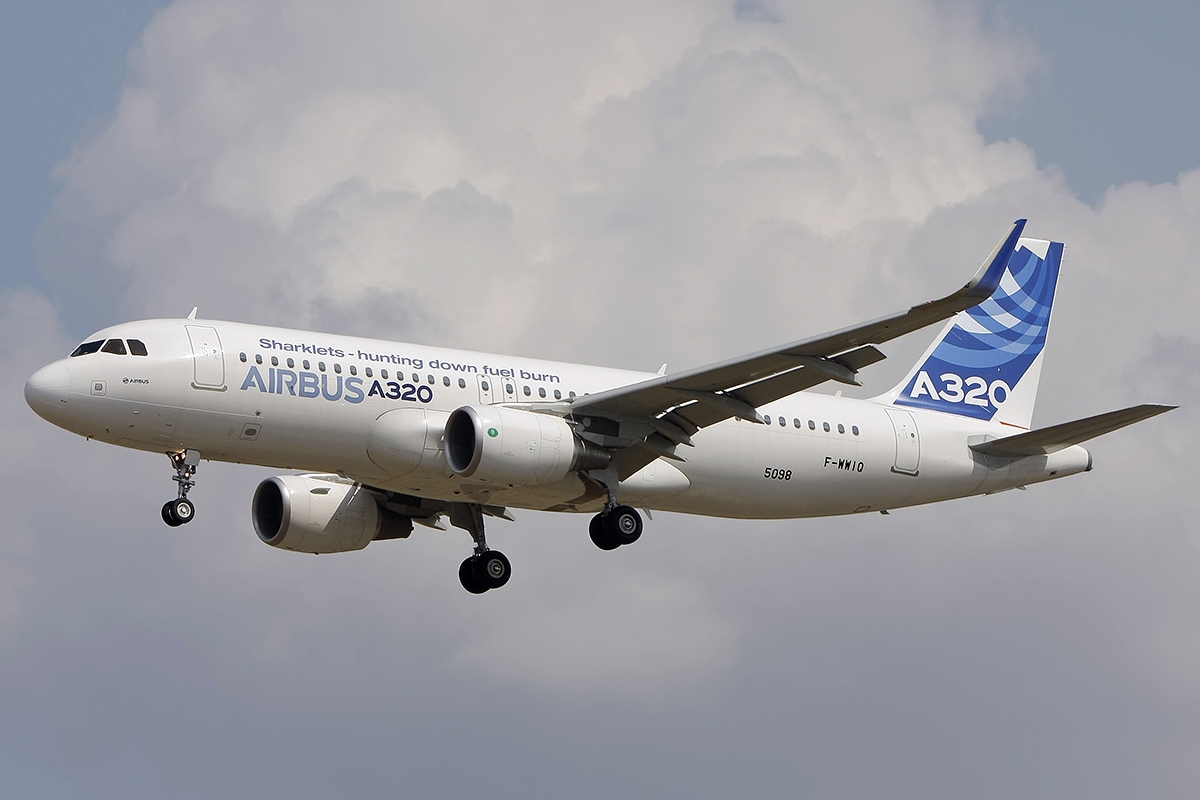
The Airbus A320 is a narrow-body, twin-engine jet airliner developed by Airbus to compete with the Boeing 737 and McDonnell Douglas MD-80, and it stands as the founding member of the best-selling A320 family. Launched in March 1984 and first flown on 22 February 1987, it entered service with Air France in April 1988 as the first commercial aircraft to feature full digital fly-by-wire flight controls, a innovation that reshaped cockpit design across the industry. For a simulator pilot it is essential flying: a benchmark short-to-medium-haul airliner whose side-stick, envelope protection and family commonality defined modern airline flying.
The Airbus A320 is a narrow-body, twin-engine jet airliner built by Airbus, occupying the short-to-medium-haul segment of the airliner market. It is the original and namesake member of the Airbus A320 family, which also comprises the shorter A318 and A319 and the stretched A321, all sharing a common six-abreast economy cross-section and a common cockpit. The family as a whole is described as the best-selling airliner ever built, having overtaken the Boeing 737 family in fleet size in 2017, in total orders in October 2019, and in total deliveries in September 2025.
Airbus's interest in a single-aisle successor to types such as the BAC One-Eleven and rival to the Boeing 737 and McDonnell Douglas DC-9 traces back to studies of A300 derivatives from the early 1970s, including a series of concepts designated A300B1 to B9 and a tenth variant, the A300B10, which became the Airbus A310. A separate Joint European Transport (JET) programme was established in June 1977 by British Aerospace, Aerospatiale, Dornier and Fokker, based at the former BAe site in Weybridge, Surrey, and this work fed into Airbus's Single-Aisle (SA) studies from 1980. The JET2 concept, seating 163 passengers, evolved into the Airbus S.A1/2/3 series before the project was redesignated A320 in February 1981, with Airbus working alongside Delta Air Lines on a 150-seat requirement. Funding negotiations proved difficult: the UK government was initially unwilling to fund the tooling requested by BAe, estimated at 250 million pounds, before agreeing on 1 March 1984 to pay 50 million pounds regardless of whether the aircraft flew, with the balance recovered as a levy on aircraft sold. The A320 programme was formally launched in March 1984, the aircraft first flew on 22 February 1987, and it entered service with Air France on 18 April 1988. The family was subsequently expanded with the stretched A321 (first delivered January 1994), the shorter A319 (April 1996) and the shortest variant, the A318 (July 2003). In December 2010 Airbus announced the re-engined A320neo (new engine option), which entered service with Lufthansa in January 2016; the earlier generation was retrospectively renamed A320ceo (current engine option). Final assembly of the family takes place in Toulouse, France; Hamburg, Germany; Tianjin, China (since 2009); and Mobile, Alabama, in the United States (since April 2016), with new final assembly lines inaugurated in Mobile and Tianjin in 2025.
The A320 is a twin-engine, low-wing airliner with a six-abreast economy-class cabin cross-section. Engine options on the ceo generation are the CFM56-5A, CFM56-5B or IAE V2500 turbofans. The aircraft was the first commercial type to feature full digital fly-by-wire flight controls in place of conventional mechanical linkages, replacing the traditional control yoke with a side-stick, and it introduced flight envelope protection, which limits the aircraft from exceeding its structural and aerodynamic performance limits. The A320 is 37.6 metres (123 feet) long. Across the family, maximum take-off weights range from 68 to 93.5 tonnes (150,000 to 206,000 lb). The A320neo introduced new-generation engines together with aerodynamic wingtip devices known as Sharklets, and later variants use Carbon Fibre Reinforced Polymer in key wing structures and Aluminium-Lithium alloys in the fuselage to reduce weight. Airbus states the family is certified to fly on up to 50 percent Sustainable Aviation Fuel and is engineered for up to 100 percent SAF capability by 2030.
The A320 typically accommodates 150 to 186 passengers, with a range of 5,740 to 6,940 kilometres (3,570 to 4,320 miles; 3,100 to 3,750 nautical miles) quoted for the family as a whole. Under current Airbus marketing figures for the A320neo variant, the aircraft flies up to 3,400 nautical miles and seats up to 194 passengers at maximum capacity, with a maximum take-off weight of 79 tonnes; Airbus states the neo delivers at least 20 percent lower fuel burn and CO2 emissions per seat compared with the previous generation. The original A320 design brief called for the aircraft to carry 150 passengers over distances of 5,280 to 3,440 kilometres (3,280 to 2,140 miles; 2,850 to 1,860 nautical miles) using fuel from the wing tanks alone, with a cruise speed target of Mach 0.84 inherited from the earlier JET programme studies. The fly-by-wire system and envelope protection give the type a distinctive handling character, smoothing pilot inputs electronically and preventing the aircraft from being flown outside its certified limits.
The A320 is the founding member of a family that expanded to include the stretched A321, first delivered in January 1994; the shorter A319, introduced in April 1996; and the shortest variant, the A318, delivered from July 2003. The A318 is unique in the family in offering a choice of CFM56-5B or PW6000 engines in place of the IAE V2500 fitted to other ceo variants. In December 2010 Airbus launched the A320neo (new engine option) family, encompassing re-engined and aerodynamically improved A319neo, A320neo and A321neo variants; the earlier generation was renamed A320ceo to distinguish it. The A321XLR (Xtra Long Range), the newest and longest-range family member, extends operational range to 4,700 nautical miles (8,700 km) through a newly designed rear centre fuel tank and enhancements to the landing gear and wing flaps, giving a 30 percent lower fuel burn per seat than previous-generation single-aisle aircraft. Airbus Corporate Jets are modified business-jet versions of the standard commercial variants.
The A320 family serves operators ranging from low-cost carriers to major mainline airlines across short-haul, medium-haul and, with the A321XLR, long-range transcontinental routes. American Airlines is the largest A320 family operator, with 489 aircraft in its fleet, while IndiGo is the largest customer, with 930 aircraft on order. More than 375 operators fly the family, and the global fleet has completed more than 176 million flights over 328 million block hours since entry into service. The A320ceo generation originally competed against the Boeing 737 Classic and McDonnell Douglas MD-80, and later their successors the 737 Next Generation and MD-90, while the Boeing 737 MAX was developed by Boeing as a direct response to the A320neo.
The A320 is significant to any simulator pilot as the aircraft that introduced full digital fly-by-wire flight controls and side-stick handling to commercial aviation, replacing the conventional yoke with an electronic interface and giving the type its distinctive smooth, computer-mediated control feel. Flight envelope protection is a defining characteristic of flying the type, preventing the aircraft from being manoeuvred outside its structural and aerodynamic limits regardless of pilot input. Commonality of cockpit design across the wider A320 family, and indeed across other Airbus types, means that skills learned on one variant transfer readily to others, which is part of why the type remains such a widely modelled and flown aircraft in simulation.