Departure
92%
vs 95% ▼ 3
 MY FS FLIGHTS
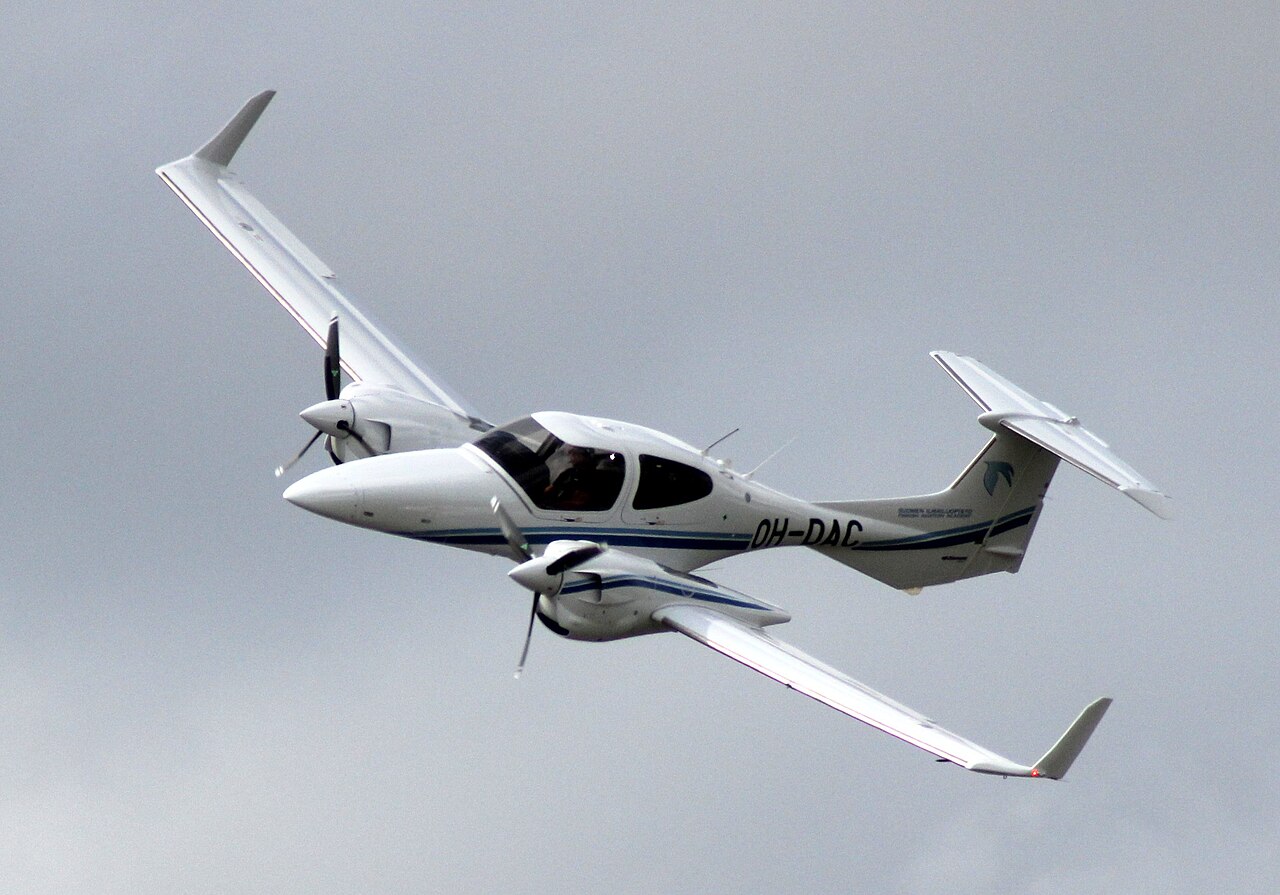
The Diamond DA42-TDI Twin Star was the original production version of Diamond Aircraft's first twin-engined design, a four-seat, low-wing, all-composite light twin powered by a pair of turbocharged Thielert-built diesel engines burning jet fuel. Introduced as the world's first certified piston aircraft to combine a new-technology composite airframe, turbo-diesel powerplants and a fully integrated Garmin G1000 glass cockpit, it set a benchmark for efficient, modern general aviation twins and remains of interest to simmers as the ancestor of today's DA42 NG and DA42-VI.
The DA42-TDI is the diesel-engined original variant of the Diamond DA42 Twin Star, a four-seat, twin-engine, propeller-driven light aircraft manufactured by Austrian firm Diamond Aircraft Industries. It is a low-wing cantilever monoplane with a T-tail, retractable tricycle landing gear and an all-carbon-composite airframe, designed as a touring and multi-engine training aircraft. The TDI designation refers to its turbo-diesel injection engines, and the type was the first new European twin-engine aircraft in its class to be developed in over 25 years, combining an advanced airframe, jet-fuel-burning powerplants and a glass avionics suite in a single certified package.
The DA42 concept originated in the late 1990s when Diamond founder and CEO Christian Dries tasked the design team with developing the company's first twin-engined aircraft, intended to be simple to operate, fuel-efficient and to offer a comfortable four-seat cabin. The prototype first flew on 9 December 2002. The aircraft, in its TDI form powered by TAE Centurion 1.7 turbo-diesel engines, received European Aviation Safety Agency certification in April 2004 under EASA's newly introduced Part procedures, and was described by Flight International as having no natural competitors in its class and setting a benchmark for European general aviation. The DA42-TDI subsequently received FAA certification in the United States, with Diamond marketing it as the world's first certified piston aircraft to incorporate new-technology airframe, powerplant and avionics technology together. In August 2004, a DA42 Twin Star flown by Gerard Guillaumaud became the first diesel-powered fixed-wing aircraft to complete a non-stop crossing of the North Atlantic, taking 12.5 hours at an average fuel consumption of 21.73 litres per hour for both engines combined. Production of Thielert-engined DA42s, including the TDI, was suspended in July 2008 following the insolvency of engine manufacturer Thielert, whose administrator cancelled warranty support and reduced the time-between-overhaul rating on the Centurion engines; at that point the DA42 held around 80 percent of the piston twin market. Diamond subsequently achieved EASA certification for the Austro Engine AE300 in March 2009, allowing production to resume under the new designation DA42 NG, with the first Austro-powered aircraft delivered to a Swedish customer in April 2009 and FAA certification following in April 2010. A number of existing DA42-TDI airframes were later factory-upgraded to NG configuration with Austro AE300 engines.
The DA42-TDI shares its airframe with the wider DA42 Twin Star family: an all-carbon-composite low-wing monoplane with a T-tail, retractable tricycle undercarriage and prominent winglets. It was originally fitted with two TAE Centurion 1.7 turbocharged, common-rail-injected diesel engines burning Jet A rather than avgas, offering notably lower fuel costs than comparable gasoline-powered piston twins. The cockpit featured a fully integrated Garmin G1000 glass flight deck, making the TDI the first certified piston aircraft to combine a new-generation composite airframe, diesel powerplants and glass avionics as a package. Contemporary period figures quoted for the TDI include a maximum take-off weight of around 3,935 lb and a useful load of approximately 1,008 lb. Later Austro-engined derivatives of the same basic airframe, marketed as the DA42 NG and DA42-VI, use two 168 hp Austro Engine AE300 turbocharged common-rail diesel engines driving three-blade MT constant-speed propellers, with an empty weight of 1,420 kg, maximum take-off mass of 1,999 kg, maximum useful load of 579 kg and total fuel capacity of 289 litres across main and auxiliary tanks, giving an indication of the design lineage the TDI began.
Period figures for the DA42-TDI recorded a rate of climb of around 1,280 feet per minute. Diamond's non-stop North Atlantic crossing by a DA42 Twin Star in August 2004 was flown in 12.5 hours with an average fuel burn of 21.73 litres per hour across both engines, equivalent to 10.86 litres per hour per engine, demonstrating the type's long-range efficiency on diesel power. For comparison, the later Austro AE300-powered DA42 achieves a maximum speed of 197 knots true airspeed at 16,000 feet and maximum continuous power, a maximum cruising speed of 190 knots TAS, a 75 percent cruise speed of 175 knots TAS, a stall speed in landing configuration of 62 knots CAS, a sea-level rate of climb of 1,114 feet per minute at maximum take-off weight, a single-engine service ceiling of 16,000 feet, and a maximum range of 1,225 nautical miles at 50 percent power from FL180. Total fuel consumption at 60 percent power is quoted at 10.4 US gallons per hour.
The DA42-TDI was the original Thielert Centurion 1.7 diesel-engined production version of the DA42 Twin Star. Following the 2008 Thielert insolvency and the subsequent switch to Austro Engine AE300 powerplants, production continued under the designation DA42 NG, and a number of existing TDI airframes were factory-upgraded to NG specification with the new engines. The lineage continued with the DA42-VI, the current production model featuring the Austro AE300 engines, Garmin G1000 NXi avionics and updated interior options. Diamond also developed a Lycoming-powered version of the DA42 alongside the diesel variants. The DA42 airframe additionally formed the basis for the Aeronautics Defense Dominator, a medium-altitude long-endurance unmanned aerial vehicle derived from the manned design, and a reported armed UAV derivative, the DA-42B, was announced in 2018.
The DA42-TDI and its DA42 family successors have been widely used in civil flight training and private touring roles, valued for their fuel-efficient diesel engines burning widely available jet fuel rather than avgas. Government and military operators have made significant use of DA42 variants in the aerial surveillance role, a use that grew substantially after the 2008 economic downturn reduced civil sales and led Diamond to derive a greater share of its revenue from military and government surveillance contracts. This operational demand for manned surveillance aircraft also informed the development of the unmanned Aeronautics Defense Dominator derivative. The type was named 2006 Airplane of the Year in the General Aviation Piston Twin category by Aero-News Network.
For a pilot flying the type, the DA42-TDI's defining characteristics are its diesel engines with single-lever power control, which simplify engine management compared with a conventional twin, and its fully integrated Garmin G1000 glass cockpit, which brought modern avionics training to a light twin trainer role. The composite airframe, T-tail and winglet-equipped wing give the type a modern, docile handling reputation that Diamond has marketed around stability, control and crashworthiness, qualities that carried through into the later NG and VI models built on the same basic design.