Departure
94%
vs 95% ▼ 1
 MY FS FLIGHTS
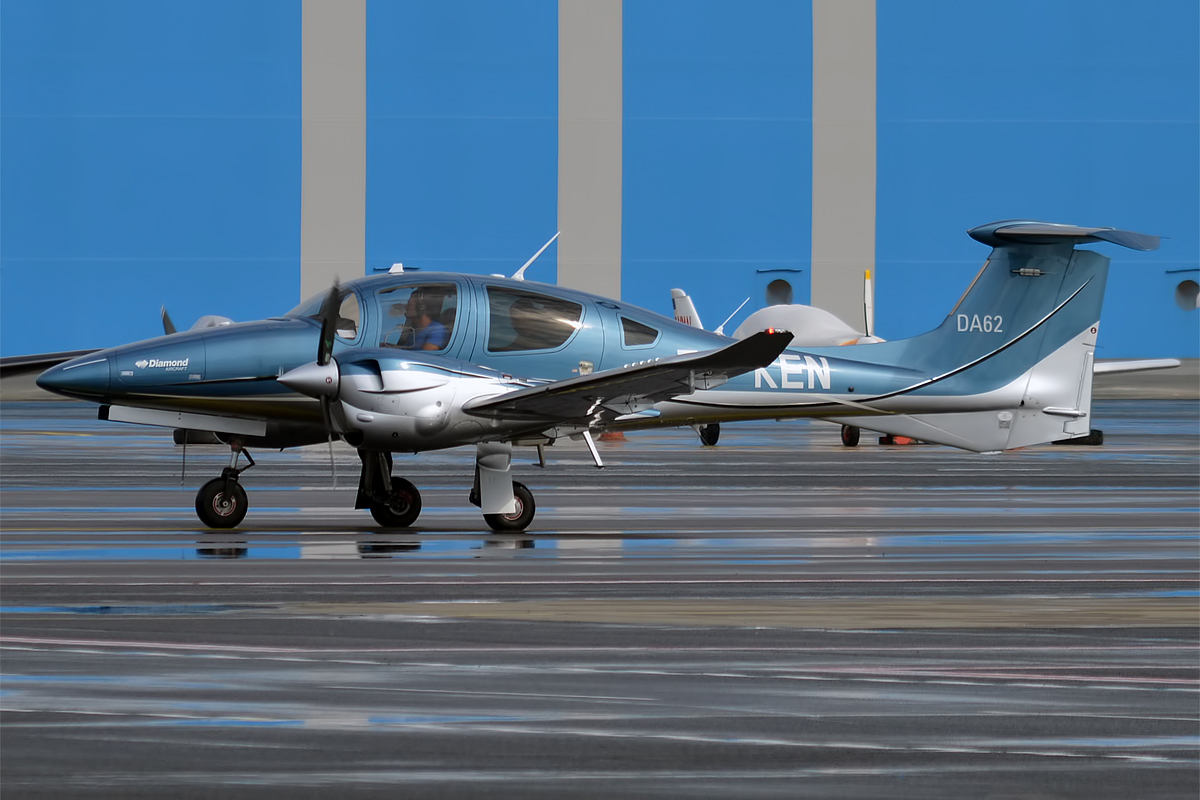
The Diamond DA62 is a five- to seven-seat, twin-engine light aircraft built by Diamond Aircraft Industries of Austria, combining an all-composite airframe with twin Jet A-burning diesel engines to offer what the manufacturer describes as twin-engine security with single-engine simplicity. Developed from the single-engine DA50 and first flown as the DA52 prototype in 2012, it has become Diamond's flagship piston twin, used for private, corporate, charter and increasingly special-mission and government roles. For a simulator pilot it represents a modern, glass-cockpit, FADEC-controlled twin with strong efficiency and docile handling.
The DA62 is a twin-engine light aircraft manufactured by Diamond Aircraft Industries, built around a fuselage shared with the single-engine DA50 but fitted with two Austro AE330 turbocharged diesel engines burning Jet A fuel. It seats five to seven occupants depending on configuration and is marketed as a business-ready, family-capable light twin combining space, range and fuel efficiency with the redundancy of two engines. The type has been in production since 2015 and, alongside its private and corporate use, has found a role as a special-mission platform in the DA62 MPP variant.
The aircraft's development was headed by Diamond managing director Manfred Zipper and was first announced in March 2012 under the designation DA52. The first prototype flew on 3 April 2012 from Diamond's Wiener Neustadt plant after six months of development, and during its delivery flight to that year's AERO Friedrichshafen show it achieved a fuel efficiency figure of 16.6 mpg (14.2 litres/100 km), credited to improvements in cooling and aerodynamic drag made during development. Company CEO Christian Dries indicated at the time that the diesel engines might eventually be replaced with turboprops, and fly-by-wire controls were expected as an option by 2014, though this did not materialise and the original July 2013 sales target slipped. In June 2014 the production aircraft was redesignated the DA62. European certification (EASA) followed on 16 April 2015, and by September 2015 the company was preparing to deliver the first production aircraft, including the tenth DA52/DA62 built and the third production example, destined for display at the 2015 National Business Aviation Association Convention. FAA certification was granted on 23 February 2016, ten months after EASA approval. At the 2016 AERO Friedrichshafen show Dries reported plans to raise production to 60-62 aircraft per year to meet demand, and the DA62 received the 2016 fliegermagazin Award for best new aeroplane. By April 2019 more than 120 DA62s had been delivered, and by April 2024 total deliveries stood at 273. In January 2023 it was announced that Aeromot would begin assembling DA62s in Brazil from kits supplied by Diamond Aircraft Canada from 2025, with an intended ramp-up to 50 aircraft per year for the South American market. Aircraft are built in both Austria and Canada.
The DA62 uses an all carbon-fibre composite airframe derived from the single-engine DA50, powered by two Austro Engine AE330 turbocharged, common-rail injected 2.0 litre jet-fuel engines rated at 180 hp (134 kW) each, controlled through a single-lever FADEC (EECU) system and driving 3-blade MT constant-speed propellers (MTV-6-R-C-F/CF 194-80) with automatic feathering via a single switch. The aircraft has a length of 9.19 m (30 ft 2 in), a wingspan of 14.55 m (47 ft 9 in), a height of 2.82 m (9 ft 3 in) and a wing area of 17.10 sq m (184.1 sq ft). Empty weight is given as 1,570 kg (3,461 lb) in one source and 1,598 kg (3,523 lb) without options in the manufacturer's technical data, with a maximum useful load of 702 kg (1,545 lb). It is offered in two weight versions: a five-seat 'European' version with a maximum take-off weight of 1,999 kg (4,407 lb), intended to help operators avoid higher weight-based air traffic control charges, and a seven-seat 'US' version at 2,300 kg (5,071 lb), with the third row of seating and higher MTOW available as factory options. Fuel capacity totals 327 litres (86.4 US gal) in the main tanks plus a 138 litre (36.4 US gal) auxiliary tank, giving 465 litres combined, and the engines run on Jet A-1, Jet A, TS-1, RT, No. 3 Jet Fuel or JP-8. The cockpit is built around the Garmin G1000 NXi glass flight deck with dual 10-inch displays, GFC 700 automatic flight control system with yaw damper, ADS-B in/out, ChartView, Flight Stream 510 and Synthetic Vision Technology, with options including an alphanumeric keypad, weather radar and traffic advisory system. The aircraft features hydraulic retractable landing gear, gull-wing doors, electrically adjustable rudder pedals, optional TKS de-icing, optional air conditioning and front baggage compartments rated for up to 30 kg (66 lb) per side, plus a rear compartment for up to 12 kg (265 lb) in the five-seat configuration.
At maximum continuous power at 14,000 ft the DA62 reaches a maximum true airspeed of 356 km/h (192 kt), with a cruise speed of 333 km/h (180 kt) TAS at 85 percent power at 12,000 ft according to the manufacturer, or 317 km/h (171 kt) at 75 percent power per other published figures. Stalling speed in the landing configuration is 126 km/h (68 kt) CAS. Maximum rate of climb at sea level is 5.2 m/s (1,028 ft/min), and the certified service ceiling is 6,096 m (20,000 ft), with a single-engine service ceiling of 3,354 m (11,000 ft) and a single-engine absolute ceiling of 4,116 m (13,500 ft). Maximum range, including use of the auxiliary tank at FL160 and 50 percent power with no reserves, is quoted at 2,385 km (1,288 nm), and typical fuel consumption at 60 percent power at 12,000 ft is 44.7 l/h (11.8 US gal/h) total for both engines. Take-off ground roll is 480 m with a take-off distance over an obstacle of 883 m, while landing ground roll is 441 m with a landing distance of 779 m, all at sea level. Maximum demonstrated crosswind is 46 km/h (25 kt). In handling, pilot impressions describe the aircraft as straightforward to fly, with docile stall characteristics: with power at idle, flaps set to take-off and gear down, the nose remains above the horizon through the stall and the aircraft simply mushes down without a sharp break. The landing gear has been noted for absorbing touchdowns smoothly even in imperfect conditions.
The DA52 was the initial prototype designation, with two aircraft built before the type was redesignated. The DA62 is the five- to seven-seat production variant, distinguished from the prototype by an extra third window and a larger horizontal stabiliser. The DA62 MPP, or Multi-Purpose Platform, is a special-mission derivative built for law enforcement, search and rescue and surveillance operations, fitted with hardpoints on the nose and belly for mission sensors such as EO/IR cameras, land and sea radars, COMINT solutions, airborne laser scanners and large-format digital aerial cameras, with mission equipment also mountable in the cabin and nose luggage compartments. It builds on the earlier DA42 MPP but offers increased performance, space and capability.
The DA62 serves private owners, corporate and charter operators, and increasingly government and special-mission customers. Notable private ownership has included the current Chancellor of Germany, Friedrich Merz, whose use of a DA62 to attend a ministerial wedding in July 2022 drew media attention over comparative fuel-efficiency claims against road transport. In the special-mission role, the Nigerian Air Force acquired four DA62 MPPs, registered NAF260-263, on 6 October 2023. In July 2024 a contract worth €23.3 million was signed for three DA62 MPPs for Greece's Hellenic Fire Service, intended to serve as air operations centres for firefighting and search and rescue as well as for aerial surveillance and damage assessment; delivery was completed on 13 November 2025, with the Greek Prime Minister noting potential additional use for border surveillance.
Pilots who have flown the real DA62 describe it as notably simple to operate for a twin, with single-lever power control on each engine reducing workload compared with older piston twins, and a Garmin G1000 NXi flight deck with GFC 700 autopilot that will be familiar to anyone used to modern glass-cockpit singles. The stall behaviour is gentle, with the nose staying above the horizon and the aircraft settling into a mush rather than breaking sharply, and the well-designed gear has been praised for absorbing firm touchdowns smoothly. These characteristics, combined with the type's twin-engine redundancy and efficient jet-fuel powerplants, make it an appealing subject for pilots wanting to practise multi-engine procedures, glass-cockpit workflow and long-range cross-country flying without the heavier workload of older-generation twins.