Departure
92%
vs 95% ▼ 3
 MY FS FLIGHTS
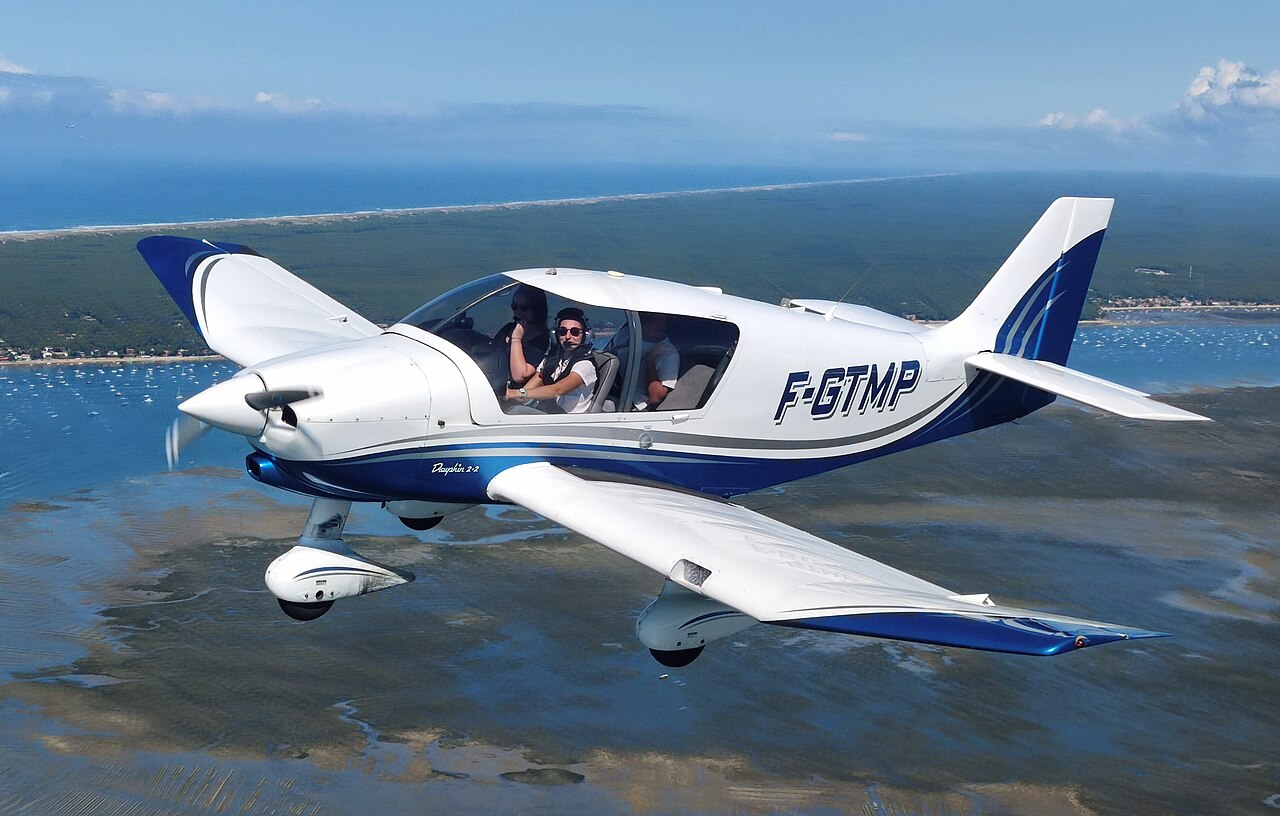
The Robin DR400 is a wooden, fabric-covered single-engine light aircraft built by Avions Pierre Robin (now Robin Aircraft) at Dijon-Darois in France, descended from the Jodel family of designs. Seating up to four and offered with engines from 100 to 200 horsepower, it became the mainstay trainer and touring aircraft of French flying clubs, and its cranked-wing, forward-sliding canopy layout is instantly recognisable to any pilot who has flown from a European aero club.
The DR400 is a single-engine, four-seat (or two-plus-two) light aircraft of wood and fabric construction, built by Avions Pierre Robin, later Robin Aircraft, at Dijon-Darois in Burgundy. It sits within the lineage of Jodel-derived designs and is classed as a light touring and trainer aircraft, with a low, positive-dihedral cranked wing and a tricycle undercarriage. It is one of the most widely used aircraft in French flying clubs, serving as both primary trainer and cross-country tourer, and remained largely unknown to American pilots despite being, by some accounts, among the most popular light aircraft in continental Europe.
The DR400 traces its ancestry to the Jodel series of wooden light aircraft. Avions Pierre Robin was formed in October 1957, as Centre Est Aeronautique, by Pierre Robin and Jean Delemontez, the principal designer behind Jodel. Early production comprised developments of the tail-dragger Jodel types, including the DR-100 and DR-1050/1051, followed by the four-seat DR-220, DR-221 and DR-250, and then the tricycle-geared DR-253 and DR-300 series that formed the direct link to the DR400. The DR400 itself first flew in 1972: sources differ slightly on the exact month, with the initial 180hp Regent prototype flying at Darois in early 1972, registered F-WSQO, and both a DR-400-125 and a DR-400-180 recorded as flying in June 1972; production began on 10 May 1972. Six initial versions were introduced in short order during 1972: the DR400-180 Regent, DR400-125 Petit Prince, DR400-160 Chevalier, DR400-180R Remorqueur, DR400-140 Major and DR400-108 Dauphin 2+2. The type evolved steadily: in 1974 the 180R gained an additional rear window, extended fleet-wide in 1987, though the added weight and structural reinforcement (some 25kg) proved detrimental to performance on the less powerful versions and was removed from those models in 1993. In 1975 the DR400-108 was renamed DR400-100, with the Petit Prince becoming the DR400-120; the DR400-100 went out of production in 1979. In 1980 the DR400 B Major was replaced by the Major 80, still with a 160hp engine but with extended range to 1,375 km. The DR400-125I, with a fuel-injected 125hp IO-240, appeared in 1995, and the DR-500 President, effectively a DR-400-200I with a widened, taller cabin and a 200hp constant-speed-prop engine, was unveiled at the 1997 Paris Airshow with deliveries beginning in 1998. Robin Aircraft states that more than 3,000 DR400s have been sold, though Wikipedia records production of over 2,700 aircraft; the Dauphin 2+2 proved the best-selling member of the family, remaining so into the 21st century thanks to its attractive price and performance. DR400 production ceased in 2014, with the type succeeded by the more modern DR401.
The DR400 is built around a wooden and fabric structure, sharing its wing type and materials with the Jodel series. Robin Aircraft notes that each aircraft uses around 170kg of wood and 38 metres of canvas, with roughly 2,000 hours of handcrafting per airframe. The wing has a distinctive cranked-wing (dihedral) configuration for stable cruising and safer stall characteristics, mounted low on the fuselage. The undercarriage is a fixed, non-retractable tricycle arrangement. Compared with the preceding DR300 series, the DR400 introduced a wider cabin at shoulder level and a forward-sliding canopy, replacing the earlier doors, a concept first introduced on the Robin HR-1 in 1969; the dashboard was also raised and clarified for easier instrument reading. Some aircraft use a brake handle between the front seats rather than pedal brakes. For the DR-400-120: wingspan 8.72m (28ft 7in), length 6.96m (22ft 10in), height 2.23m (7ft 3in), wing area 13.6 sq m (146.4 sq ft); empty weight 535kg (1,180lb) and maximum take-off weight 900kg (1,985lb). The DR-400-180 has an empty weight of 600kg (1,320lb) and a maximum take-off weight of 1,100kg (2,425lb). Engine options across the range include the 112hp Lycoming O-235-L2A (DR-400-120 Dauphin 2+2), the 125hp fuel-injected IO-240 (DR-400-125I, introduced 1995), the 160hp Lycoming O-320 (DR-400-140 Dauphin and DR-400-160 Chevalier), the 180hp Lycoming O-360 (DR-400-180 Regent and DR-400-180R Remo 180, the latter optimised for glider towing), and the 200hp IO-360 with constant-speed propeller fitted to the DR-400-200R Remo 200 glider tug and the DR-500 President.
Performance varies considerably across the power range. The DR-400-120 has a maximum speed of 241 km/h (130kt) and a maximum cruising speed of 215 km/h (116kt), an initial rate of climb of 600ft/min, a service ceiling of 12,000ft, and a range at maximum cruising speed of 860km (465nm) with standard fuel and no reserves. The DR-400-180 is considerably more capable, with a maximum speed of 278 km/h (150kt), maximum cruising speed of 260 km/h (140kt), economical cruising speed of 245 km/h (132kt), initial rate of climb of 825ft/min, service ceiling of 15,475ft, and range at economical cruising speed of 1,450km (783nm). The 160hp Major 80, introduced in 1980, offered an extended range of 1,375 km, making it particularly well suited to cross-country travel. Pilot reports describe the type as flying well despite an unconventional appearance, being quick to master around the pattern, and capable of handling demonstrated crosswind components of up to 22 knots with only minimal control input.
The DR400 family grew from a series of predecessor Jodel-derived types, including the DR315 Petit Prince, DR330, DR340 Major, DR360 Chevalier, and the DR300 series (DR300/108 2+2, DR300/120, DR300/140, DR300/180 and DR300/180R glider tug), all of which fed directly into the DR400 line. Within the DR400 designation itself, principal versions included the DR400/100 Cadet (a two-seat development of the DR400-108), the DR400/108 Dauphin 80 2+2, the DR400/120 Petit Prince and later Dauphin 2+2 (with extra cabin windows), the DR400/125 (with a 125hp Lycoming O-235-F), the DR400/140 Earl, the DR400/140B Major 80 (with a 160hp Lycoming O-320-D2A, originally designated DR400/160 Chevalier), the DR400/180 Regent (later the Regent III Nouvelle, with extra cabin windows), and the DR400/180R Remorqueur/Remo 180 glider tug. Further developments included the DR-400-125I with fuel injection, introduced in 1995, and the DR-400-200R Remo 200, the most powerful DR400 variant, also intended for glider towing. The line-topping DR-500 President, unveiled at the 1997 Paris Airshow as the DR-400-200I, featured a widened and taller cabin and a 200hp constant-speed-prop engine, with deliveries beginning in 1998; over 40 DR-500s were built. The DR400 was ultimately succeeded in 2014 by the DR401, which offered more modern technology and increased comfort.
The DR400 has been used overwhelmingly as a training and club aircraft in France, where it remains a mainstay of aero clubs; in 2019, French air clubs operated 864 DR300 and DR400 models out of 2,394 training and rental aircraft nationwide. Beyond training, the type has served as a private touring aircraft, valued for its cabin comfort, four-seat capacity on the more powerful variants, and range suited to cross-country travel, while the 180R and 200R variants were specifically optimised for glider-towing duties. Although it achieved considerable popularity across continental Europe and Great Britain, the DR400 remained largely unknown to American pilots, its wood-and-fabric construction and unconventional appearance setting it apart from the metal designs dominant in the United States.
Pilots who have flown the type note that despite its somewhat unconventional looks, the DR400 flies well and is quick to master, with only a few circuits needed to become comfortable in the pattern. Its cranked-wing design promotes stable cruising and forgiving stall behaviour, while the forward-sliding canopy gives excellent visibility, a feature that makes it a natural fit for club and training operations. The type has demonstrated the ability to cope with crosswind components of up to 22 knots with only minimal control correction, and the range of engine options from the docile 112hp Dauphin 2+2 up to the 200hp Remo 200 and President gives a wide spread of handling character, from gentle trainer to genuine four-seat tourer, within a single, familiar airframe.