Departure
82%
vs 95% ▼ 13
 MY FS FLIGHTS
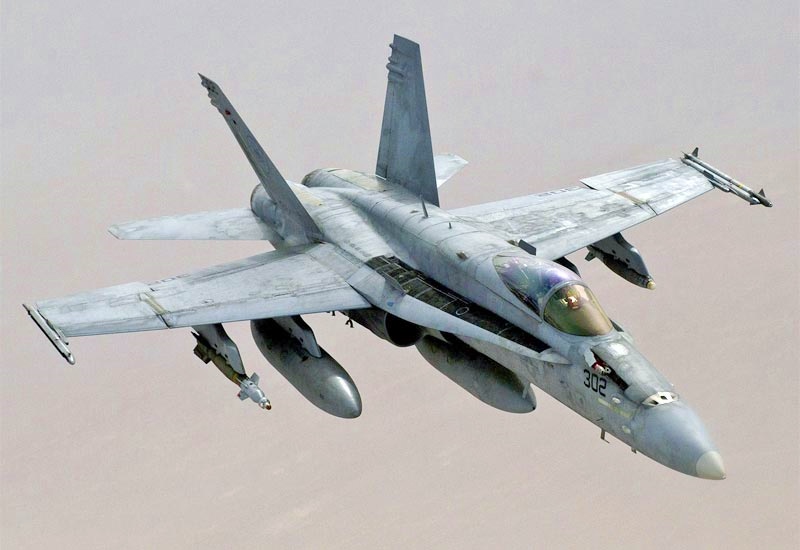
The McDonnell Douglas F/A-18 Hornet is an all-weather, twin-engined, carrier-capable multirole combat aircraft built to serve as both fighter and attack platform, hence its F/A designation. Developed from the Northrop YF-17 for the United States Navy and Marine Corps, it became one of the most successful and versatile designs in naval aviation history, and remains of interest to simulator pilots for its renowned low-speed agility and high angle-of-attack handling.
The F/A-18 Hornet is a supersonic, twin-engined, carrier-capable multirole fighter designed by McDonnell Douglas and Northrop as both a fighter and a ground-attack aircraft. It was derived from the Northrop YF-17, which had been beaten by the General Dynamics YF-16 in the United States Air Force's lightweight fighter competition but was judged by the Navy to be better suited to carrier operations. Entering service with the US Navy and Marine Corps, the Hornet went on to be flown by several other air arms, including the Finnish Air Force and Spanish Air and Space Force, and formerly equipped the Navy's Blue Angels display team. It was designed to be highly versatile, thanks to its avionics, cockpit displays and aerodynamic characteristics suited to high angle-of-attack manoeuvring, and it could carry a wide variety of weapons across fighter escort, fleet air defence, suppression of enemy air defences, air interdiction, close air support and reconnaissance roles.
The Hornet's origins lie in the Navy's Naval Fighter-Attack, Experimental (VFAX) programme, launched to replace the Douglas A-4 Skyhawk, A-7 Corsair II and remaining McDonnell Douglas F-4 Phantom IIs while complementing the Grumman F-14 Tomcat. In August 1973 Congress mandated that the Navy pursue a lower-cost alternative to the F-14, and Secretary of Defense James Schlesinger ordered the Navy to evaluate the two contenders in the Air Force's Lightweight Fighter programme, the General Dynamics YF-16 and Northrop YF-17. In May 1974 the House Armed Services Committee redirected funding from VFAX into a new Navy Air Combat Fighter (NACF) programme intended to exploit the lightweight fighter technology. Although the YF-16 won the Air Force competition, the Navy was sceptical that a single-engined design with narrow landing gear could be adapted economically to carrier service, and on 2 May 1975 it selected the YF-17 instead. Because the lightweight fighter requirements differed from VFAX, McDonnell Douglas and Northrop were asked to develop a new aircraft from the YF-17's design and principles. Northrop, brought in as a secondary contractor to draw on McDonnell Douglas's carrier-aircraft experience, agreed to split manufacturing evenly: McDonnell Douglas built the wings, stabilators and forward fuselage and served as prime contractor for the naval versions, while Northrop built the centre and aft fuselage and vertical stabilizers and acted as prime contractor for a proposed land-based export version, the F-18L. On 1 March 1977 Secretary of the Navy W. Graham Claytor announced the name Hornet, after the insect and after a long line of US Navy ships named USS Hornet. The aircraft, initially known as the McDonnell Douglas Model 267, first flew on 18 November 1978. It entered operational service with the US Marine Corps on 7 January 1983 and with the US Navy on 1 July 1984, with the first deployed Hornets sent to USS Constellation (CV-64) in 1985. The type first saw combat during the 1986 United States bombing of Libya, Operation El Dorado Canyon, and went on to serve in the 1991 Gulf War, over Bosnia and Kosovo in the 1990s, and in the 2003 Iraq War and subsequent Middle East operations. An upgraded version able to carry the AIM-120 AMRAAM entered service in 1987, and the night-attack F/A-18D followed in 1990. A total of 1,480 F/A-18A/B/C/D aircraft were built between 1974 and 2000, with production of the C and D models ending in 2000 and the last F/A-18D delivered to the US Marine Corps that summer. The type was retired by the US Navy in 2019 and by the Royal Australian Air Force in 2021, having by then been supplanted in frontline US carrier air wings by its larger evolutionary redesign, the Boeing F/A-18E/F Super Hornet, whose origins trace to a McDonnell Douglas concept of the 1980s known as "Hornet 2000".
The Hornet is a twin-engined, mid-wing aircraft with a length of 56 feet (16.8 metres), a wingspan of 40 feet 5 inches (13.5 metres) and a height of 15 feet 4 inches (4.6 metres). Maximum takeoff weight is 51,900 pounds (23,537 kg). Power comes from two General Electric F404-GE-402 enhanced-performance turbofan engines, each rated at 17,700 pounds of static thrust. Crewing differs by model: the A, C and single-seat variants carry one crew member, while the B and D models are two-seaters used for training and night-attack missions respectively. Armament centres on an internal M61A1/A2 Vulcan 20 mm cannon, supplemented by a wide weapons load including AIM-9 Sidewinder, AIM-7 Sparrow and AIM-120 AMRAAM air-to-air missiles, Harpoon, HARM, SLAM and SLAM-ER anti-ship and stand-off weapons, Maverick missiles, the Joint Stand-Off Weapon (JSOW), Joint Direct Attack Munition (JDAM), and various general-purpose bombs, mines and rockets. The design's aerodynamic layout, inherited from the Northrop YF-17, gave the aircraft particularly good characteristics for high angle-of-attack manoeuvring, a key element of its versatility as both fighter and attack platform.
The Hornet is capable of Mach 1.7 or more and has a service ceiling in excess of 50,000 feet. Combat radius with a clean airframe plus two AIM-9 Sidewinders is quoted as 1,089 nautical miles (1,252 miles / 2,003 km), while ferry range with two AIM-9s and three 330-gallon external tanks extends to 1,546 nautical miles (1,778 miles / 2,844 km). The aircraft was built to be versatile, flexible and manoeuvrable, especially at low speeds, a quality that made it effective across the full range of fighter and attack missions it was assigned. Its robustness was demonstrated operationally, with Hornets recorded taking direct hits from surface-to-air missiles, recovering successfully, being repaired quickly and flying again the following day.
The single-seat F/A-18A and two-seat F/A-18B were the initial production models, with the B used primarily for training. These were followed by the improved single-seat F/A-18C and two-seat F/A-18D, which performed attack, air control and reconnaissance missions in addition to the fighter role; the D model was developed specifically as a night-attack variant, entering service in 1990. An upgrade fielded in 1987 gave Hornets the ability to carry the AIM-120 AMRAAM. Other derivatives included the Canadian-operated McDonnell Douglas CF-18 Hornet and the specialised High Alpha Research Vehicle used for aerodynamic testing. The Hornet family was ultimately developed into the substantially larger and more advanced Boeing F/A-18E/F Super Hornet, which traces its wing and tail configuration back through the Hornet to the Northrop P-530 concept of the mid-1960s, and which in turn spawned the EA-18G Growler electronic-warfare variant.
The Hornet replaced the F-4 Phantom II and A-7 Corsair II in US Navy and Marine Corps service, taking on both the air-to-air fighter role previously filled by the Phantom and F-14 Tomcat and the air-to-ground attack role previously filled by the A-6 Intruder and A-7 Corsair. It became the longest-serving aircraft type in Marine Corps tactical aviation and equipped Marine Corps fighter attack squadrons and Marine Corps Reserve units worldwide. The Navy's Blue Angels flight demonstration squadron adopted the F/A-18 in 1986, replacing the A-4 Skyhawk. Operationally, the Hornet flew combat missions against Libya in 1986, in the 1991 Gulf War, where VFA-81 Sunliners F/A-18Cs shot down two Iraqi MiG-21 Fishbeds on the opening day of Operation Desert Storm, and in Operation Southern Watch from 1992 to 2003, over Bosnia and Kosovo during the 1990s, and in Operation Enduring Freedom from 2001 and Operation Iraqi Freedom from 2003. Beyond US service, the type was operated by several allied air arms, including the Finnish Air Force and Spanish Air and Space Force. The US Navy retired its F/A-18C fleet in 2018 and completed withdrawal of legacy Hornets in 2019, with the type superseded operationally by the F/A-18E/F Super Hornet and, more recently, the F-35C Lightning II.
For a simulator pilot, the Hornet's appeal lies largely in the qualities that made it such an effective fleet aircraft: it was engineered to be versatile, flexible and especially manoeuvrable at low speeds, with aerodynamic characteristics well suited to high angle-of-attack flying, a trait that translates into distinctive handling behaviour around the carrier and in close manoeuvring flight. Its dual identity as both fighter and attack aircraft gives it a broad operational repertoire to explore, from air-to-air intercepts flown with Sidewinder, Sparrow or AMRAAM loadouts to precision strike work with JDAM or Maverick ordnance, while its documented robustness and reliability as a carrier asset underline why it became such a mainstay of naval air wings for over three decades.