Departure
92%
vs 95% ▼ 3
 MY FS FLIGHTS
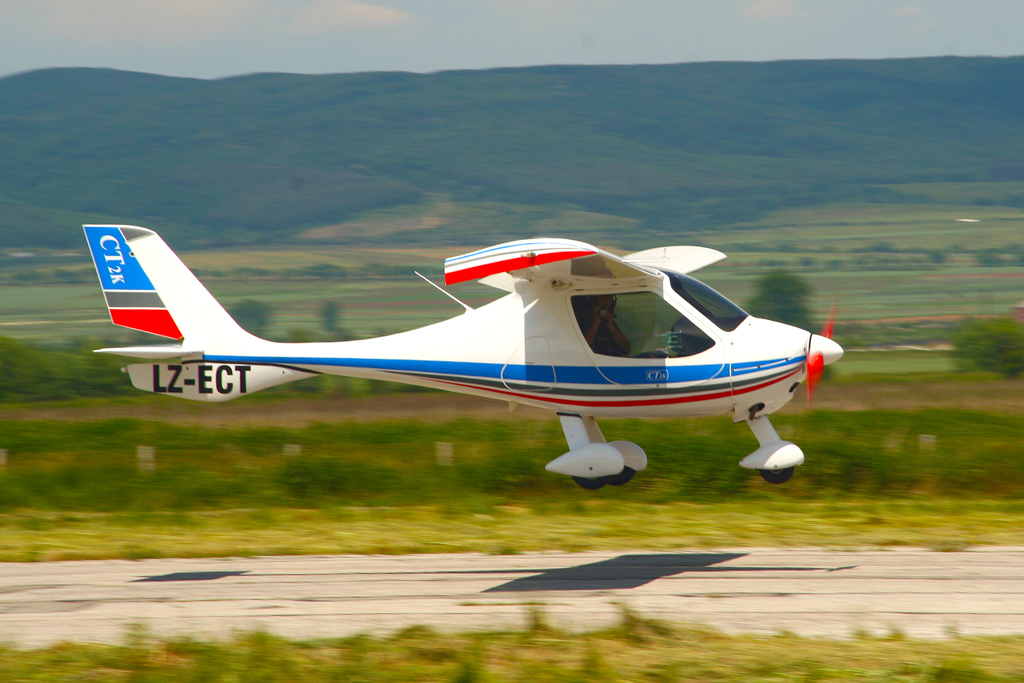
The Flight Design CT series is a family of high-wing, tricycle-gear, two-seat ultralight and light-sport aircraft built by Flight Design of Germany, known for its all-composite carbon fibre and Kevlar construction and glider-like wing. First flown in March 1996, it went on to become one of the best-selling designs in the LSA and microlight class worldwide, prized by pilots for its spacious cockpit, high visibility and efficient handling.
The Flight Design CT is a German-designed, high-wing, tricycle-undercarriage, two-seat ultralight and light-sport aircraft manufactured by Flight Design (Flightdesign Vertrieb), designed by Matthias Betsch. The family, which includes the original CT, CT2K, CTSW, CTLS and MC models, has been produced continuously since 1997 and has become one of the most widely used types in the light-sport and microlight category, popular with flight schools, flying clubs and private owners alike.
Development of the CT series began in the mid-1990s, only a few years after Flight Design was founded in 1993 as a maker of hang gliders and powered microlights. The original CT first flew in March 1996 and was specifically designed to meet the European ultralight-microlight (UL-ML) category, gaining EASA certification for sale across Europe. Quantity production began in 1997 at Flight Design's facility in Ukraine, and that same year the company ceased production of its other product lines to concentrate on the CT. Through the late 1990s and 2000s the design was progressively developed into a family of models: the improved CT2K and the short-winged CTSW had both appeared by 2005. In April 2005 the CTSW gained FAA light-sport aircraft (LSA) certification, opening the lucrative North American market, with aircraft imported in partially complete form and assembled by Flightstar Sportplanes prior to sale. In Germany the type could also be flown under the UL-ML category, subject to a reduced fuel load and mandatory fitment of a Ballistic Recovery Systems (BRS) parachute. By mid-2005 some 400 CT series aircraft had been sold worldwide, with production running at around ten aircraft a month and a backlog of roughly a year. By 2011 the CT series had been cleared to fly under a wide range of national rules, including FAA LSA, Canadian advanced ultralight and EASA Permit to Fly regulations. The CTLS received type design approval and a production certificate from the Civil Aviation Administration of China in December 2009, and in 2015 Flight Design opened a dedicated CTLS production plant in China to meet rising demand. In June 2007 Indian Air Force pilots Rahul Monga and Anil Kumar flew a Flight Design CT on what became the first circumnavigation of the globe by a light-sport aircraft. Across the CT series and its various subsidiary-built variants, Flight Design and its partners have sold close to 2,000 aircraft, and the lineage continues with the newer F2 model, developed to meet evolving rules such as the American MOSAIC regulation.
The CT series is built almost entirely from composite materials, principally carbon fibre reinforced with Kevlar (aramid) for added strength, a choice that Flight Design credits with allowing a highly aerodynamic fuselage shape, a useful payload nearly equal to the aircraft's own empty weight, and strong crash resistance, albeit at higher manufacturing and repair cost than a metal airframe. The pod-shaped cockpit is notably spacious for a two-seat design, with large windows, detachable doors and an overhead skylight that together were intended to support secondary roles such as light reconnaissance and surveillance as well as recreational flying, touring and glider towing; the skylight in particular reduces the blind spot typical of a high-wing layout. The wing is a symmetrical, cantilever, in-house Flight Design design with a glider-like aspect ratio, relatively large flaps for generating high lift, and integral wing tanks that hold all of the aircraft's fuel. Power is provided by either an 80 hp (60 kW) Rotax 912UL or a 100 hp (75 kW) Rotax 912ULS engine mounted in tractor configuration, typically driving a three-bladed fixed-pitch propeller and a generator for the electrical systems. Standard equipment includes flight instrumentation, VHF radio, transponder and GPS, along with electrically actuated flaps offering five positions for cruise, take-off and landing; the panel carries four standard flight instruments with further indicators available as options. Cabin heating is provided by ducted engine air, with louvers for cooling and ventilation. On the CTLS, the carbon/aramid fuselage is shaped to maximise cabin space while reducing drag and improving airflow to the stabiliser, the wing is a smooth strutless cantilever design, and winglets are fitted to improve climb, cruising range and aileron control at low speed. The composite main undercarriage is designed to absorb over half of landing energy on the first rebound, while urethane polymer shock absorbers cushion the nose gear. Baggage capacity on the CTLS is up to 50 kg (110 lb), split between dual storage compartments, and the aircraft can be fitted with either Garmin G3X or Dynon SkyView HDX avionics suites with high-definition touchscreens and synthetic vision.
The CTLS has a demonstrated never-exceed speed (VNE) of 300 km/h in flight testing, though this is limited in practice by the fitted ballistic recovery system or by national regulations. The high-aspect-ratio, glider-like wing gives the CT series notably efficient cruise performance and low fuel consumption across the speed range, and the winglets fitted to later models are said to improve climb, cruising range and aileron control at low speed. This same aerodynamic efficiency means the aircraft can feel comparatively 'floaty' during the landing flare, requiring a deliberate approach technique from pilots more used to draggier types.
The family began with the original CT, certified to the European UL-ML microlight category, followed by the improved CT2K and the CTSW, which introduced a shortened wing and was the first variant to gain FAA LSA certification in 2005. The CTLS followed as a further-refined model, offered with EASA CS-LSA Restricted Type Certification, as a 600 kg ultralight, or as a compliant Special LSA, and has been updated over time, including the CTLS 2020 Sport Edition with a lighter empty weight, revised interior and redesigned engine cowling. A motor-glider derivative, the MC, has also been produced. Law-enforcement and licensed-production variants exist as well, including the CTLE for law-enforcement roles and AeroJones-built derivatives such as the AJCT and AJ Sport. The lineage has since continued with the newer F2 model, developed to meet contemporary regulatory frameworks.
The CT series has been used primarily for recreational flying, touring and flight training, with its high-wing layout, large glazing and detachable doors also making it suitable for glider towing and light aerial observation or surveillance work. It has proved popular with flight schools and flying clubs as well as private owners, and by 2005 several hundred examples were in service across Europe, with the type subsequently certified for use under the FAA's LSA rules, Canadian advanced ultralight regulations and EASA Permit to Fly arrangements, extending its operational reach across North America and beyond. Production and assembly in Ukraine, the United States and later China have supported this global spread. The type's most notable individual achievement came in 2007, when Indian Air Force pilots Rahul Monga and Anil Kumar flew a Flight Design CT around the world, the first such circumnavigation by a light-sport aircraft.
Pilots coming to the CT series can expect a wide, comfortable cabin with excellent visibility, thanks to its large windows and overhead skylight, and light, sporty handling from its glider-derived wing. The same high-aspect-ratio wing that gives the CT its efficient cruise and strong climb performance also means it can float during landing, so a disciplined approach and flare technique are needed to avoid extending the touchdown point. Standard features on later models such as the CTLS, including a rigid composite safety cell, four-point harnesses and an airframe parachute system, along with modern glass-panel avionics options, make it a representative example of a well-equipped, safety-conscious modern light-sport type for pilots exploring this class of aircraft.