Departure
93%
vs 95% ▼ 2
 MY FS FLIGHTS
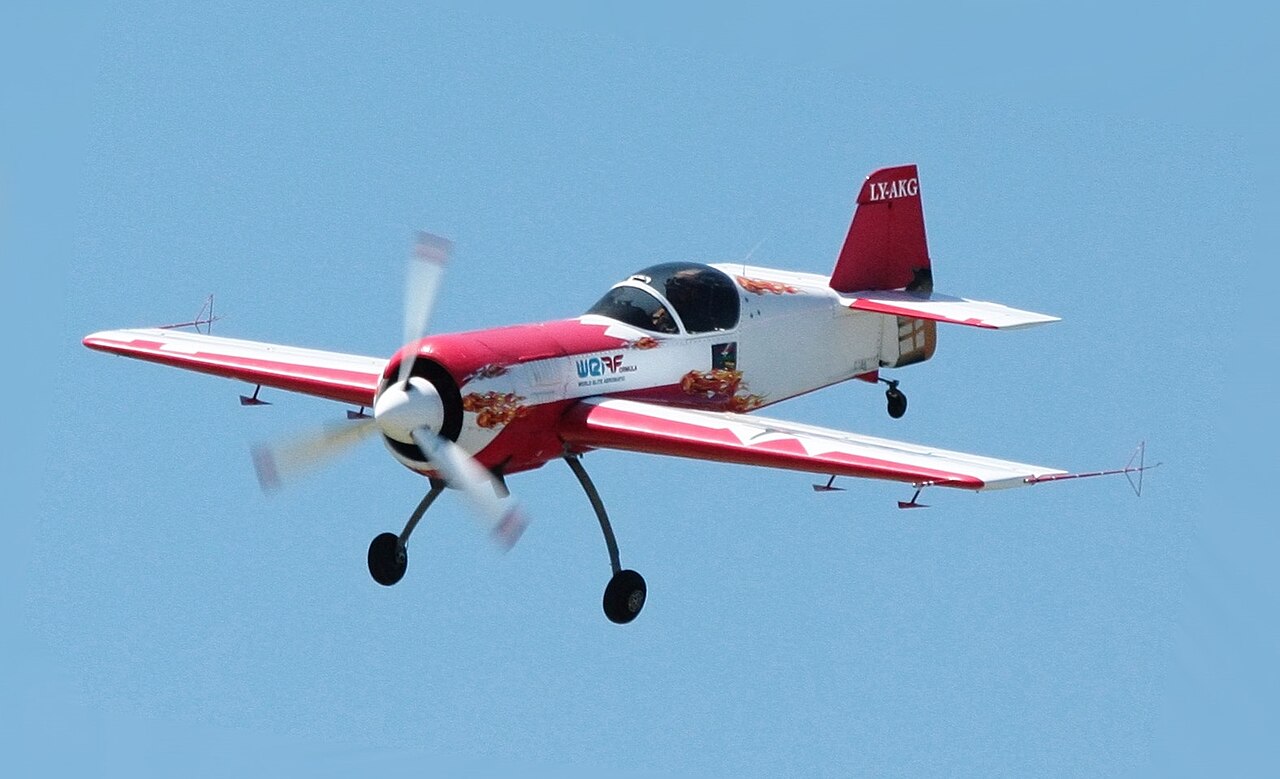
The Sukhoi Su-26 is a single-seat, radial-engined aerobatic aircraft designed by the Sukhoi Design Bureau in the Soviet Union specifically for unlimited-category competition flying. Compact, immensely strong and built with a high proportion of composite material, it became the aircraft that redefined what was possible in competition aerobatics through the 1980s and beyond, and it remains of interest to sim pilots as one of the few Soviet-era types to appear as flyable content in a major combat flight simulator.
The Su-26 is a single-seater aerobatic aircraft from the former Soviet Union, powered by a single radial reciprocating engine. It has mid-mounted straight wings and fixed landing gear, with the main gear mounted on a solid titanium arc, and was created specifically for unlimited aerobatic competition rather than any military or utility role. It sits at the head of a family of purpose-built Sukhoi aerobatic designs that went on to dominate international competition flying.
The Su-26 was designed in 1983 by fighter design engineers within the Sukhoi Design Bureau, better known for its military aircraft, specifically for unlimited aerobatic competition. It made its first flight in June 1984, with the original four airframes fitted with a two-bladed propeller. The type was first used operationally by the Soviet National Aerobatic Team in August 1984 at the World Aerobatic Championships in Hungary. Production then switched to the refined Su-26M, which introduced revised tail surfaces and a German-made MTV-9 three-blade composite propeller; this model won both the men's and women's team prizes at the 1986 World Aerobatics Championships. A later development, the Su-26M3, fitted with the new M9F engine rated at 320 kW (430 hp), dominated the 2003 and 2005 Aerobatic World Championships as well as the 2004 European Championships. The design lineage continued into the related Sukhoi Su-29 and Su-31.
The Su-26 is built with mid-mounted, symmetrical straight wings (18 percent thickness at the root, 12 percent at the tip) and fixed conventional landing gear, the main legs mounted on a solid arched titanium spring rather than a conventional oleo strut. The Su-26M airframe is made of more than 50 percent composite materials, contributing to its exceptional strength-to-weight ratio for aerobatic loading. Power comes from a single Vedeneyev M14P nine-cylinder air-cooled radial piston engine rated at 270 kW (360 hp, with some operators quoting 400 hp), driving a three-bladed constant-speed propeller (the composite MTV-9 unit on M-model aircraft). The cockpit uses fully metric instrumentation, with the exception of the altimeter. Dimensions are: length 6.827 m (22 ft 5 in), wingspan 7.8 m (25 ft 7 in), height 2.89 m (9 ft 6 in) and wing area 11.83 sq m (127.3 sq ft). Empty weight is 700 kg (1,543 lb), gross weight 790 kg (1,742 lb) and maximum take-off weight 962 kg (2,121 lb). The later, more powerful Su-26M3 variant, fitted with the Vedeneyev M-9F engine of 430 hp, has a quoted maximum take-off weight of around 950 kg (2,100 lb) and a maximum payload of about 400 kg (850 lb), with fuel capacity of roughly 300 litres.
The Su-26 is rated to an ultimate load factor of +12g, reflecting its purpose as an unlimited-category competition aircraft. Maximum speed is 450 km/h (280 mph, 240 kn), cruise speed 295 km/h (183 mph, 159 kn) and landing speed 115 km/h (71 mph, 62 kn). Range is 800 km (500 mi, 430 nmi), service ceiling 4,000 m (13,000 ft) and rate of climb 18 m/s (3,500 ft/min). The later Su-26M3 variant, with its more powerful M-9F engine, is capable of roll rates exceeding 400 degrees per second, underlining the extreme control authority built into the design for high-energy aerobatic sequences.
The original Su-26 comprised four airframes fitted with a two-bladed propeller. Production then moved to the Su-26M, which introduced refined tail surfaces and a German-made MTV-9 three-blade composite propeller, and this became the definitive production standard used by national aerobatic teams. The Su-26M3 followed, fitted with the more powerful M-9F engine producing 320 kW (430 hp), and this variant proved dominant in international competition during the mid-2000s. The design was subsequently developed into the related Sukhoi Su-29 and Su-31 aerobatic aircraft.
The Su-26 was flown from the outset by the Soviet National Aerobatic Team, which used it to compete at the World Aerobatic Championships beginning in 1984 and went on to take both the men's and women's team titles in 1986. Individual Su-26M airframes were later sold out of Russian state ownership to private aerobatic pilots and clubs abroad; one well-documented example, built in 1990 and flown 222 times by the Soviet team, was purchased in 1998 by an American aerobatic pilot who competed with it in advanced and unlimited categories. The type has continued in use with aerobatic demonstration teams and competition pilots internationally, and the improved Su-26M3 variant was flown by multiple world champions and dominated major championships in the early 2000s.
The Su-26 gained wider recognition among simulator pilots when it was made available as downloadable content for IL-2 Sturmovik: Cliffs of Dover, added via a Steam patch in October 2012 after having originally been promised but omitted at the game's 2011 release. Its inclusion gave players access to a modern, high-performance aerobatic type within a simulation otherwise built around 1940s combat aircraft, offering a markedly different handling experience built around extreme roll rates, high load-factor tolerance and a very high power-to-weight ratio compared with the piston fighters that populate the rest of the title.