Departure
84%
vs 95% ▼ 11
 MY FS FLIGHTS
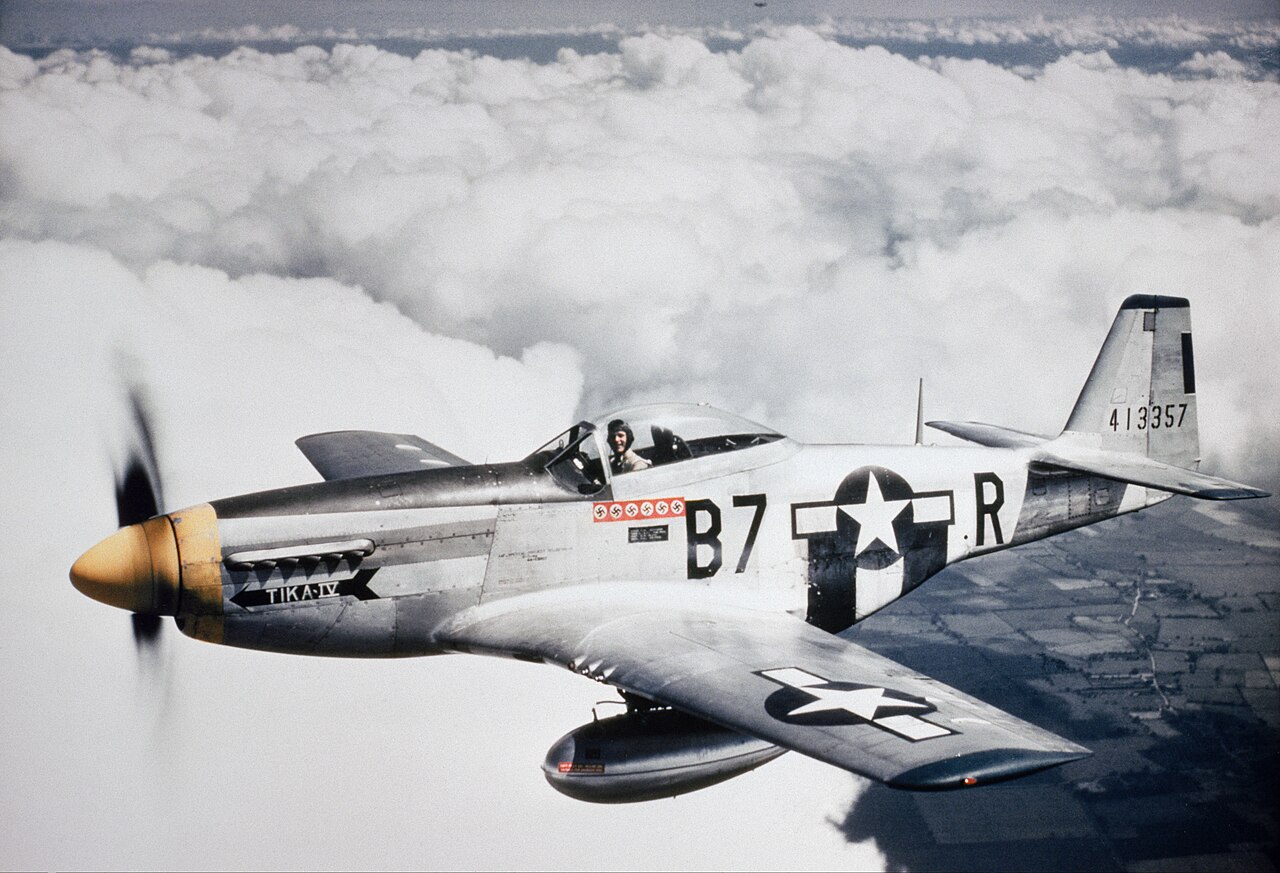
The North American P-51 Mustang is a single-seat, single-engine long-range fighter and fighter-bomber built by North American Aviation, originally designed in 1940 to a British specification and later adopted in large numbers by the US Army Air Forces. Married to the Rolls-Royce Merlin engine, it became the definitive long-range escort fighter of the Second World War and is widely regarded as the finest all-around piston-engined fighter of the conflict, making it a benchmark warbird for any simulator pilot.
The P-51 Mustang is a single-seat, single-engine fighter aircraft designed and produced by North American Aviation, originally for the British Royal Air Force and later adopted by the US Army Air Forces. It served principally as a long-range escort fighter and fighter-bomber during World War II and continued in front-line and reserve service, under the designation F-51, into the Korean War. More than 15,000 Mustangs of all types were built, and the type is considered the best piston-engined fighter of World War II and one of the world's aviation elite.
The Mustang originated from a 1940 request by the British Purchasing Commission, headed by Sir Henry Self, for North American Aviation to build Curtiss P-40 fighters under license for the RAF. NAA president James 'Dutch' Kindelberger instead proposed designing a wholly new, more modern fighter using the same Allison V-1710 engine, and could have it flying sooner than setting up a P-40 production line. NAA purchased Curtiss's P-40 wind-tunnel data and flight-test reports for £56,000, and the Mustang project was formally begun on 4 May 1940, with an order for 320 aircraft placed on 29 May 1940. The prototype NA-73X airframe was completed on 9 September 1940, just 102 days after contract signing (described elsewhere as a '100 day wonder' with first flight some 149 days after contract signing), and made its first flight on 26 October 1940. The aircraft was one of the first to have its fuselage lofted mathematically using conic sections, producing smooth, low-drag surfaces, and it used a laminar-flow wing developed with the US National Advisory Committee for Aeronautics. The RAF initially flew the aircraft as the Mustang Mk I, a tactical-reconnaissance and fighter-bomber powered by the Allison V-1710, which gave limited high-altitude performance. In mid-1942 the Rolls-Royce Mustang X project replaced the Allison with a two-stage, inter-cooled, supercharged Rolls-Royce Merlin 65; testing at Rolls-Royce's Hucknall airfield showed a dramatic improvement in performance above 15,000 ft without sacrificing range. Following further evaluation by USAAF pilots, North American developed this into the P-51B/C (Mustang Mk III), the first long-range fighter able to compete with Luftwaffe fighters. The definitive P-51D introduced the Packard-built V-1650-7 (a licensed Merlin 66 derivative), a bubble canopy, and six .50 calibre machine guns. Rolls-Royce test pilot Ronald Harker's April 1942 evaluation of a stock Allison-engined Mustang, followed by trials in which five Mustangs were fitted with Merlin engines, showed speeds in excess of 430 mph at 30,000 ft, almost 100 mph faster than with the Allison. By early 1944 the arrival of the Merlin Mustang, combined with new aggressive tactics, was turning the air war in the Allies' favour; during the 'Big Week' bombing offensive of February 1944 Mustang pilots destroyed a significant proportion of the Luftwaffe's experienced fighter pilots in air combat.
The Mustang is a single-seat, single-engine, all-metal fighter of conventional low-wing configuration, notable for its laminar-flow wing and mathematically lofted fuselage, which gave low-drag surfaces well ahead of contemporary designs. Early Allison-engined variants (Mustang Mk I) used the Allison V-1710 without an export-sensitive turbosupercharger or multi-stage supercharger, limiting high-altitude performance. The definitive P-51D was powered by a single Packard-built V-1650-7 Merlin liquid-cooled, supercharged V-12 engine rated at 1,490 hp (1,720 hp with War Emergency Power); other sources give the Packard-built Rolls-Royce Merlin V-1650 as producing 1,695 hp. The P-51D introduced a bubble canopy for improved visibility and was armed with six .50 calibre (12.7 mm) AN/M2 Browning machine guns, three in each wing. It could carry up to 1,000 lbs of bombs on two underwing hardpoints, or alternatively ten 5-inch rockets or 2,000 lbs of bombs. Typical dimensions for the P-51D are a length of 32 ft 3 in, a wingspan of 37 ft 0 in, and a height of 13 ft 8 in. Empty weight was around 7,635 lbs, with a loaded weight of up to 12,100 lbs.
The P-51D had a maximum speed of around 440 mph (other figures give 437 mph), with a cruising speed cited variously as 362 mph or 275 mph depending on power setting and source. Service ceiling was 41,900 ft, and initial rate of climb was about 3,475 ft per minute. Range without drop tanks was given as 1,155 miles, with other sources citing a range figure closer to 1,000 miles; with external tanks the type's range was extended considerably, enabling deep-penetration escort missions. The switch from the Allison-engined Mk I to the Merlin-powered P-51B/C transformed performance above 15,000 ft without sacrificing range, allowing the Mustang to match Luftwaffe fighters at altitude, whereas the Allison-only aircraft had been limited to low- and medium-altitude effectiveness. The type did experience some handling issues with external wing tanks, as the weight of fuel carried there had a tendency to destabilise the aircraft in a dive.
The initial production model for the RAF was the Mustang Mk I, powered by the Allison V-1710 and used for tactical reconnaissance and fighter-bomber duties. The Rolls-Royce Mustang X was a Merlin 65-engined conversion project that proved the value of re-engining the airframe. This led to the P-51B/C, known to the RAF as the Mustang Mk III, the first Merlin-powered production version and the first long-range fighter capable of matching Luftwaffe fighters. The definitive P-51D introduced the Packard V-1650-7 engine, the bubble canopy, and six-gun armament. Related developments included the North American A-36 attack variant, the Rolls-Royce Mustang Mk X conversion, the CAC Mustang built in Australia, and postwar civilian conversions such as the Cavalier Mustang; the design also led to the twin-fuselage North American F-82 Twin Mustang and, much later, the Piper PA-48 Enforcer.
The Mustang first entered RAF service in January 1942 and was flown operationally as a tactical-reconnaissance aircraft and fighter-bomber in its Allison-engined Mk I form. From late 1943, Merlin-powered P-51Bs and P-51Cs, joined from mid-1944 by P-51Ds, were used by the USAAF's Eighth Air Force to escort heavy bombers on raids deep into Germany, a role in which they helped secure Allied air superiority in 1944; the RAF's Second Tactical Air Force and the USAAF's Ninth Air Force meanwhile used Merlin Mustangs as fighter-bombers. The type also saw service in the North African, Mediterranean, Italian, and Pacific theatres. During World War II, Mustang pilots claimed 4,950 enemy aircraft destroyed, making the P-51 the highest-scoring US fighter in the European theatre of operations. Escort missions earned Mustang pilots the nickname 'Little Friends' among the bomber crews they protected, and units such as the 332nd Fighter Group (the Tuskegee Airmen, flying 'Red Tail' Mustangs) became particularly associated with the type. Before the Merlin Mustang entered service, the Eighth Air Force's bomber units had suffered a 77 percent overall casualty rate between 1942 and 1944; the escort's arrival reversed this trend. After the war, Mustangs served with the Strategic Air Command until 1949 and with US Air Reserve and National Guard units, some of which saw early action in the Korean War after redesignation as the F-51. Some RAF Mustangs remained in Fighter Command service until 1946, and surplus American and British aircraft went on to serve with some 50 air forces worldwide; the type remained in service with some air forces until the early 1980s, with final retirement from the Dominican Air Force in 1984. After military retirement, Mustangs became popular civilian warbirds and air-racing aircraft.
The Mustang's blend of range, speed and manoeuvrability, which made it the standout long-range escort fighter of World War II, is central to its enduring popularity as a warbird and air-racing aircraft in the real world, and by extension its appeal to simulator pilots seeking an authentic high-performance piston-fighter experience. Its combination of a fast, laminar-flow airframe with the powerful two-stage supercharged Merlin gives it strong performance across the altitude band, from low-level fighter-bomber work to high-altitude bomber escort, reflecting the aircraft's historical dual role. The type's continued active life on the air-race circuit, including at the Reno Air Races, underscores its reputation as a demanding but rewarding high-performance piston type to fly.