Departure
91%
vs 95% ▼ 4
 MY FS FLIGHTS
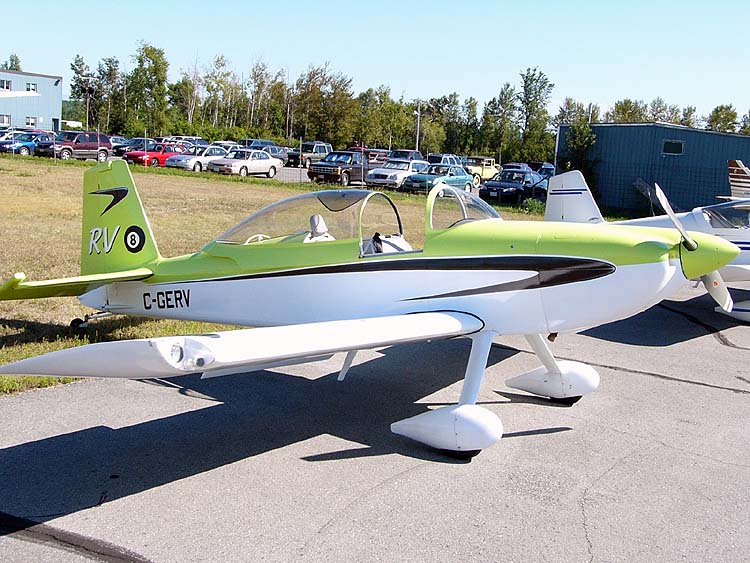
The Van's Aircraft RV-8 is a tandem two-seat, single-engine, low-wing homebuilt kit aircraft designed by Richard VanGrunsven as a larger, updated successor to the RV-4. Renowned for its fighter-like centreline seating, sliding canopy and aerobatic capability, it is the fastest aircraft in the RV lineup and a favourite among builders wanting sporty cross-country performance combined with genuine aerobatic manners.
The RV-8 is a tandem two-seat, single-engine, low-wing homebuilt aircraft sold in kit form by Van's Aircraft. It is offered in two landing gear configurations: the RV-8 with conventional (tailwheel) gear, and the RV-8A with tricycle gear. Designed by Richard VanGrunsven, it shares its basic design concept with the earlier RV-4 but is a larger aircraft, with increased wingspan, wing area, cockpit width, headroom and legroom, along with greater useful load. Van's Aircraft markets it as offering the fighter-like feel of centreline seating combined with genuine cross-country capability, and it holds the distinction of being the fastest model in the RV range.
Richard VanGrunsven designed the RV-8 as an updated, larger tandem aircraft based on the RV-4 concept, incorporating lessons learned from producing the popular RV-4. In 1995 Van's revisited the tandem-seating layout, reasoning that despite the enormous popularity of the side-by-side RV-6/6A, a significant number of pilots still wanted centreline seating and a roomier tandem airplane with better cross-country capability. A one-of-a-kind demonstrator was built and introduced at Oshkosh in 1995, drawing an overwhelming public response, with Van's personnel reportedly fending off people waving cash to buy one. The RV-8 first flew in 1995. The tricycle-gear RV-8A, part of the design concept from the outset, first flew in 1998. As of November 2022, 1,611 RV-8s and RV-8As had been completed and flown.
The RV-8 is an all-metal, low-wing homebuilt with a wide fuselage and cockpit designed to accommodate large pilots, up to 6 feet 7 inches in the front seat, with passengers up to 6 feet 9 inches and 260 lbs having flown in the rear seat during factory demonstration flights. Two baggage compartments, one forward and one aft, are provided, with a baggage capacity of 125 lbs. The distinctive fighter-like sliding canopy is built around a sturdy steel roll bar and fixed windshield and must remain closed in flight, though standard fresh-air ducts serve both seats. The aircraft is designed to be flown from the front seat, although a rear stick is standard and a rear throttle and rudder pedals are optional. The RV-8 airframe accepts engines from 150 to 210 hp, including the 200 hp Lycoming IO-360 four-cylinder, horizontally opposed, fuel-injected engine, and since 2020 the 210 hp Lycoming IO-390A. Propellers may be fixed-pitch or constant-speed. General dimensions for the RV-8 include a length of 21 ft 0 in (6.40 m), wingspan of 24 ft 0 in (7.32 m), height of 5 ft 7 in (1.70 m), and wing area of 116 sq ft (10.8 sq m); the RV-8A has a slightly different length of 20 ft 10 in and height of 7 ft 4 in due to its tricycle undercarriage. Empty weight ranges from 1,067 to 1,120 lb (approximately 508 kg), with a gross weight of 1,800 lb (816 kg) and an aerobatic gross weight of 1,600 lb, at which the aircraft complies with the +6/-3G standards of the FAA's Aerobatic Category while still carrying two people. Fuel capacity is 42 US gallons (160 L), and wing loading is 15.5 lb/sq ft (76 kg/sq m). Like the RV-3 through RV-7 that preceded it, the RV-8 is stressed for aerobatics.
With a 200 hp Lycoming IO-360, the RV-8 has a maximum speed of 221 mph (356 km/h, 192 kn), a cruise speed of 210 mph (340 km/h, 180 kn) at 75 percent power at 8,000 feet, a stall speed of 58 mph (93 km/h, 50 kn), a range of 940 mi (1,510 km, 820 nmi) at 55 percent power and 8,000 feet, a service ceiling of 22,500 ft (6,900 m), and a rate of climb of 1,900 ft/min (9.7 m/s). Van's factory figures show a range of performance across engine options: at solo weight of 1,400 lb, top speeds range from 206 mph with a 160 hp engine to 222 mph with a 200 hp engine, with corresponding takeoff distances of 300 ft and 250 ft and climb rates of 2,000 fpm and 2,700 fpm respectively. At gross weight of 1,800 lb, top speeds range from 205 mph to 221 mph across the same engine range, with takeoff distances of 650 ft to 500 ft and climb rates of 1,400 fpm to 1,900 fpm; service ceiling at gross weight ranges from 18,500 ft to 22,500 ft depending on power. The prototype fitted with the 200 hp IO-360 demonstrated exceptional performance for a single occupant, taking off in 250 feet and climbing at 2,600 fpm, performance striking enough that it reportedly prompted tower controllers to ask what kind of airplane it was. Van's describes handling, on the ground or in the air, as typical RV: exciting and responsive, but never twitchy or unpredictable, with almost-perfect control balance and harmony and excellent visibility that make aerobatics a delight.
The RV-8 is the conventional (tailwheel) gear version, offering a slightly lower drag profile and marginally higher speed than its stablemate. The RV-8A is the tricycle-gear version, retaining the same great looks and performance while adding improved visibility on the ground; once airborne, the two models handle and perform almost identically. Both share the same wing, fuselage and powerplant options, differing mainly in undercarriage configuration and consequent length and height.
The RV-8 is used primarily for sport flying, air racing, formation flying and aerobatic competition, with the type seen competing in sportsman and intermediate aerobatic categories. Its fighter-like slider canopy and centreline seating mean it is often finished in military or other striking paint schemes. Formation aerobatic pilots have used the RV-8 for airshow display flying, valuing it as a capable light aerobatic aircraft that is also fully IFR-equipped and suited to long-distance cross-country flying. As a kit-built aircraft it is constructed by individual builders, a project typically requiring a substantial and sustained time commitment, and the type has built a strong reputation within the homebuilt and experimental aviation community for craftsmanship, performance and a favourable safety record relative to other homebuilts.
Pilots and reviewers describe the RV-8 as offering fighter-like handling and performance, positioned as a more accessible alternative to traditional warbirds thanks to its responsive, agile controls and centreline seating. Van's Aircraft characterises its handling, on the ground or in the air, as typical RV: exciting and responsive, but never twitchy or unpredictable, with almost-perfect control balance and harmony that make aerobatic manoeuvres such as loops and rolls a delight, aided by excellent visibility from the bubble-style sliding canopy. It climbs well, lands slow and goes fast, and the wide range of usable engine power from 150 to 210 hp means its personality can vary from an economical, spirited trainer-like feel at the lower end to a genuinely potent performer at 200 to 210 hp.