Departure
92%
vs 95% ▼ 3
 MY FS FLIGHTS
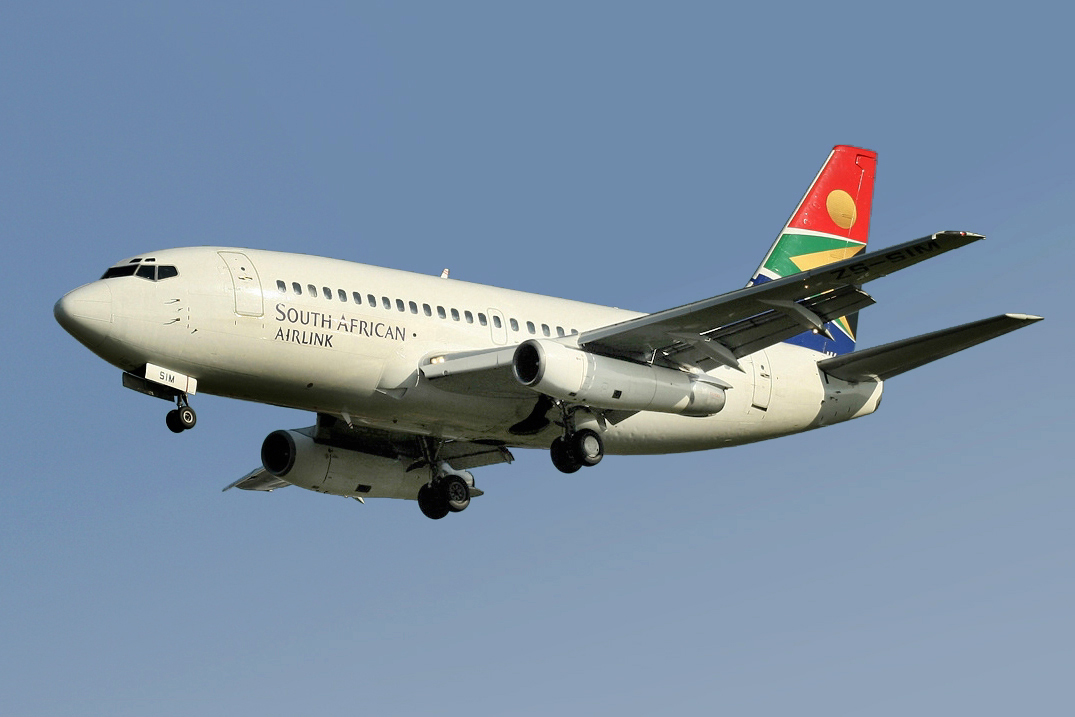
The Boeing 737 is an American narrow-body twinjet built by Boeing at its Renton, Washington factory, developed from the mid-1960s to supplement the three-engined 727 on short and thin routes. It has grown through four generations - Original, Classic, Next Generation and MAX - into the best-selling commercial jet airliner in history, and remains a familiar sight and a benchmark type for any simulator pilot exploring narrow-body airline flying.
The 737 is a twin-engined, narrow-body jet airliner produced by Boeing Commercial Airplanes at Renton, Washington. It was conceived to complement the Boeing 727 on shorter, thinner routes, retaining the 707-derived 148-inch fuselage width and six-abreast seating of its larger stablemates but built around two underwing turbofans rather than three rear-mounted engines. Since entering service in 1968 it has evolved through four distinct generations - the Original 737-100/-200, the 737 Classic -300/-400/-500, the 737 Next Generation -600/-700/-800/-900, and the 737 MAX -7/-8/-9/-10 - covering seating for between 85 and 215 passengers, and it has become the most widely produced and operated jet airliner family in aviation history.
Boeing began preliminary design work on May 11, 1964, after research indicated a market for a fifty- to sixty-seat airliner flying routes of 50 to 1,000 miles. The initial concept had podded engines on the aft fuselage and a T-tail like the 727, but engineer Joe Sutter relocated the engines to the wings, mounting the nacelles directly beneath the wing without pylons so the landing gear could be shortened and the fuselage lowered for easier baggage and passenger access. Boeing was well behind rivals such as the Sud Aviation Caravelle, BAC One-Eleven, Douglas DC-9 and Fokker F28, so to speed development it reused around 60 percent of the structure and systems of the 727, including its 707-derived, 148-inch-wide fuselage, which gave the 737 six-abreast seating against its competitors' five-abreast layouts. The board approved the roughly $150 million launch program on February 1, 1965, and Lufthansa became launch customer on February 19, 1965, with an order for 21 aircraft worth $67 million, after Boeing assured the airline the project would not be cancelled. The original 737-100 first flew on April 9, 1967, received FAA certification on December 15, 1967, and entered service with Lufthansa on February 10, 1968, making Lufthansa the first non-American airline to launch a new Boeing type. A longer-fuselage version ordered by United Airlines, the 737-200, first flew on August 8, 1967, and entered United service on April 28, 1968; it proved far more popular with airlines than the -100, of which only 30 were built. Early aircraft were assembled near Boeing Field because the Renton plant was occupied with 707 and 727 production, with the line moving to Renton in 1970 after 271 aircraft had been built. Early thrust reversers were found to lift the aircraft off the runway in use, reducing brake effectiveness; an improved design was fitted to all aircraft built after March 1969 and made available as a retrofit. From May 1971, following the 135th airframe, the 737-200 Advanced incorporated these thrust-reverser and flap refinements along with more powerful engines and greater fuel capacity, extending range and payload. The second-generation 737 Classic series, comprising the -300, -400 and -500, was launched in 1979/1980 and introduced in 1984, adopting CFM International CFM56-3 high-bypass turbofans in place of the JT8D. The third-generation 737 Next Generation was launched on November 17, 1993 after Boeing's regular customer United Airlines bought the more advanced, fly-by-wire Airbus A320, prompting Boeing to modernise the 737 rather than replace it outright. The first NG, a 737-700, rolled out on December 8, 1996 and first flew on February 9, 1997, entering service with launch customer Southwest Airlines on December 17, 1997. The fourth generation, the 737 MAX, was launched in August 2011 to counter the Airbus A320neo and entered service in 2017 with CFM LEAP-1B engines and split-tip winglets. Two fatal accidents, Lion Air Flight 610 in October 2018 and Ethiopian Airlines Flight 302 in March 2019, both linked to the Maneuvering Characteristics Augmentation System responding to faulty angle-of-attack data, led to a worldwide grounding of the MAX fleet from March 2019 until November 2020.
The 737 shares its 148-inch-wide fuselage cross-section with the 707 and 727, via the 727's fuselage, giving six-abreast seating rather than the five-abreast layout of contemporaries such as the DC-9 and BAC One-Eleven. The wing's airfoil sections were based on those of the 707 and 727 but made somewhat thicker, with modified sections near the nacelles to reduce drag at high Mach numbers. The engines are mounted directly beneath the wing without pylons, a configuration that allowed the landing gear to be shortened and the fuselage to sit lower, easing baggage handling and passenger boarding; it also removed the need for a T-tail, letting the horizontal stabiliser attach conventionally to the aft fuselage. The original design eliminated the flight engineer's station used on the 707 and 727, adopting a two-crew flight deck from the outset. Powerplants have evolved through the generations: the Original series used Pratt & Whitney JT8D low-bypass turbofans, the initial JT8D-1 rated at 14,500 pounds-force of thrust; the Classic series introduced CFM International CFM56-3 high-bypass turbofans; the Next Generation adopted the CFM56-7 series together with a redesigned, larger-area wing with a wider span, greater fuel capacity, higher maximum takeoff weight, longer range and a glass cockpit; and the MAX introduced CFM LEAP-1B engines with aerodynamic refinements including split-tip winglets and structural changes. Next Generation airframes span roughly 102 feet (31.09 m) to 138 feet (42.06 m) in length across the -600 to -900 variants. Later production incorporated a Short Field Performance package, developed in response to Gol Transportes Aereos' need to operate from restricted airports, which added sealed leading-edge slats usable in all takeoff flap settings and a winglet lift credit to reduce approach speeds; this became standard on the 737-900ER. From 2008 Messier-Bugatti-Dowty carbon brakes were offered in place of steel brakes, saving 550 to 700 pounds depending on brake capacity, with a 700-pound reduction estimated to cut fuel burn by about 0.5 percent on a 737-800. A Performance Improvement Package introduced from 2011 refined the CFM56-7BE nacelle for roughly a 1 percent drag reduction and up to a 2 percent fuel-burn improvement on longer sectors, and from 2015 a single wing-root-mounted LED light package replaced the earlier scattered HID lighting.
Across its generations the 737 has been built to seat between 85 and 215 passengers, with the fourth-generation MAX variants accommodating 138 to 204 people and offering a range of 3,300 to 3,850 nautical miles (6,110 to 7,130 km). The Next Generation's redesigned wing, with its larger area, wider span and greater fuel capacity, brought a higher maximum takeoff weight and longer range than the Classic series it replaced. Enhanced Short Runway equipment on the -600, -700, -800 and -900ER variants increased landing payloads by up to 8,000 lb on the 737-800 and 737-900ER and up to 4,000 lb on the -600 and -700, with takeoff payload gains of up to 2,000 lb and 400 lb respectively, achieved through sealed leading-edge slats usable across all takeoff flap settings and a winglet-derived reduction in minimum landing-approach speed.
The Original series comprises the 737-100, the first variant to fly, of which only 30 were built, and the longer 737-200 developed for United Airlines, later refined as the 737-200 Advanced with improved thrust reversers, flaps, engines and fuel capacity. The 737 Classic generation added the -300, -400 and -500, re-engined with CFM56-3 turbofans and offering 110 to 168 seats. The Next Generation family consists of the -600, -700, -800 and -900, with the -800 becoming the most-ordered variant of the NG line, alongside a -900ER long-range model and Enhanced Short Runway options. The fourth-generation MAX series comprises the MAX 7, MAX 8, MAX 9 and MAX 10, with a high-density MAX 8-200 variant launched by Ryanair. Military and specialised derivatives include the T-43 and CT-43 navigation trainers, the C-40 Clipper transport, the E-7 Wedgetail airborne early warning aircraft and the P-8 Poseidon maritime patrol aircraft, alongside corporate Boeing Business Jet versions produced since the Next Generation.
The 737 has been operated worldwide as a mainstay of short- and medium-haul airline networks, with Southwest Airlines, Ryanair, United Airlines and American Airlines listed among its primary current users. As of June 2026, 17,497 aircraft had been ordered and 12,615 delivered, making it the best-selling commercial aircraft family until Airbus's competing A320 family overtook it in orders in October 2019, though the 737 retained the lead in cumulative deliveries over the A320 until September 2025. Its principal competitors over the decades have been the McDonnell Douglas DC-9 and its MD-80/MD-90 derivatives, and more recently the Airbus A320 family. By 2013 the global 737 fleet had completed more than 184 million flights and 264 million block hours since entering service. The type's reliability and economics have given it a reputation as an airline workhorse found in fleets across the world. The MAX generation's global grounding between March 2019 and November 2020, following the Lion Air and Ethiopian Airlines accidents, marked the most serious disruption to the programme's otherwise continuous production history since 1967.
For a simulator pilot, the 737's appeal lies in its sheer ubiquity and the long, layered development history embodied in its cockpit and systems. The lineage from the two-crew flight deck of the Original series, which dispensed with the flight engineer's station used on the 707 and 727, through to the glass cockpits introduced on the Next Generation and refined further on the MAX, gives a study-level rendition of the type real depth, spanning eras of instrumentation and automation within a single, continuously updated airframe. The low-slung engine installation and shortened landing gear, a direct consequence of mounting the nacelles without pylons beneath the wing, are visually and operationally distinctive features that shape ground handling and engine-out procedures. Because the type has been in continuous production and front-line service since 1967, and remains the backbone of major carriers such as Southwest, Ryanair, United and American, it offers a realistic and richly documented basis for short-haul airline operations, from busy European low-cost sectors to high-frequency American domestic routes.