Departure
92%
vs 95% ▼ 3
 MY FS FLIGHTS
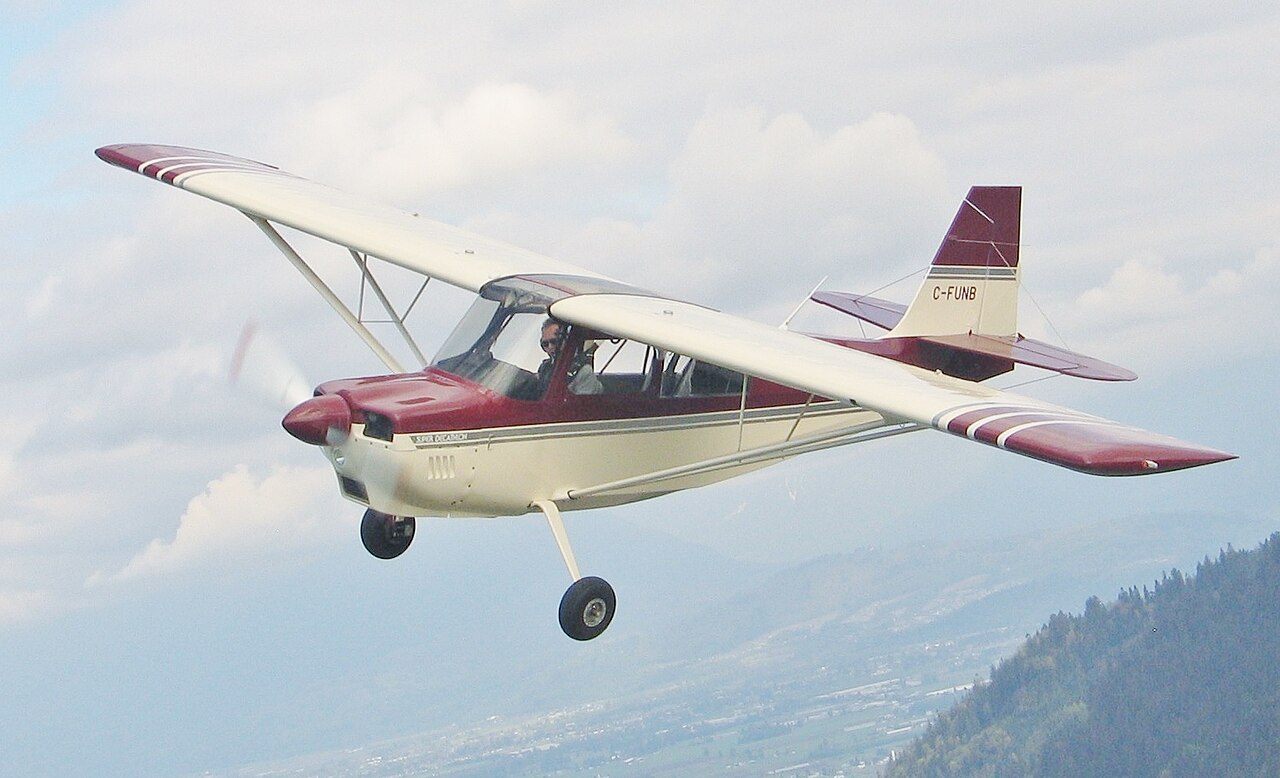
The American Champion Decathlon is a two-seat, tandem-cockpit, fixed conventional-gear aerobatic aircraft descended from the Citabria and Aeronca Champ lineage, built to sustain aerobatic loads from +6g to -5g. Originally produced by Champion Aircraft Corporation from 1972 and later by Bellanca, it is now manufactured by American Champion Aircraft as the Super Decathlon and Xtreme Decathlon, and remains a favourite among sim pilots and real-world flyers alike for aerobatic training and tailwheel work.
The Decathlon is a two-seat, tandem-seating, high-wing, single-engine light aircraft with conventional (tailwheel) landing gear, manufactured by American Champion Aircraft Corporation. It was designed as a fully aerobatic derivative of the Citabria line, itself descended from the Aeronca Champ, and is certificated for both normal and acrobatic categories. Today it is produced in two forms, the 180 hp Super Decathlon and the 210 hp Xtreme Decathlon, and serves as both a serious aerobatic mount and a practical tailwheel trainer.
The Decathlon entered production in the United States in 1970 as a more powerful and structurally stronger complement to the Citabria line, developed by the Champion Aircraft Corporation. While the Citabria's 7KCAB variant had added limited inverted flight capability, it could not perform outside manoeuvres requiring significant negative-g loads, and pilot demand for a fully aerobatic aircraft led Champion to introduce the 8KCAB Decathlon. Production at Champion began in 1972, just before the company was acquired by Bellanca Aircraft Corporation, so only a handful were built under the Champion name. Bellanca continued production through the 1970s, introducing the more powerful Super Decathlon variant in 1976, and built over 600 examples of the 8KCAB design before the company's assets were liquidated in 1981. The design then passed through several companies during the 1980s, including an unrelated firm also named Champion Aircraft Company, without any aircraft being built in that period. American Champion Aircraft Corporation acquired the Decathlon design in 1990, along with the 8GCBC Scout and the Citabria and Champ family, and returned the Super Decathlon to production that same year; it remains in production today, with over 6,000 examples of the type built in total.
The Decathlon traces its structural lineage through the Citabria back to the Aeronca Champ, sharing tandem seating, centre-stick controls, and a welded steel-tube fuselage and tail structure with a triangular cross-section, a feature dating back to the Aeronca C-2 of the late 1920s. The outer fuselage shape is formed by wooden formers and longerons and covered in fabric, as are the strut-braced wings, which use aluminium alloy ribs. Early Champion and Bellanca-built Decathlons used wooden wing spars, while American Champion has since moved to aluminium spars, also available as a retrofit for older airframes. The wing employs a semi-symmetrical NACA 1412 airfoil, in contrast to the Citabria's flat-bottomed section, giving markedly better inverted flight and negative-g performance. The Decathlon's wingspan of 32 feet (9.8 m) is slightly shorter than the Citabria's 33.5 feet (10.2 m). Landing gear is conventional, with main legs traditionally made of spring steel, though American Champion introduced aluminium gear legs from 2004. To support sustained inverted and negative-g flight, the fuel-injected engine is fitted with a Christen Industries inverted oil system and the fuel system incorporates a 1.5 gallon header tank beneath the instrument panel. Early Decathlons used Lycoming IO-320 engine variants of 150 hp with a choice of fixed-pitch or constant-speed propeller, while the Super Decathlon introduced the Lycoming AEIO-360-H1A or H1B of 180 hp paired with a constant-speed propeller; the current American Champion Super Decathlon uses the AEIO-360-H1B. The current-production Super Decathlon 8KCAB specifications include a length of 22.9 ft, height of 7.7 ft, wing area of 169 sq ft, wing loading of 11.5 lb/sq ft, and power loading of 10.0 lb/hp. Empty weight is 1,305 lb, with a maximum gross weight of 1,950 lb in the normal category (useful load 645 lb) and 1,800 lb in the acrobatic category (useful load 495 lb). Fuel capacity is 43 gallons (40 usable), oil capacity 10 quarts, and baggage capacity 100 lb. The cabin measures 8 ft 10 in long, 2 ft 6 in wide and 3 ft 11 in high. Standard equipment includes a Christen-style inverted fuel and oil system, front and rear five-point harnesses, adjustable front seat, LED lighting, an electric boost pump, and wheel fairings with lightweight aluminium main gear; optional equipment includes three-blade MT or two-blade Hartzell propellers, a heated pitot, glider tow assembly and a competition harness.
The Super Decathlon is rated for acrobatic loading of +6g and -5g. Published performance figures show a takeoff ground roll of 580 ft and a takeoff distance over a 50-ft obstacle of 1,061 ft, with a demonstrated crosswind component of 17 kts. Rate of climb at sea level is 1,130 fpm, maximum level speed at sea level is 155 mph TAS, and cruise speed at 75 percent power is 141 mph with an endurance of 3.4 hours including a 45-minute reserve, burning 9.6 gph at 7,500 ft. Service ceiling is 16,000 ft. Landing distance over a 50-ft obstacle is 1,126 ft, with a ground roll of 498 ft. Key airspeeds are Vx (best angle) 58 mph IAS, Vy (best rate) 82 mph IAS, Va (design manoeuvring) 107 mph CAS, Vno (maximum structural cruising) 160 mph CAS, Vne (never exceed) 200 mph CAS, Vr (rotation) 57 mph IAS, and Vs1 (stall, clean) 57 mph IAS. Pilots who have flown the type over many years and thousands of hours have continued to favour it as a trainer even as newer designs have appeared, citing its versatility as both a Sunday fun airplane and a serious airshow performer; aerobatic champion Patty Wagstaff is among the pilots who have used a Decathlon for airshow work.
The original Champion Model 8KCAB Decathlon used a 150 hp Lycoming AEIO-320-E1B engine. Bellanca's Decathlon retained a similar powerplant before the company introduced the Super Decathlon in 1976, fitted with the more powerful 180 hp Lycoming AEIO-360-H1A or H1B engine and a constant-speed propeller. American Champion's current lineup comprises the Super Decathlon, with a 180 hp Lycoming AEIO-360-H1B and an MT composite constant-speed propeller, and the more powerful Xtreme Decathlon, fitted with a 210 hp Lycoming AEIO-390-A1B6 engine; both share an empty weight and gross weight profile close to 1,950 lb maximum gross, though the Xtreme's empty weight is slightly higher at 1,330 lb.
Decathlons and Super Decathlons have been used primarily as aerobatic trainers, for beginning and intermediate aerobatic instruction, and as personal sporting aircraft, in addition to serious airshow work. The type has also seen use in collegiate flight training, including as a Super Decathlon fleet aircraft for pilot training programmes. Though the original Decathlon went out of production within a decade of its introduction, this was attributed to the general slump in US general aviation at the end of the 1970s rather than any fault in the design, and the Super Decathlon has sold steadily since its reintroduction in 1990. The type has attracted a degree of public notoriety: aviator Steve Fossett was flying a Bellanca-built Super Decathlon when he went missing on 3 September 2007 after taking off from an airstrip near Reno, Nevada, with wreckage found some 13 months later near Mammoth Lakes, California. Television presenter James May, known for his work on Top Gear and The Grand Tour, owned an 8KCAB Decathlon registered G-OCOK, a reference to his catchphrase from Top Gear.
For a simulator pilot, the Decathlon and Super Decathlon represent classic tandem-seat, tailwheel aerobatic trainers, offering the challenge of conventional gear handling combined with genuine positive and negative-g aerobatic capability thanks to the inverted fuel and oil systems. Its long service as both a primary aerobatic trainer and airshow mount, alongside its continuous production history since 1990, has kept it a familiar and respected type for pilots progressing from basic tailwheel flying into aerobatics.